Home front? Authorities investigate terror attacks and hacks in US as part of Iranian retaliation
From a Texas bar shooting to a cyberattack on a Michigan company, recent episodes stoke fears that the war with Iran has crossed U.S. borders.

Attack in Austin, Texas

Hours after the U.S.-Israeli strikes in Iran began, a man's voice began transmitting, on short-frequency radio, the words "Tavajjoh! Tavajjoh!" That is: "Attention!" "Attention!" in Farsi, the official language in Iran. The call for attention was followed by a series of numbers. It was, apparently, a Cold War communication system: the receiver connects to the device (old, by today's standards) at a certain time and station and writes down the sequence of numbers (which he then translates into letters).
Immediately, it sparked concern: "The federal government appears concerned that it may be a person or agency inside Iran communicating a message 'intended to activate or provide instructions to prepositioned sleeper assets operating outside of Iran,'" explained by the Lawfare analysis group. As the conflict spreads, concern over possible instances of attacks on U.S. soil has continued to grow.
Asked whether Tehran would try to activate sleeper cells, Donald Trump replied, "They’ve been trying for a long time, and we’ve been very much on top of it." Without going any further, just this month the Justice Department convicted an Iranian operative of having participated in a plot to try to assassinate Trump in 2024. Although Iran's terrorist tentacles are not new news, the risk of it activating them as part of its multiple strategy since the start of the war to strike inside the U.S. has set off all the alarms.
Moreover, the authorities are investigating whether the first cases have already occurred:
- Austin, Texas bar shooting: just 26 hours after the start of Operation Epic Rage, an attacker opened fire on patrons in a bar leaving two dead and 14 wounded. He was identified as Ndiaga Diagne, a naturalized American originally from Senegal. According to images of the attack and sources familiar with the investigation, Diagne was wearing a coat that read "Property of Allah" over a T-shirt in the colors of the Iranian flag. The FBI is investigating the shooting as a possible terrorist attack.
- Michigan synagogue attack: occurred at Temple Israel in West Bloomfield. Ayman Mohamad Ghazali, a 41-year-old naturalized Lebanese national, filled the doors of the building with a vehicle and died after a shootout with private security is identified. It is also being investigated as a possible terrorist attack. According to the Israeli military, the attacker's brother was a commander of the Iranian-backed Hezbollah terrorist group.
- Shooting at Old Dominion University (ODU), Virginia: occurred almost simultaneously with the Michigan shooting. Mohammed Jalloh, a former member of the Army National Guard, fired in a classroom at ROTC officers in training. He shouted, according to reports of the attack, "Allah is the greatest." There was one fatality, the class instructor. In 2017, Jalloh had been sentenced to 11 years in prison for attempting to provide material support to ISIS. The attack is being investigated as a possible terrorist act, although no mention of Iran has been made.
Possible terrorist attacks are not the only incidents linked to the ayatollahs' regime. Last week, the Iran-linked hacker group Handala Hack Team claimed a cyberattack on a medical technology company in Michigan. In a message posted on social media, it claimed that it had acted "in response to ongoing cyber assaults against the infrastructure of the Axis of Resistance." Days earlier, the FBI had alerted the California police of possible drone attacks on the West Coast, though, the White House later downplayed the threat, saying "no such threat from Iran to our homeland exists."
Society
From Michigan to Virginia: The day terrorism met resistance from unsung heroes
Carlos Dominguez

Intelligence community and law enforcement on alert
"Iran has proven capable of developing lethal operations against Americans at home and abroad and probably will attempt to pursue such efforts again if the current government remains in power and is able to rebuild," according to the 2026 Annual Threat Assessment presented Wednesday by Director of National Intelligence (DNI) Tulsi Gabbard.
"Prominent Shia religious leaders in Iran issued religious decrees calling to avenge Khamenei, which is likely to inspire at least some individuals to seek to conduct terrorist activities against U.S. targets worldwide," the DNI warns. Ayatollah Ali Khamenei, Iran's top religious-political leader, was killed in the early hours of the conflict.
The intelligence assessment also names Iran as one of the countries, along with China, North Korea, Pakistan and Russia, that have been "researching and developing an array of novel, advanced, or traditional missile delivery systems with nuclear and conventional payloads, that can strike the Homeland." Missiles that will combine, he assures, with cheap weapons, such as drones, to exhaust U.S. defenses.
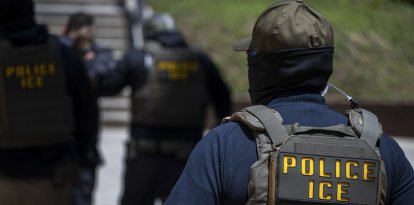
The alarm has escalated and descended through all levels of security. The FBI went on high alert for possible attacks from inside the U.S. borders. Police departments in cities such as New York, Los Angeles and Washington DC reinforced with additional patrols in areas considered "sensitive." The State Department issued a global alert, advising Americans around the world to exercise extreme caution.

The Intelligence Community acknowledges in the annual assessment that it is still evaluating how the conflict in the Middle East "will affect the worldwide terrorism landscape during the coming year." However, it states that, although weakened, the Iranian regime continues to be able to "spread Islamist propaganda to incite terrorist acts."
That is a point that experts stress: no matter how the Middle East front progresses, the threat at home will remain latent. "Even if there is a transition like the one the president wants toward an allied Iran, we would still have the criminal ecosystem created by the theocracy of the ayatollahs," explained security and defense expert Hugo Achá in a conversation with Voz News.
"Entrapment," he explains, which includes nations like Russia and China, and armed groups like Hamas and Hezbollah. And that "caused us to have operatives like the one recently convicted of attempting to assassinate the president of the United States."
"No doubt an Iran ruled by an aligned government would be a relief, but it would not nullify the threat that the West let nurture in the heart of Iran for decades," Acha adds. The threat from "this brutal regime and its tentacles around the world."
FBI has sabotaged 640 terrorist attacks as of 2025
Patel listed four "terror plots" that would have been broken up by the agency during the Christmas holidays (prior to the start of the war in Iran):
- Dec. 12: the FBI proceeded to arrest four members of the Turtle Island Liberation Front, a far-left, anti-government-leaning organization. The detainees were allegedly coordinating a plan to detonate explosives in various commercial establishments in Southern California during New Year's Eve celebrations.
- Dec. 21: Thanks to cooperation with state and local authorities in Pennsylvania, the FBI arrested an individual who was collecting ISIS propaganda. The subject intended to use this information to execute a campaign of explosive device attacks.
- Dec. 29: In the state of Texas, FBI agents were able to intercept and arrest an ISIS sympathizer. This individual intended to supply bomb-making materials to a foreign terrorist organization.
- Dec. 31: In a joint operation between state and federal partners in New York, an individual was neutralized in North Carolina who aspired to join the ranks of ISIS. The suspect planned to perpetrate a mass attack with multiple victims during New Year's Eve.
LATEST