A strong week of wins for Mike Johnson
Contrary to the headlines earlier in the week, Mike Johnson managed to end the partial DHS shutdown and closed out the week with a string of unexpected wins, continuing to demonstrate his ability to navigate a deeply divided and complex Congress.

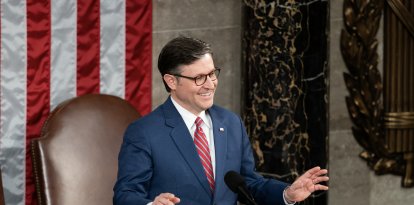
Mike Johnson on Capitol Hill/ Saul Loeb
House Speaker Mike Johnson has once again shown his extraordinary skills at navigating a highly complicated Congress. Last Monday's headlines in the mainstream media were talking about the stormy week the GOP leader would have to navigate, yet Johnson turned what looked like a chaotic week into a winning streak.
The biggest accomplishment is undoubtedly the end of the partial shutdown of the Department of Homeland Security (DHS), which had lasted more than two months and had become the longest in DHS history. Johnson succeeded in splitting the funding into two parts, overcoming the Democrats' refusal to fund ICE and Border Patrol. He also conducted the vote at a time when sufficient support had already been achieved, making it pass quickly and without endless, repetitive votes.
The speaker used a staggered strategy, in which he first secured the reopening of critical DHS functions; areas that were already running out of resources. Second, he secured passage of the budget resolution, separately paving the legislative way to negotiate funding for ICE and Border Patrol, without the need for Democratic votes in the Senate.
On the one hand, the House passed the bill to reopen and partially fund the Department of Homeland Security. The agreement includes funding for agencies considered essential, such as TSA, FEMA, the Coast Guard and the Secret Service, which were already on the verge of running out of resources. The bill left out immediate funding for ICE and Border Patrol, which are where Democrats do not want to support Republicans.
To get ICE and Border Patrol funded, with a simple majority and no Democratic vote, the House passed a budget resolution, which does not directly allocate money, but sets the overall framework for federal spending for the fiscal year. By moving forward through the budget reconciliation process, Republicans overcame the obstacle which was lack of Democratic support.
In addition to the end of the partial shutdown of the Department of Homeland Security, Speaker Johnson succeeded in passing the renewal of Section 702 of the FISA (Foreign Intelligence Surveillance Act), considered an important intelligence tool for the United States, as it allows the government to collect electronic communications from foreigners located outside the country, without the need for an individual court order. This capability is essential to prevent threats of terrorism, espionage or cyber attacks, and in the midst of the war with Iran, and all the national security threats facing the country, this approval was indispensable.
However, despite the timing and the importance of urgently renewing Section 702 of FISA, there was a debate about it, and even doubts among some Republicans, since these communications collections may "incidentally" include conversations of American citizens, which has raised doubts among some congressmen about privacy and possible abuses. However, Johnson won the necessary bipartisan support.
Another week in which the speaker, without much show or confrontation, almost silently, managed to turn what some thought would be a chaotic week into a winning streak.
LATEST