ANALYSIS
Gabbard on if Iran poses an 'imminent threat': 'Only person who can determine [that] is the president'
The director of national intelligence was grilled in the Senate on actions taken by the Trump administration in the Middle East.
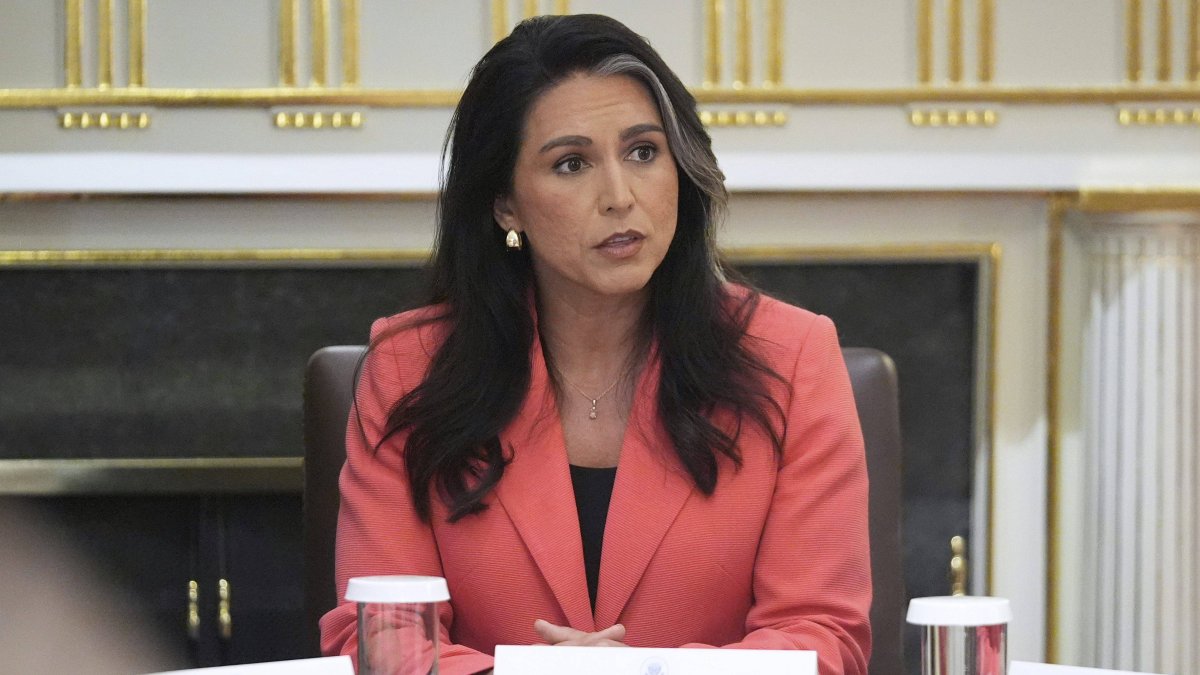
Tulsi Gabbard at a Trump administration cabinet meeting. File image

Director of National Intelligence Tulsi Gabbard had to appear before the Senate after the internal crisis that arose in the wake of Joseph Kent's resignation as head of the National Counterterrorism Center. In the testimony, in which she answered questions posed by several members of Congress, she also defended the position and actions taken by President Donald Trump in the Middle East.
One of the questions posed to Gabbard during his appearance before the Senate Homeland Security Committee was whether Iran represents an "imminent threat," a claim maintained by the Trump administration.
The "only person who can determine what is and is not an imminent threat is the president," Gabbard responded to Sen. Jon Ossoff (D-Ga.), who was combative throughout the hearing. Gabbard insisted that it is not the intelligence community’s responsibility to "determine what is and is not an imminent threat."

Politics
Tulsi Gabbard defends Trump after Kent's resignation, accused of leaking information
Joaquín Núñez
What Gabbard did specify was that "Iran's nuclear enrichment program was obliterated," thanks to Operation Midnight Hammer.
"As a result of Operation Midnight Hammer, Iran's nuclear enrichment program was obliterated. There has been no efforts since then to try to rebuild their enrichment capability," the director of national intelligence said in a statement.
What was Operation Midnight Hammer?
Gabbard's warning about the possible resurgence of the Islamist regime
Despite noting that the Islamist regime showed no efforts "to try to rebuild their enrichment capability," Gabbard was skeptical about whether a new figure might emerge in Iran in the future to reflate its arsenal.
The Iranian regime "appears to be intact but largely degraded due to attacks on its leadership and military capabilities," Gabbard said.
"If a hostile regime survives, it will seek to begin a yearslong effort to rebuild its missiles and UAV [unmanned aerial vehicle unit] forces," the director of national intelligence added.
Does Russia share intelligence information with Iran?
Another question asked to Gabbard was whether she is aware of the alleged claim that Russia shares resources and intelligence information with Iran. To the question, asked by Sen. Angus King (I-Maine), she did not give a specific answer.
"If there is that sharing going on, that would be an answer that would be appropriate for a closed session," Gabbard responded to King. "What I can tell you is that according to the Department of War, any support Iran may be receiving is not inhibiting their operational effects."
LATEST