ANALYSIS
Iranian hydra: Missiles, drones and terrorist allies to continue striking after the death of Khamenei
Tehran is betting on a strategy of attrition with cheap weapons, multiple fronts and a conflict that threatens to spill over into the Middle East.

Iranian missile in Israel

On its first day, Operation Epic Fury (for the U.S.), also referred to as Roaring Lion (Israel), removed Iran's supreme politico-religious leader. Upon the death of ayatollah Alli Khamenei followed by the Chief of General Staff (Abdolrahim Mousavi), the commander of the ideologized and elite Revolutionary Guard (Mohammad Pakpour), the Minister of Defense (Aziz Nasirzadeh) and the alleged head of nuclear weapons research (Hossein Jabal Amelian), and more. Trump promised, moreover, to cut off any new head that peeked out of Tehran: "Everyone that wants to be a leader ends up dead."
Headless, with an Army several times smaller, a budget estimated to be 90 times smaller, Iran is nonetheless firing back, shaking the region and the world economy. To try to bridge the asymmetry, Iranian strategists combined:
- Massive attacks against U.S. allies in the area, for which it makes use of relatively cheap missiles and drones.
- The blockade of the Strait of Hormuz.
- Activating its network of terrorist allies in the region and the world.
Iranian military strength
Iran possesses the largest and most diverse missile arsenal in the Middle East, according to Missile Threat project by the think tank Center for Strategic and International Studies (CSIS). The regime has spent the past decade perfecting the "precision and lethality" of these weapons. It has "invested significantly," and has tested them at its own expense and at the expense of others, distributing them to allies around the world.
Can Iranian missiles reach U.S. territory? No, according to the consensus of experts. From CSIS they claim that Iran was indeed developing longer-range technology under its space launch program. The current short range may be due to strategy rather than inability: according to Iran Watch, the regime itself preferred to focus on accuracy rather than missile mileage. Currently its longest-range missile is the Sejjil: its 18 meters long and 23,600 kg in weight can reach targets at 2,000 km. A far cry from the more than 11,600 kilometers that separate the United States from Iran.
Although with that range they can cover the entire Middle East, and even reach southeastern Europe. They can, therefore, damage U.S. bases, embassies and other sites in the region. Indeed, that is, according to analysts, part of the Iranian strategy that has already claimed American lives. Trump himself acknowledged, when announcing the operation, that risk: "The lives of brave American heroes may be lost."
Iran initiated that strategy - hitting U.S. targets in the region, even at the risk of further antagonizing its neighbors - within hours of the start of the conflict, with reports of attacks on:
- Bahrain: the tiny kingdom is home to the Naval Support Activity Bahrain facility, which houses the Navy's Fifth Fleet and Naval Forces Central Command. Several U.S. ships homeport in Bahrain, including anti-mine ships and logistics support ships.
- Iraq: The United States has troops in Iraq's autonomous Kurdish region as part of the international coalition against the Islamic State group.
- Jordan: according to various reports, the U.S. deployed dozens of military aircraft to the Muwaffaq Salti air base in the days leading up to the attacks.
- Kuwait: hosts several U.S. bases, including Camp Arifjan, where the forward headquarters of CENTCOM is located. The U.S. Army also maintains equipment and supply stockpiles in the country.
- Qatar: the Al Udeid air base includes the forward components of CENTCOM, as well as the command's air and special operations forces.
- Syria: U.S. forces are currently in the process of withdrawing from the country.
- United Arab Emirates: the Al Dhafra air base hosts 10 squadrons of aircraft, as well as drones.
Iranian drones also have regional reach, which also have the advantage of low cost. Here, the Shahed family of drones shines: for only $35,000 per unit, they can carry 40 kilograms of explosives for 2,000 kilometers. By comparison, the cost of missiles hovers around and exceeds $1 million.
Drones became, along with missiles, the main Iranian aerial military production, partly because economic sanctions prevented the development of other types of weaponry. "But what began as a military workaround has become a global weapon," analyst Arun Dawson said. So much so, that Iran began exporting drones to allies such as terrorist groups in the region and Russia. So much so, that the U.S. undertook covert efforts to capture, analyze and reverse them: thus the Lucas family of drones was born. Devices released against Iran itself in the current war.
Last year, drones were at the heart of Iran's latest military innovation: a carrier. Unveiled during the anniversary of the Islamic Revolution, the IRIS Shahid Bagheri is actually a South Korean-made cargo ship converted to carry 60 UAVs. U.S. Central Command shared images of a missile striking "an Iranian drone carrier, roughly the size of a WWII aircraft carrier."
In thinking about missiles and drones, the Iranian command would be taking three factors into account:
- Mass production: Tehran has the capacity to produce about 10,000 missiles per month, according to an analysis by the Centre for Information Resilience cited by Reuters. Although the size of its arsenal is unknown, estimates range from 2,500 to 6,000 missiles. Rapid production, however, may have been undermined by the attacks.
- Swarm tactics: by launching high numbers of slow, cheap drones at the same time, it is possible to saturate radars and deplete enemy defensive missile inventories. Thus, more sophisticated missiles can be used for higher-value targets.
- Price of war: attack and interdiction hit countries in the region hard financially as well. For example, an Arrow 3 interceptor from Israel costs about $3 million. Even if it succeeds in taking out a $30,000 Iranian drone, in financial terms it can be considered a defeat.
That last point is particularly sensitive for the Gulf states that received ammunition from Tehran, with United Arab Emirates (UAE), Bahrain and Qatar in the front line. The latter are also directly hit in the country model they have been promoting: both their refineries and their image of stability and security, essential to attract investment and tourism, are damaged by the attacks.
Expert Kelly Grieco, senior analyst at the Stimson Center, illustrated the mathematics of war with the case of the UAE. The oil-rich monarchy managed to shoot down 92% of the attacks, according to Grieco. "That's extraordinary." However, the high cost of that defense can turn victory into defeat: "The UAE spent 5–10x more defending than Iran spent attacking." The case of drones is especially pressing: For every dollar Iran spent on a drone, the UAE spent between $20 and $28 to shoot it down.
"This is the core of Iran's strategy — and it's not new. It's the same math Russia has been running against Ukraine for 3 years," she added, noting that Washington faces the same problem: "Every Pat battery defending a Gulf base, every naval interceptor fired from a destroyer runs the same equation, MILLIONS to stop THOUSANDS. At scale, the attacker's economics win even when their weapons don't."

An Iranian Shahed launched by Russia
Beyond the region: how far can Iran go?
From the outset, the ayatollahs' regime sought to extend the war beyond its borders. As days and hours passed, it extended the battle front. As of Friday, the U.S. Central Command recorded Iranian attacks in 12 countries.
Its attacks reached as far as Azerbaijan and Turkey. The latter is a member of the North Atlantic Treaty Organization (NATO), a military alliance comprising 32 countries, including the U.S. Its Article 5 considers an armed attack against any of its members as an attack against all. At the moment, however, it has not been confirmed whether the missile that hit Turkish soil was destined for that country.
The Hudson Institute describes both impacts as attempts to widen the conflict, with the aim of raising the diplomatic cost of the war for Washington. Tehran would thus seek to have U.S. allies pressure the White House to cease hostilities.
Tehran also has an extensive network of groups it has been funding and training for years. Known as its proxies, they include organizations such as Hamas in Gaza and Hezbollah in Lebanon. In Iran they are known as "the axis of resistance." The Council on Foreign Relations lists those still in force as:
- Hezbollah in Lebanon
- Hamas and the Palestinian Islamic Jihad in the so-called Palestinian territories
- The Huthis in Yemen
- Several armed groups in Iraq: Kata'ib Hezbollah, Asa'ib Ahl al-Haq, Hezbollah Harakat al-Nujaba, Badr Organization and Kata'ib Sayyid al-Shuhada.
So far, they have been on the back burner. Hezbollah is the only one to step forward. The Lebanese militia opened a northern front for Israel, launching rockets and drones. "While Israel intercepts longer-range Iranian missiles, Hezbollah hopes to launch shorter-range rockets and drones from Lebanon to increase pressure on Israel’s layered air-defense system at lower altitudes," the Hudson Institute asserted, where they also see their intervention as serving more to "diplomatic pressure on the United States by widening the fight" than to alter the course of the conflict.
But the mullahs can look to even more distant geographies. The regime has been accused on numerous occasions of having an extensive covert network of agents, convinced or paid, who carry out assassinations, kidnappings and bombing campaigns around the world. Even on U.S. soil.
The State Department issued a global alarm, advising "Americans worldwide to exercise increased caution." The FBI assured it was on high alert: "While the military handles force protection overseas, the FBI remains at the forefront of deterring attacks here at home," promised its director, Kash Patel.
The Iranian regime "maintains relationships with transnational criminal syndicates, and those transnational criminal syndicates have the ability to carry out operations in the United States," warned Jason Brodsky, policy director of United Against Nuclear Iran, one of several experts who raised alarms:

Does Iran have nuclear weapons?
Although it lacks nuclear weapons, it has been developing nuclear know-how and capabilities for decades. In fact, Iranian delegates boasted that they could produce 11 nuclear bombs in the rounds of negotiations prior to the U.S.-Israeli attack, according to special envoy Steve Witkof.
"Western analysts say the country has the knowledge and infrastructure to produce a nuclear weapon in fairly short order should its leaders decide to do so," the Council on Foreign Relations said. In the early 2000s, the country was found to possess secret nuclear facilities. Although its leaders swore time and again that they were pursuing peaceful purposes, "Iranian officials have also talked publicly since then about the possible need for nuclear weapons."
Destroying Iran's nuclear capabilities is one of the central purposes of Operation Epic Fury, as explained by Trump himself. The president claimed he had ordered the offensive because of the regime's insistence on continuing its nuclear program. In June, the U.S. military attacked nuclear bases in the country in Operation Midnight Hammer and then began a new round of negotiations with its authorities. Trump assured that, nevertheless, the Iranians had continued to develop their nuclear capabilities.
"Just imagine how emboldened this regime would be if they ever had, and actually were armed with nuclear weapons as a means to deliver their message," the president assured.

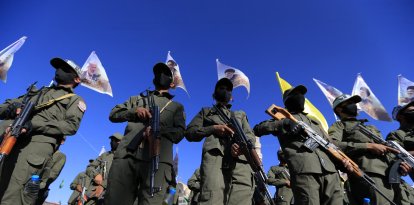
Military parade in Iran (archive)
Strait of Hormuz: a blow to the global economy
The regime of the ayatollahs internationalizes the conflict also through the economy. The key is the strategic Strait of Hormuz, a narrow arm of the sea through which more than 20% of the world's oil flows. When its passage is threatened, the international price of oil and gas rises rapidly. As was seen with the rise in prices during the present conflict.
Using (again) drones and missiles, Iran harasses merchant ships and oil tankers. It can also sabotage maritime tracking systems, causing chaos in navigation circuits. Despite these sabotage efforts, no total blockade has been reported so far. Traffic did decrease, however. Several shipping lines diverted their routes.
In response, U.S. sources claimed to have sunk 30 Iranian vessels in the first six days of the conflict. In addition, Trump promised that the United States would offer insurance and escort in the face of the naval blockade, and temporarily authorized the supply of sanctioned Russian oil to India. The president noted at the beginning of the operation that one of his main objectives was to take out the Iranian Navy.
Analyst Giovanni Staunovo explained to AFP that every day that the Strait of Hormuz remained closed, the oil market became more tense. For his part, expert Homayun Falakshahi warned that given the limited storage capacities of the Gulf nations, countries would start to rationalize crude oil production and reduce refinery activirty.
Questions to be solved
After the death of Ayatollah Ali Khamenei, who will take the reins? Will there be an internal succession or, as Trump said, will the U.S. participate in the election of the next president? Will U.S. soldiers set foot on Iranian soil? Will the people return to the streets once the attacks subside? Will they revolt or will they be repressed? How long will the conflict last, how long will the Iranian arsenal hold out?
There are fundamental questions that analysts and official sources are still unable to answer. They agree: they will have to be resolved in the coming hours, in the coming days. In just one week, Iran has changed drastically. What will it be like in "four to five," the period estimated by Trump for the end of operations?
LATEST