‘Decapitate and delegate’: the strategy Trump is using in Venezuela that could be replicated in Iran and Cuba
The Trump Administration hopes that Venezuelans and Iranians will take responsibility for achieving the transition to democracy, without the need for the United States to deploy troops on the ground.

A woman holds photographs of the late Iranian leader, Ali Khamenei, with a Venezuelan flag

The Trump administration is taking a fresh approach to provoking regime change in adversarial countries: removing or neutralizing their leaders, as happened in Venezuela last January 3, but let the political transition be taken over, at first, by senior leaders of the headless regime itself and, subsequently, by the citizens of the affected country.
Some U.S. officials have summarized this strategy bluntly and unequivocally: "Decapitate and delegate". The concept - mentioned in a recent analysis published in The Wall Street Journal - describes a model, used in 1991 by George H.W. Bush in Iraq, in which Washington acts to remove the top leadership from power, but avoids direct involvement in subsequent political reconstruction, something its Democratic and Republican predecessors did in Middle Eastern countries.
With this, the Trump Administration seeks to weaken or dismantle regimes considered hostile without repeating the long and costly military interventions that marked the wars in Iraq and Afghanistan.
Venezuela, first success story, for now
Washington's strategy is being applied, for now with success, in Venezuela.
Last January 3, the former Chavista dictator Nicolás Maduro, who now faces drug trafficking and terrorism charges in New York, was captured by U.S. forces. According to the U.S. indictments, Maduro led the Cartel de Los Soles, and
utilized the Tren de Aragua, to attempt to flood the U.S. with cocaine. in addition, he grossly mismanaged the Venezuelan economy generating the largest migratory exodus in recent history and ruthlessly repressed Venezuelans.
The military intervention, although it removed the Chavista leader, left intact a large part of the political structure that governed the country de facto.
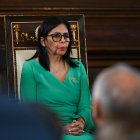
Following the operation, power was immediately assumed on an interim basis by Chavista Vice President Delcy Rodriguez, who since January has maintained constant communications with Washington, which for the moment is overseeing a transition that, according to Secretary of State Marco Rubio, is scheduled for three steps: stabilization, recovery and transition.
Since Maduro's capture, the Rodriguez interim regime has been forced to push through an amnesty law - highly questioned by various sectors of Venezuelan society that consider it incomplete and politicized -, free hundreds of political prisoners and give an image of openness towards freedom of the press and politics. Although the steps are small and slow, Venezuelans, in a majority, consider that the country will improve significantly in economic matters in the coming months, despite being skeptical with Rodriguez and the rest of the Chavista leadership. Marco Rubio, President Donald Trump and opposition leader María Corina Machado are the most popular politicians in the country.
Politics
Poll: María Corina Machado and Marco Rubio top popularity rankings in Venezuela
Emmanuel Alejandro Rondón
According to The Wall Street Journal analysis, the ultimate goal of the White House, after the interest in the Venezuelan oil and mining sector, is to push for political changes without assuming full control of the Venezuelan state or deploying large military contingents that would ensure a democratic transition.
The Trump Administration, according to U.S. officials, hopes that Venezuelan society itself will push for a political transition once the country is in a position for a democratic process.
A model to export?
While it is still too early to determine whether Venezuela will become a long-term success story, the approach taken by the Trump Administration in Caracas seems sound enough to try to replicate in other latitudes. Even within the White House, the nickname "the Delcy Rodriguez of..." is beginning to be popularized to refer to the search for possible successors within the power structures of regimes such as those of Iran or Cuba.
After ordering attacks against Iranian regime targets, Trump has publicly urged the country's population to bring about internal political change. The idea would be to replicate the formula used in Caracas: decapitate the regime's leadership while waiting for internal forces - political opposition, civil society or even sectors of the state apparatus itself - to push for a transition, in the hope that they will be better leaders than the previous ones.
In the words of the very approach described by U.S. officials to The Wall Street Journal, it is about removing enemy leaders and delegating the country's political future to its citizens, thus avoiding, in this way, entering into eternal wars, a concept that screeches deep within U.S. society and drove the growth of the MAGA.

Politics
Congress backs Trump: House of Representatives also rejects limiting military actions in Iran
Luis Francisco Orozco
Avoiding eternal war
It is no secret that the prolonged interventions in Afghanistan and Iraq generated a deep erosion in public opinion and fueled the political discourse that promised to avoid new open wars, with Trump being the main standard-bearer of this current.
Therefore, with the risk of becoming contradictory and stepping on his promises, the current strategy of Trump and his administration seeks to obtain geopolitical results -such as weakening adversaries or reducing threats- without deploying large forces on the ground, with the tangible advantage of always keeping an elegant way out of the conflict if events do not happen as expected.
However, the approach is not without risk. Some analysts warn that removing a regime's leaders does not guarantee that the political system will automatically change and that power structures can survive even after the fall of their leading figures.
Alexander Downes, a professor at George Washington University and a specialist in regime change, pointed out that relying on bombings or coups against the top echelons of power to provoke a popular rebellion is often an uncertain bet, especially in countries with consolidated repressive apparatuses such as Iran.
According to Downes, without a presence on the ground it is very difficult to dismantle these structures or prevent the regime from violently suppressing any attempted uprising.
In a similar vein, Jon Alterman, a global security expert at the Center for Strategic and International Studies (CSIS),said that even when leaders fall, power systems can remain intact and adapt quickly, casting doubt on whether simply removing the top leadership will guarantee a lasting political transition.
Still, for the White House the Venezuelan experiment could become a precedent. If the model works, the "decapitate and delegate" doctrine could become Washington's new formula for confronting adversarial governments without repeating the military interventions of the past.
LATEST