Iran destroyed a key US missile defense radar as reports emerge of Russian cooperation
Satellite images analyzed by international media, including CNN and Bloomberg, show that the AN/TPY-2 radar, used by the THAAD missile defense system, was hit and apparently destroyed.

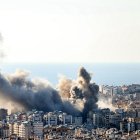
Smoke and fire seen from Mehrabad International Airport, Tehran

Iranian forces destroyed a U.S. radar system valued at about $500 million in Jordan, a crucial component for U.S. missile defense in the Middle East. The strike, perhaps the most significant Iran has carried out since the start of the war, was revealed in the press as reports emerged that Russia had shared intelligence with Tehran that could help it target U.S. military assets in the region.
Satellite images analyzed by international media, including CNN and Bloomberg, show that the AN/TPY-2 radar, used by the THAAD (Terminal High Altitude Area Defense), was hit and apparently destroyed at Muwaffaq Salti Air Base in Jordan during the early days of the attacks in the war between the United States, Israel and Iran.
The destruction of the equipment was initially reported from commercial images analyzed by CNN and later confirmed by a U.S. official who requested anonymity, according to information also released by Bloomberg.
The images show debris and severe damage around the radar equipment, as well as four-meter craters nearby, suggesting multiple impacts in the area where that system was located. The radar is part of a THAAD battery deployed to detect ballistic missiles and guide interceptors designed to destroy them before they reach their target.
The AN/TPY-2 radar is a transportable system manufactured by Raytheon, now part of RTX Corp, and is one of the most important sensors in the THAAD system. According to data cited by CNN from the U.S. Missile Defense Agency's budget, each unit costs close to $500 million.
The United States operates eight THAAD batteries, while the United Arab Emirates has two and Saudi Arabia has one. These batteries are designed to intercept ballistic missiles in the final phase of their trajectory and protect wide areas against long-range attacks.

World
Iran says it is prepared for ground invasion and warns US would face 'disaster'
Sabrina Martin
Experts cited by CNN said the radar plays a central role within the system. N. R. Jenzen-Jones, munitions specialist and director of the research firm Armament Research Services (ARES), explained that the AN/TPY-2 "is essentially the heart of the THAAD battery," as it allows it to detect threats, coordinate interceptor launches and contribute to the integrated air defense network.
The expert added that the loss of such a radar constitutes a significant operational event. In addition to its high cost, the system cannot be replaced quickly. A replacement unit would likely have to be moved from another region, which would require time, logistical planning, and resources.
The radar attack in Jordan could be part of a broader strategy aimed at weakening U.S. and allied air defenses in the region. According to analyses of satellite imagery cited by CNN, facilities housing similar radars were also attacked in the United Arab Emirates and Saudi Arabia during the early days of the conflict.
Russia aiding Iran?
Meanwhile, new reports point to possible indirect support from Moscow to Tehran. Two officials familiar with U.S. intelligence told the Associated Press that Russia may have provided Iran with information that could help identify U.S. military targets, including ships, aircraft and other facilities in the region.
The sources cited by AP noted that U.S. intelligence has found no evidence that Moscow is directly directing Iranian operations or dictating how to use that information. However, the revelation represents the first sign of possible Russian involvement in the conflict that began after the U.S.-Israeli strikes against Iran.
The White House downplayed the significance of those reports. Press secretary Karoline Leavitt said the intelligence sharing is "clearly not making any difference" to military operations, asserting that U.S. forces continue to dominate the scene.
President Donald Trump was also asked about the Russia and Iran reports during a college sports roundtable and catalogued the question on the matter as "stupid."
The Pentagon avoided offering specifics about damage to its systems in the region. A Department of Defense spokesman told CNN that, for operational security reasons, the U.S. government will not comment on the status of specific military capabilities deployed in the Middle East.
LATEST