Cuba's medical missions under scrutiny: IACHR warns of persecution and abuses
The Cuban Penal Code establishes penalties of between three and eight years in prison for those who abandon a mission abroad, as well as the denial of return to the island for eight years.

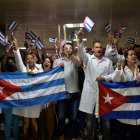
The brigade of 100 Cuban medical specialists in Honduras (Archive).

The Inter-American Commission on Human Rights (IACHR) denounced Tuesday in a report serious human rights violations in Cuba's international medical missions, including withholding participant's salaries, threatening jail for those who leave and confiscating passports.
These missions, created in the 1960s by Fidel Castro's communist regime for solidarity and international promotion, took a more lucrative turn after the 1990s and are today the island's main source of foreign exchange, the IACHR document indicates.
According to official Cuban statistics cited in the report, those missions brought $4.882 billion to the island in 2022, 69% of the services exported by the Caribbean country.
Fulfilling "a mission" to the end
The health professionals who participate in them barely receive, however, between 2.5% and 25% of what the receiving countries pay Cuba for their services, while the State retains the rest, according to human rights organizations cited in the report referred to by AFP.
As a result, the IACHR concludes that the personnel involved "would not have remuneration that would allow them to subsist in dignity" or "cover basic living costs."
"They gave me a small stipend (four dollars) and with that I could not buy anything. It was not enough for sugar and coffee (...) I only had one meal a day," one of the 71 professionals interviewed, whose identity was protected for fear of retaliation, told the agency.
Retaliation
According to the document, the Cuban state pressures health personnel to carry out the mission to the end.
Those who leave before the deadline set with the receiving country can be declared deserters or emigrants, thus lose all their rights in Cuba, including ownership of their homes, and see their relatives suffer reprisals, according to the report.
The Cuban Penal Code establishes penalties of between three and eight years in prison for those who abandon a mission abroad, as well as the denial of return to Cuba for eight years.
The IACHR also documents the confiscation of participants' passports upon arrival in the destination country, as well as the retention of the money they collected in "frozen" bank accounts in Cuba, which they can only access if they return to the island.
World
Bahamas to cancel contracts for Cuban 'slave' doctors after talks with Washington
Diane Hernández
Indications of forced labor situations and, in some cases, human trafficking
The staff of these missions cannot freely interact with people from the country where they work or with Cubans residing there, adds the IACHR, which interviewed participants in missions in 10 countries in the Americas (Bahamas, Brazil, Bolivia, Dominica, Ecuador, Guatemala, Jamaica, Mexico, St. Lucia and Venezuela) and in Africa, the Middle East and Asia.
In light of these elements, the agency sees indications consistent with forced labor situations and, in some cases, trafficking in persons in international medical missions.
83% of the 71 testimonies that were collected in Latin American countries come from Venezuela, one of the countries that has made most use of Cuban missions since 2003.
LATEST