ANALYSIS.
The growing influence of religion in government and public life
A Pew Research poll notes that 37% of voters believe that different faiths are gaining weight in society and politics, up 19% over the past two years, returning to 2002 levels.
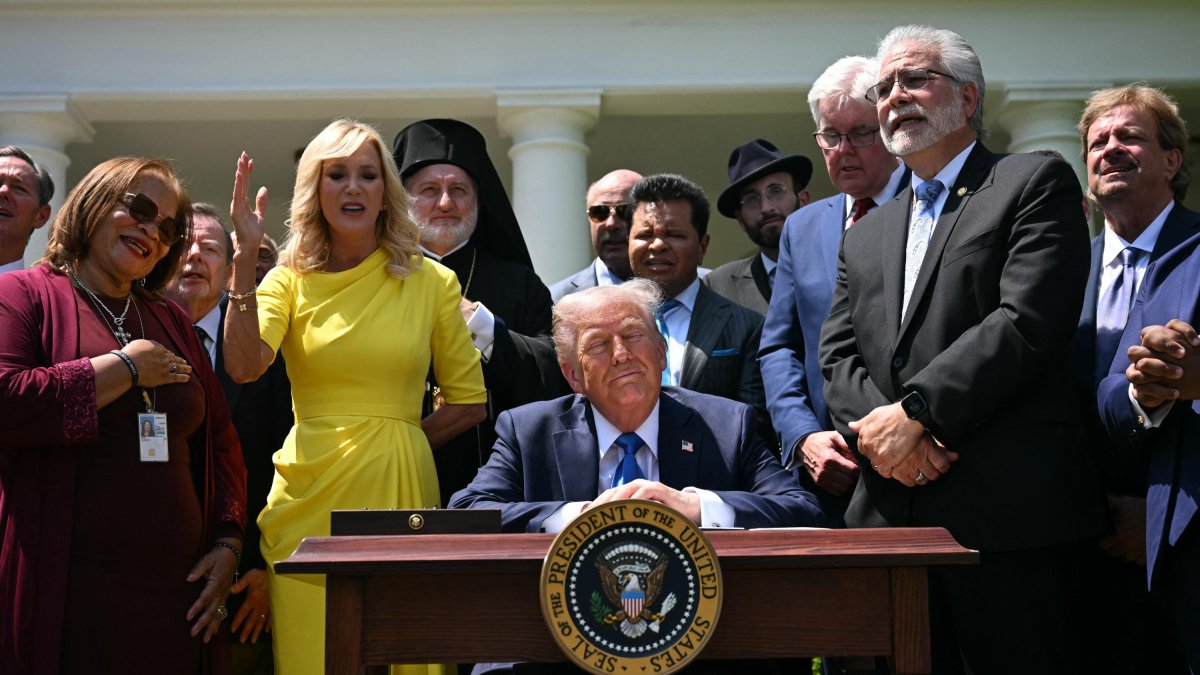
Religious leaders pray with Trump at the White House.

The numerous images of Donald Trump praying with members of his cabinet, or else being blessed by pastors are not just empty photos. Behind them lies a reality, the growing weight of religion in politics and public life, which a Pew Research survey has brought to light.
According to the aforementioned poll, 37% of Americans believe that religion is increasing its influence in government and public life. Although the vast majority (61%) continue to believe it is losing strength, those who believe it is growing have increased an impressive 19% in just two years, returning to the levels of nearly 25 years ago (2002).
This image backs the spiritual rebirth that is being experienced on a global scale, and in the United States in particular, with a significant number of people returning to the faith and an increase in attendance at religious services or ceremonies. Young people in particular stand out in this trend.

Most people who think religion's influence is growing see this as positive
The study also reveals that "Most people who think religion’s influence is growing see this as a good thing. Overall, 55% of U.S. adults express a positive view of religion’s role in American life – saying either that religion’s influence is growing and this is a good thing (21%) or that its influence is declining and this is a bad thing (34%)."

Nevertheless, and despite the increased positive view of religion in public life, "most Americans are uneasy with the idea of churches getting directly involved with politics." Thus, an overwhelming 79% assert that "churches and other houses of worship should not support candidates in elections."
In addition, "two-thirds say churches and other houses of worship should keep out of political matters rather than expressing views on day-to-day social and political questions." In this last section, however, there has been an increase among people who view religious leaders speaking out on these issues in recent years as positive.
Should Christianity be the official religion of the U.S.?
The poll also asked about the relationship between religion and the nation. In this regard, 17% believe the U.S. should adopt Christianity as the official religion. This is up 4 points from 2024 (13%).
In fact, even among the majority who disagree with that assumption, 43% say the government should promote Christian moral values, 5 points higher than those who believe that faith in Christ should not be official and its teachings should not be promoted by the government.
By their faith you will know them: Differences between Republicans and Democrats
The study also uncovered differences in views on religion according to the party for which one votes. However, they do agree on one thing: "rising shares of both Republicans and Democrats think religion is gaining influence in American life: 43% of Republicans now say this (up 28 percentage points since 2024) along with 34% of Democrats (up 14 points)."
From there, "75% of Republicans and independents who lean toward the GOP express a positive view of religion’s influence in American life. This is nearly double the share of Democrats and Democratic leaners who do so (38%). Today, Democrats are about as likely to express a negative view of religion’s role in society (37%) as to express a positive view (38%)."
LATEST