LIVE | Trump: 'With Iran we’ve been negotiating for a long time, and this time, they mean business'
The president said the negotiations took place over the weekend and, in view of their good progress, ordered the Department of War "to postpone any and all military strikes against Iranian power plants and energy infrastructure for a five day period."

A sailor watches as a fighter jet approaches to land on the USS Gerald R. Ford
After a weekend marked by Donald Trump's ultimatum to "obliterate" all Iranian power plants if they did not reopen the Strait of Hormuz within 48 hours, and the response from the Iranian regime threatening to retaliate by destroying regional facilities, the panic that had returned to global markets amid ongoing attacks between the two sides has eased with the president's announcement that negotiations have begun.
Meanwhile, both sides intensified their attacks, entering what the director of the WHO and other international agencies qualified as a "perilous phase," by targeting military nuclear power plants and basic services such as the water distribution system.
All times are Eastern Standard Time (EST).
Wall Street closes higher on Trump's remarks on Iran
(AFP) The New York Stock Exchange closed higher on Monday, boosted by falling oil prices and Donald Trump's comments on negotiations with Iran.
Both the Dow Jones and the Nasdaq rose 1.38%, and the broader S&P 500 gained 1.15%. The U.S. market had not seen an upward session since Tuesday.
Netanyahu assures that Trump promised to safeguard Israel's interests in a possible deal with Iran
(AFP) Prime Minister Benjamin Netanyahu said Monday that he spoke with Donald Trump, saying that the president believed US-Israeli military gains in Iran could be converted into a negotiated agreement that protected Israel's interests.
"President Trump believes there is a chance to leverage the tremendous achievements of the IDF and the US military in order to realise the war's objectives in an agreement — an agreement that will safeguard our vital interests," Netanyahu said in a video statement.
"We will protect our vital interests under any circumstances," he said, adding: "At the same time, we continue to strike both in Iran and in Lebanon."
Trump: 'With Iran we’ve been negotiating for a long time, and this time, they mean business'
The president again expressed optimism about a possible agreement with Tehran to end the war. "With Iran we’ve been negotiating for a long time, and this time, they mean business," the president said, asserting that new negotiations were possible because of U.S. military pressure.
Just hours earlier in a release, Trump reported that he had ordered plans to postpone attack plans while dialogue continues. "We've had very good discussions," he stated. Negotiations only made possible by the "great job that our military did."
"The United States military and our partners have been decimating Iran's military capabilities with overwhelming firepower skill lethality and force, and we're destroying their ballistic missiles and drugs programs," he said.
Bomb-shelter schmoozing

They file in gradually, descending the two flights of steps leading to the bomb shelter. Some remain silent, heads down. Others exchange knowing glances, shrugging as if to say, “Here we go again.”
Read the award-winning columnist's full opinion.
VIDEO: Military destroys drone engine factory
U.S. Central Command shared footage of the destruction of an Iranian military factory. The plant, located in north-central Iran, produced turbine engines for attack drones and other aircraft components.
Drones are an essential part of Tehran's military strategy because of their low cost and regional reach. One of Trump's first stated objectives in announcing the start of Operation Epic Fury was the destruction of the regime's military capabilities, an objective that includes bases such as the Qom Turbine Engine Production Plant.
Iranian Parliament speaker says "no negotiations" with U.S.
Speaker of the Iranian Parliament Mohammad-Bagher Ghalibaf said Monday that no negotiations are underway with the United States, after U.S. President Donald Trump announced that talks were in progress.
"No negotiations have been held with the US, and fakenews [sic] is used to manipulate the financial and oil markets and escape the quagmire in which the US and Israel are trapped," Ghalibaf said on X.
U.S. sees oil market disruptions from Iran war as "temporary"
U.S. Energy Secretary Chris Wright said Monday that disruptions in the oil market and rising prices triggered by the war in the Middle East are "temporary."
"Prices have not risen high enough yet to drive meaningful demand destruction," he said at the annual CERAWeek conference in Houston.
Asked about market reactions to supply disruptions, Wright said that "markets do what markets do," adding that prices have surged to "send signals to everyone that can produce more: 'Please, produce more.'"
He added that Washington has adopted "pragmatic" solutions to allow sanctioned oil already in transit to enter the market, insisting that they are "mitigants of a situation that’s temporary."
Wright also said the United States began releasing oil from its Strategic Petroleum Reserve on Friday.
The volume released so far amounts to roughly 3 million of the more than 415 million barrels held by the United States, the secretary said, adding that the country expects to have more than fully replenished its reserves by the end of 2027.
More than 10,000 attendees are expected at the high-level energy gathering CERAWeek, which this year is dominated by the impact of the war.
One-fifth of global oil and gas flows through Hormuz
Roughly one-fifth of the world’s crude oil and liquefied natural gas passes through this critical waterway in peacetime.
Oil prices fell sharply on Monday after President Donald Trump abruptly ordered a pause in the strikes he had announced against Iranian infrastructure, saying Washington and Tehran were holding “productive” talks to resolve the conflict.
Using the Strait of Hormuz as a weapon is “economic terrorism,” says UAE oil chief
The head of the United Arab Emirates’ state energy company and Minister of Industry, Sultan bin Ahmed Al Jaber, on Monday criticized Tehran’s moves to block the Strait of Hormuz following U.S. and Israeli strikes.
“Using the Strait of Hormuz as a weapon is not an act of aggression against one nation,” Al Jaber said in virtual remarks at the CERAWeek conference in Houston, referring to a move that curtailed supply and drove oil prices higher.
“It is economic terrorism against every nation. And no country should be allowed to hold Hormuz hostage, not now, not ever,” he added.

JNS
Israeli MFA: Iran targeting Jewish, Muslim, Christian holy sites in Jerusalem
JNS (Jewish News Syndicate)
Trump tells AFP that "everything is going very well" with respect to Iran
U.S. President Donald Trump told AFP on Monday that "things are going very well" regarding Iran, shortly after announcing talks with Tehran and a five-day pause in the strikes he had announced against the Islamic Republic's power plants.
"Things are going very well," Trump said in brief remarks to AFP on the phone when asked about Iran, following an earlier post on Truth Social about the negotiations that immediately sent oil prices tumbling.
Iranian media denies ongoing negotiations with Trump
Iranian media reports denied that there are negotiations with Washington after U.S. President Donald Trump announced talks to end the war.
"There are no talks between Tehran and Washington," Mehr News Agency published, citing Iran's Foreign Ministry. It added that Trump's statements are part of an attempt "to reduce energy prices." Other media outlets published similar reports.
Oil prices plunge and European stock markets rebound after Trump's announcement
Oil prices fell and stock markets rose on Monday as soon as President Donald Trump ordered to postpone attacks on Iranian power plants.
This unexpected announcement caused oil prices to fall considerably, after starting the session higher. Thus, a barrel of West Texas Intermediate, the U.S. benchmark, fell 7.52% to $90.84 and a barrel of North Sea Brent lost 6.55% to $104.84.
Both events led European stock markets to rebound. At mid-morning, the Paris Stock Exchange was up 1.53%, Frankfurt 1.92%, Milan 1.24%, London 0.18% and Madrid 0.75%.
On Wall Street, futures contracts on the main indexes also rose sharply.
Trump announces "very good and productive conversations regarding a complete and total resolution of our hostilities in the Middle East"
In a post on his Truth Social account, Donald Trump announced the opening of "very good and productive" negotiations with Iran and announced the cessation of "any and all military strikes against Iranian power plants and energy infrastructure for a five day period."
Oil prices rise and stock markets fall
Oil prices rose on Monday in Asian trade, with WTI crude oil rising 1.66% to $99.86 a barrel; and North Sea Brent settling at $112.98 (+0.7%).
The main Asian stock exchanges closed with losses (Tokyo, at -3.47%; Seoul, down -6.5% and Hong Kong Kong, down -3.5%) and European ones also opened in the red.
After early trading in Europe, Paris lost 1.44%; London, 1.46%; Milan, 1.76% and Frankfurt, 1.89%.
Iran and Israel exchange attacks again
The Israeli military announced having detected "missiles fired from Iran" into its territory and said its air defense system is ready "to intercept this threat." He later announced that shelters could be abandoned "in all regions of the country."
In addition, several explosions were heard in Tehran, Fars and Mehr agencies reported, after the Israeli military said it had launched a "wave of attacks" against Iran's capital. According to Fars, the attacks reached the north, center, east and west of the capital.
Iran threatens to deploy "naval mines" in the Gulf if the country's coasts or islands were to come under attack
Iran warned that any attempt to attack Iranian coasts or islands will result "in all access routes and lines of communication in the Persian Gulf and coastal areas being laid with various types of naval mines," the Defense Council said in a statement published by state media.
IEA warns that energy crisis is a "very, very serious" threat if war in Middle East continues
"No country will be immune from the effects of this crisis if it continues to move in this direction," International Energy Agency (IEA) director Fatih Birol warned.
He also assured that the energy crisis due to the war in the Middle East is more serious than the two major oil shocks of the 1970s, so that "the world economy is facing a very, very serious threat today."
New wave of Iranian drone and missile strikes against Gulf countries
The Riyadh region of Saudi Arabia was targeted by two ballistic missiles. One was intercepted, and the other fell in an uninhabited area, according to the Defense Ministry.
For its part, United Arab Emirates announced it had responded to "missile and drone threats" from Iran, officials said. An alert was also activated in Bahrain, according to the Interior Ministry.
Russia and China call for a "political and diplomatic" solution to the conflict before the situation becomes "uncontrollable"
Russia and China called for a "political and diplomatic"solution to the war in the Middle East before the situation becomes "uncontrollable", after U.S. President Donald Trump threatened Saturday to destroy Iranian power plants if Tehran did not reopen the Strait of Hormuz within 48 hours.
"We believe that the solution should have moved toward a political and diplomatic solution," Kremlin spokesman Dmitry Peskov told reporters. "This is the only thing that can effectively contribute to defusing this catastrophically tense situation that has developed in the region," Peskov said.
Peskov warned against any attack on the civilian Buchehr nuclear power plant in Iran, where Russian specialists are working. "Bombings against nuclear facilities can be very dangerous and would have perhaps irreparable consequences," he warned.
For his part, a Chinese Foreign Ministry spokesman warned that "if the war spreads and the situation deteriorates further, the whole region could be plunged into an uncontrollable situation."
Iran threatens complete closure of Hormuz in response to Trump
World
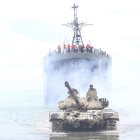
Iran threatens to completely close the Strait of Hormuz after Trump's ultimatum
Emmanuel Alejandro Rondón
State Dept. issues global alert, urges caution over risks linked to Iran

Society
State Department issues global alert, calls for caution due to the risks linked to Iran
Sabrina Martin
Everything that's happened in the war so far, here

LATEST