As Iranian war drains stockpiles, US sells $17 billion in defense missiles to three Gulf allies
The Trump administration authorized the sale of thousands of Patriot interceptors to Kuwait, the United Arab Emirates and Bahrain, amid Pentagon alarm over depleted stockpiles after two months of war against the Iranian regime.
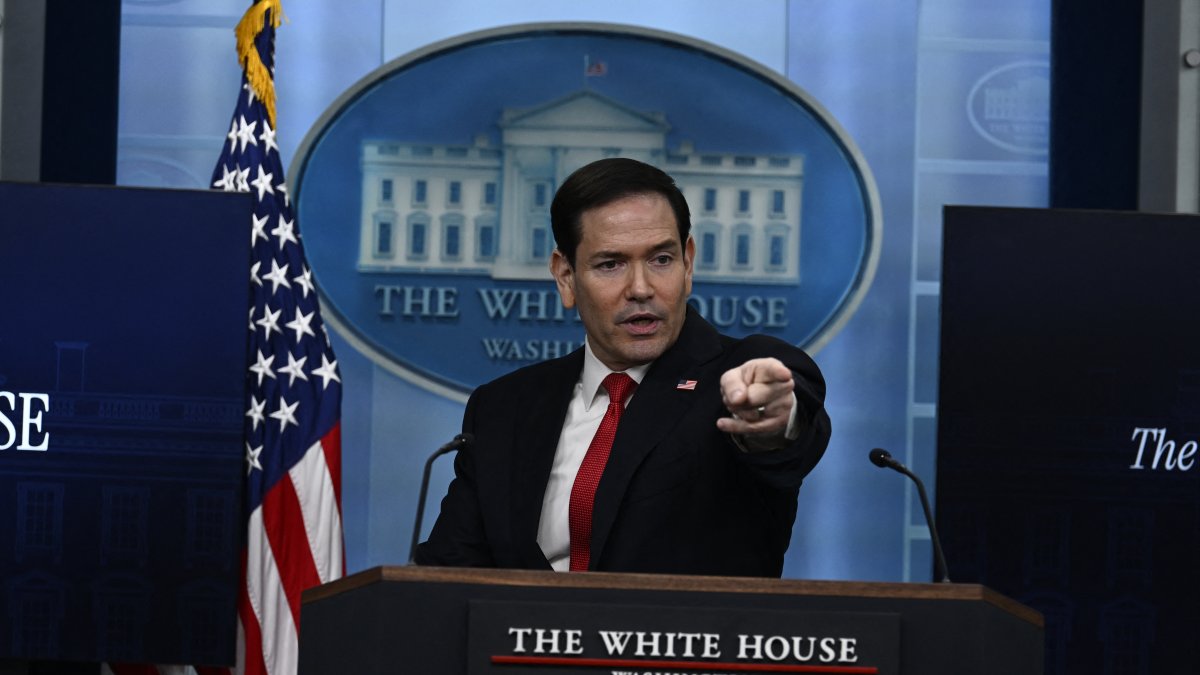
Marco Rubio at a press conference

The Donald Trump administration approved a $17 billion arms export package destined for three Persian Gulf monarchies, Department of State and congressional officials revealed to the New York Times on Thursday.
The deal includes thousands of air defense interceptor missiles and associated services, and was finalized despite warnings from Pentagon officials about the troubling level to which U.S. stockpiles have fallen in the wake of the conflict with Iran.
Unlike other arms sales authorized last Friday under an emergency clause, which were, in fact, publicly announced, this operation has not, for the time being, been disclosed in official statements. The Department of State limited itself to formally notifying Congress, as these sales constitute expansions of previously approved packages: one from 2019 for Bahrain, and two others from 2024 for Kuwait and the United Arab Emirates. In total, Washington authorized nearly $25.7 billion in arms sales to the Middle East that day.
Kuwait takes a bigger share
According to information obtained by the NYT, the breakdown leaves Kuwait as the top buyer, with $9.3 billion; the United Arab Emirates, with $6.25 billion; and Bahrain, with $1.625 billion. The letter sent to Congress by the Department of State states that each country will receive two models of the Patriot missile.
If one considers that each interceptor costs approximately $4 million, the orders total around 4,250 units. To this figure must be added the $4 billion, approximately 1,000 missiles, that Qatar ordered on that very Friday in an emergency operation that was, in fact, officially announced.
The manufacture of such a volume of weaponry, experts warn, would take years.
Patriot systems are produced by Raytheon, while both that company and Lockheed Martin handle the manufacture of the interceptor missiles. These systems are among the most sought-after in the world. Ukraine has been asking Washington for them for years to defend against Russian attacks.

Criticism in Congress
The operation reopened the dispute over the role of Congress in U.S. foreign policy. It is the third time the Trump administration has invoked emergency authorization to circumvent the regular congressional approval procedure on arms sales to the Middle East. Democratic lawmakers and some Republicans have questioned these decisions because of their impact on U.S. global military readiness.
Democratic Rep. Gregory W. Meeks, his party's ranking member on the House Foreign Affairs Committee, declared that sidetracking Congress has become commonplace in this administration and linked the urgency of the new sales to what he called a poorly planned "war of choice." According to Meeks, the White House failed to prepare for the conflict adequately and is now forced to resupply its partners by circumventing congressional oversight.
The discrepancy between the $8.64 billion in sales publicly announced on Friday and the total figure of $25.7 billion that Meeks slipped into a statement is what prompted the NYT to inquire with the Department of State, which ultimately confirmed the $17 billion deal this week.
LATEST