They killed him: A political prisoner of the Chavista regime, whose 81-year-old mother was deceived for months, dies in custody
The news reveals a chronology of systematic concealment. Quero died in July 2025.
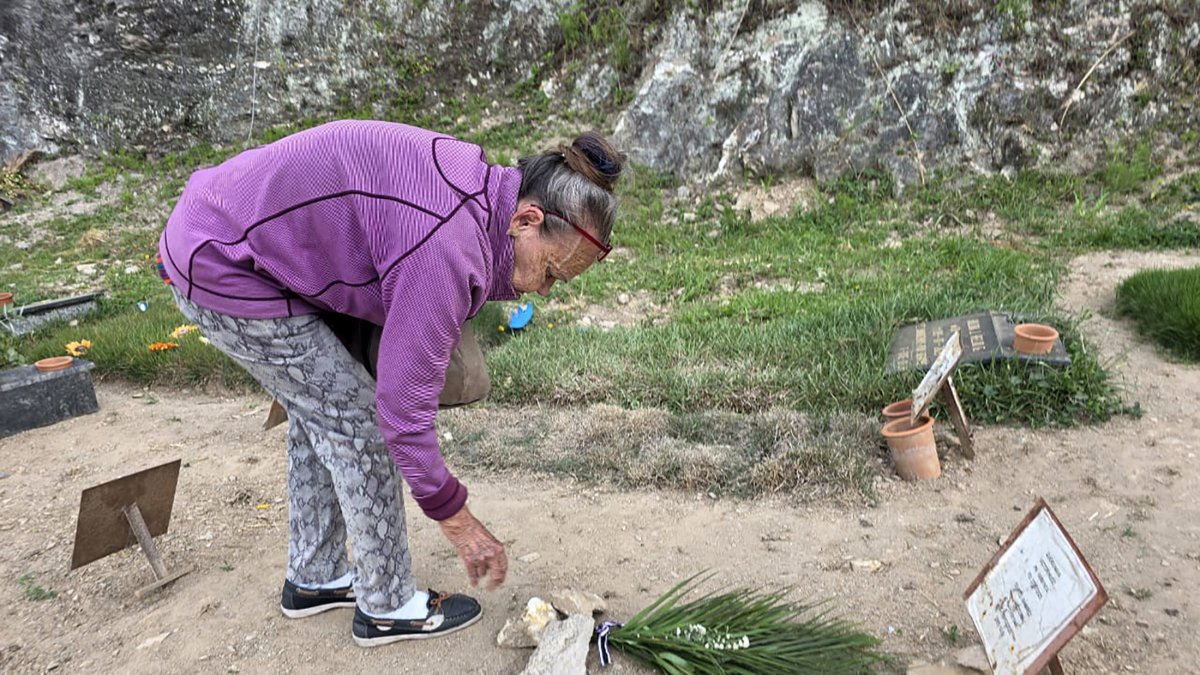
Carmen Navas, mother of Victor Quero, visiting the presumed burial place of her son, shortly after the regime reported his death.

The death of Victor Hugo Quero Navas in the custody of the Venezuelan regime has uncovered, once again, the machinery of opacity and persecution that defines the structure of chavismo.
After more than a year of forced disappearance and an administrative silence that his family came to qualify as "deliberate cruelty," the Ministry of Popular Power for the Penitentiary Service finally issued an official statement on Thursday confirming the death of the political prisoner.
The news reveals a chronology of systematic concealment. Quero reportedly died in July 2025, yet the regime kept his mother, Carmen Navas, an 81-year-old woman, traversing courts and prisons for months in search of proof of life that the Chavista regime simply could not provide.
Carmen Navas' suffering and the institutional farce
Victor Hugo Quero, a 51-year-old businessman known by his entourage as "the Russian" or "the German," was kidnapped by hooded officials of the General Directorate of Military Counterintelligence (DGCIM) on January 1, 2025.
That day, according to accounts from those close to him, he was only carrying hallacas and sweets to celebrate the New Year with his mother, Carmen Teresa Navas.
From that moment on, Quero's trail was lost in the structure of fear led then by Nicolas Maduro and later by Delcy Rodriguez.
Even though an appearance record of the Ombudsman's Office, dated October 24, 2025, and released in coordination with the Public Ministry, then headed by Tarek William Saab, assured that the detainee was in El Rodeo I (a renowned torture center on the outskirts of Caracas) facing charges of "treason, conspiracy and terrorism," the reality was much more grim. By that date, Quero had already been dead for three months.
Carmen Navas, who depended economically on her son for basic expenses and medicines, led a desperate crusade. During her visits to El Rodeo I, officials went so far as to berate her, even shouting:"Why do you insist on coming?"
While the regime today managed by Delcy Rodriguez maintained secrecy, the elderly mother was subjected to interrogations of up to five hours by the security agencies of chavismo, forcing her to reconstruct her pain under the pretext of an "update" of the file motivated by media pressure.
A pattern of abandonment and disproportionate charges
The official statement issued today by the Penitentiary Ministry attempts to justify the outcome by alleging health complications.
According to the document, Quero was transferred to the Military Hospital in Caracas on July 15, 2025 for an "upper digestive hemorrhage." Nine days later, on July 24, he died of an "acute respiratory failure secondary to pulmonary thromboembolism."
However, the official report leaves profound questions. Quero suffered from a chronic colon condition that required specialized attention, which was ignored during his imprisonment in subhuman conditions.
Organizations such as Foro Penal had already warned about the physical deterioration of the businessman, whom the Second Special Terrorism Court unfoundedly linked to foreign intelligence agencies and to former commissioner Ivan Simonovis.
The figure of Quero Navas, a man who sold clothes in the market of La Hoyada and nutrition products to support his family, was transformed by the official narrative into a threat to national security.
This disproportion between reality and the State's accusations is a recurring pattern in cases of political prisoners in Venezuela, where arbitrary detention often precedes a death sentence due to negligence or torture.
One of the most alarming details of the case is the overkill of the judicial system, which continued to operate against Quero Navas until months after his death. While the State had already buried the prisoner, the special terrorism courts continued to systematically receive and reject habeas corpus appeals and amnesty requests filed by his lawyers.
The weight of the forced disappearance
The case of Victor Quero Navas now becomes a symbol of forced disappearance in custody. The burial of his remains was allegedly carried out on July 30, 2025, without the presence of relatives, under the argument of the "absence of relatives," even though his mother never ceased to claim information in the corresponding venues.
Only until today, May 7, 2026, Carmen Navas was able to visit the presumed burial place of her son.
The return of the remains and the clarification of the circumstances of his death are now the minimum demands of a family that was deceived by the state apparatus while unknowingly in mourning.

Politics
Landau warns that without political stability, there will be no economic reconstruction in Venezuela
Andrés Ignacio Henríquez
LATEST