Poll: María Corina Machado and Marco Rubio top popularity rankings in Venezuela
Most Venezuelans positively value the increased influence of the U.S. in the political transition following the capture of Nicolás Maduro. President Trump is also among the leaders with the most favorable image in Venezuela.
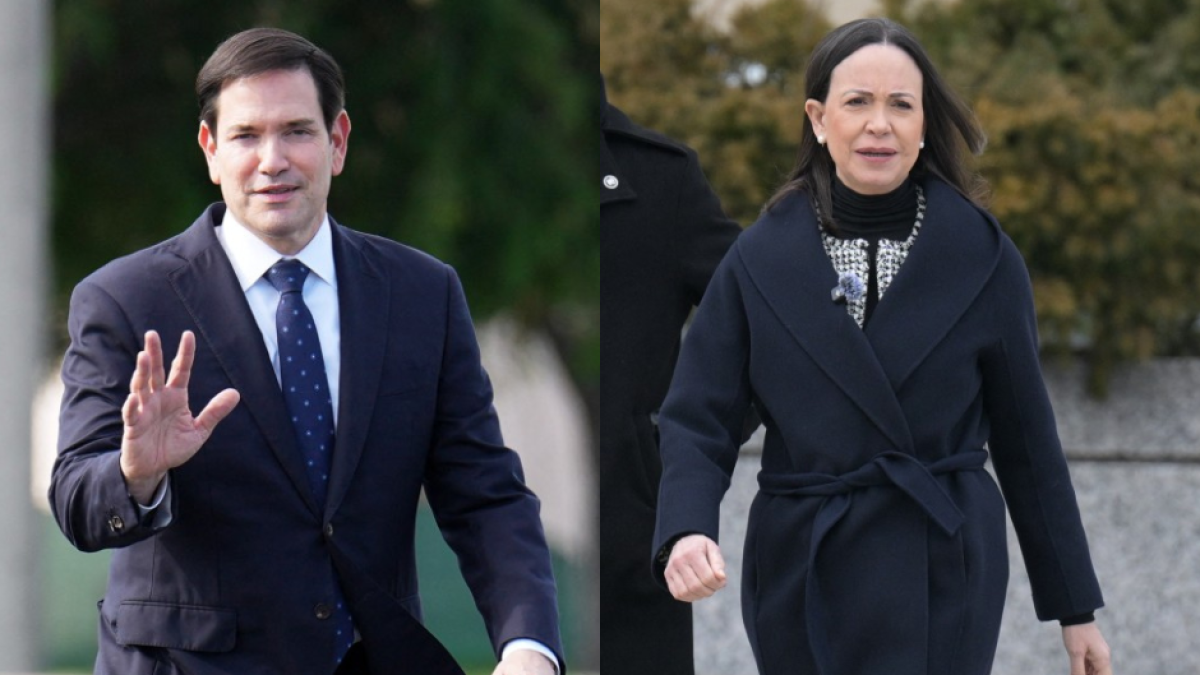
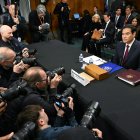
Secretary of State Marco Rubio (l) and opposition leader María Corina Machado (r)

Following the capture of Nicolás Maduro on January 3, Venezuela is facing a period of political transition where, under U.S. surveillance and pressure, the interim regime of Delcy Rodriguez began a process of releasing political prisoners and new economic and oil agreements with Washington. In this context, a new survey by AtlasIntel, in alliance with Bloomberg, conducted in February, revealed that opposition leader María Corina Machado and U.S. Secretary of State Marco Rubio are the two politicians with the best image among Venezuelan adults, who also foresee a favorable future for the country in the coming months.
According to the survey, which has a margin of error of ±2 points and was conducted exclusively within Venezuelan territory, not including the diaspora, Rubio tops the list with 57% positive image, closely followed by Machado, the Nobel Peace Prize winner, with 56%.
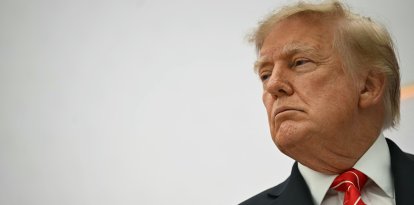
President Donald Trump also ranks among the best-valued figures among Venezuelans, with 53% positive perception.
In contrast, figures linked to the Chavista regime show high levels of rejection. Former dictator Nicolás Maduro, who faces federal charges for cocaine trafficking and other crimes, registers a 64% negative image; Chavista ringleader Diosdado Cabello has a 69% rejection rate; Jorge Rodríguez, Delcy Rodríguez's brother, has 65%; and Maduro's wife, Cilia Flores, has 61%.
In contrast, Delcy Rodríguez, who heads the interim regime after Maduro's arrest and has received praise from Trump before the press, has a slightly more positive image than the rest of the Chavista leaders, with 56% negative and 29% positive in the overall leader measurement.
The survey also measured the approval of Rodriguez's management as the head of the Venezuelan regime. For now, 44.3% disapprove of her management, while 37% approve of it. Another 18.7% say they do not know.
However, demographic crosstabs show that Delcy Rodríguez's highest approval rating is concentrated among voters who backed Nicolás Maduro and the ruling Chavista party in 2024, as well as among lower-income sectors. In contrast, younger and higher-income segments present higher levels of disapproval against the interim regime.
Likewise, practically unanimously, Venezuelans strongly reject figures of the traditional political opposition, such as Henrique Capriles, Juan Guaidó and Leopoldo López. In that sense, only Machado has a positive opinion within the country.
Venezuelans support the U.S. role in Venezuela
One of the most conclusive data points from the survey is the positive perception of the United States' role in the current Venezuelan political process.
62.4% of respondents believe that the increased U.S. influence following Maduro's arrest represents a positive change. Only 7.4% qualify it as negative, while 19.9% see it as neutral and 10.4% do not have, for the moment, a defined opinion.
On the economic front, Venezuelans continue to view the country as in a very negative moment. In general, 72% of those surveyed evaluate the country's economic situation as bad and 71% consider the labor market negative.
In "the family," 54% rate their household's economic situation as bad.

Society
Maduro's lawyer claims former dictator cannot afford legal fees due to US government sanctions
Emmanuel Alejandro Rondón
However, after the fall of Maduro, six-month expectations show a marked contrast. 78% believe Venezuela's economy will improve over the next six months, 77% expect improvements in their family's economic situation, and 73% project an improvement in the job market.
Only between 5% and 6% anticipate a worsening of the situation.
In addition, 57.7% say they expect to make more purchases of durable goods in the next six months compared to the previous six months, while 27.8% believe they will buy the same and 14.5% believe they will buy less.
In terms of civil liberties, 52.1% of respondents perceive an increase in the country, compared to 29.3% who believe the opposite.
The results make it clear that, in Venezuela, the most highly valued leaders are associated with political change in the country, while the traditional figures of Chavismo and the former opposition register high levels of rejection.
LATEST