South of the Orinoco, criminal gangs still control the gold the Rodríguez regime is selling to US companies
The honeymoon between U.S. gold mining firms and Chavista authorities is playing out, for now, in Caracas hotels, under the gaze of television cameras. The problem is that gold is not extracted there. It is extracted in the hills, where lead reigns supreme today.
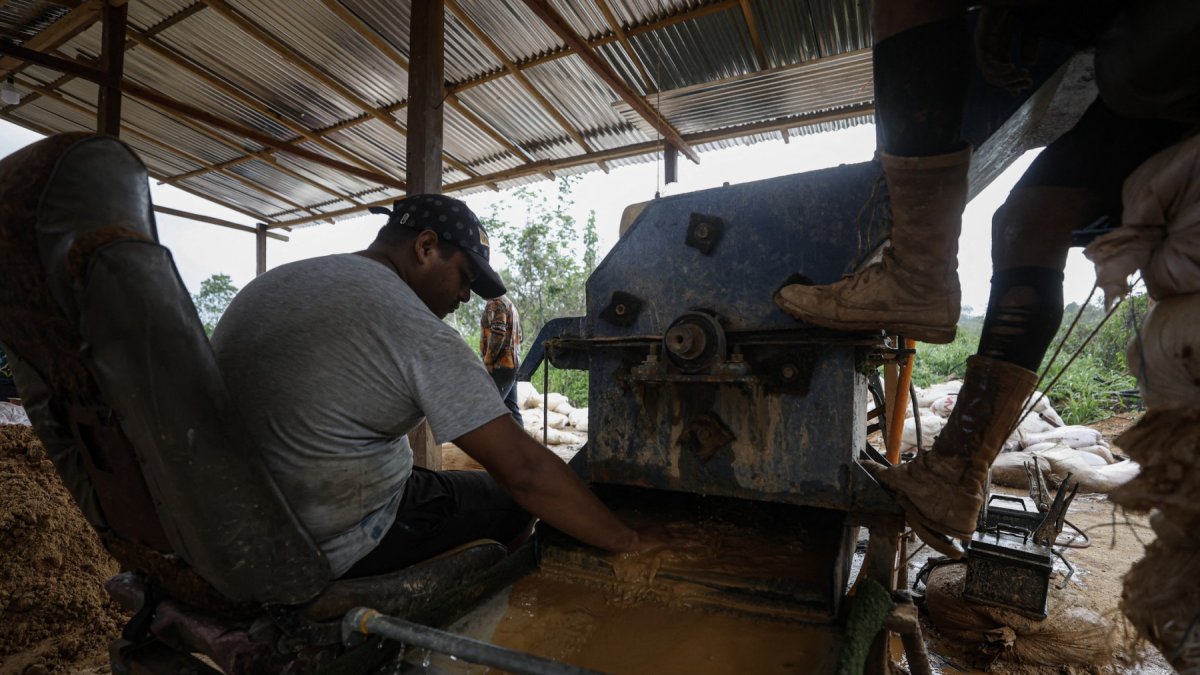
Men working in an artisanal gold mine in the town of El Dorado, Bolivar.

As Venezuelans look forward to the political transition following the capture of former dictator Nicolás Maduro, several U.S. energy companies are already evaluating their next steps to invest in Venezuela, a country that, in addition to having the largest oil reserves in the world, also possesses massive wealth in strategic minerals, including gold and diamonds in the already recognized zone of the Orinoco Mining Arc, located between the states of Bolivar, Amazonas and a small portion of Delta Amacuro. In legislative terms, the matter appears to be a no-brainer. Last month, as reported by The Atlantic, Interior Secretary Doug Burgum revealed at an oil conference that Venezuela's interim dictator, Delcy Rodriguez, and her brother, Jorge Rodriguez, leader of the South American country's Congress, unhesitatingly promised her tailored legislation to modernize Venezuela's mining industry. The conversation, according to a member of President Donald Trump's cabinet, was laughably straightforward.
"Delcy said to the U.S. executives, 'Well, tell us what you want in the bill. We're introducing it on Saturday,'" Burgum said. "So then they take the feedback. It gets introduced. Her brother is the president of the Senate. I said to him, 'Is the bill going to pass?' And he had a short answer: 'Yes.'"
Coupled with the Burgum story, the background underscores the pressure Washington is now exerting on the Rodriguez regime. In March, Chavista authorities were negotiating with senior U.S. officials the sale of up to one ton of gold for the U.S. market. Following the talks, Washington approved the sale of Venezuelan gold. In early May, U.S. firm Heeney Capital and Swiss firm Mercuria signed with the Venezuelan Mining Corporation (CVM) "a memorandum of understanding on mining" before U.S. and Venezuelan officials in Caracas.
That's how simple, and that's how fast energy deals are moving in Venezuela after the fall of Maduro. Laws are being passed at record speed, understandings look nimble, and Washington's sanctions no longer bar gold sales. However, while businessmen and politicians shake hands and fine-tune details of agreements, in the Orinoco Mining Arc, in Bolivar, Amazonas and Delta Amacuro, things have not changed much, and that, although today it does not affect the relations between the large U.S. energy companies and the interim Chavista authorities, could soon change.

Politics
Treasury Department eases sanctions on Venezuela's mining sector, including gold
Carlos Dominguez
A law that does not reach those who rule in the mountains
On May 17, Ángel Sandoval Kuniche, a 34-year-old indigenous Mapoyo, was walking near the conucos of his community, Palomo, in the Cedeño municipality of Bolivar state. He had the misfortune of stepping on an anti-personnel mine. The explosion destroyed his right leg. He was rushed to Ciudad Bolivar, the capital of that state. According to Venezuelan journalist Fritz Sánchez, who has been documenting the extractive activity in the south of the Orinoco for years and spoke to VOZ for this report, the chief of the community, Simón Bastidas, had already warned the military stationed in the Pijiguaos about the presence of mines in the area, planted, according to the complaint, by Colombian guerrilla groups operating in the south of Cedeño.
This situation, which is common in the area, occurred more than 370 miles from Caracas, where memorandums are signed in front of state television cameras and mining laws are passed within days. The health situation of this Mapoyo man is a reminder that the brutally rich mining territory, in which U.S. companies are pinning hopes of exploitation, is not yet governed from Miraflores, in Congress or from afar. It is still governed at the point of "lead, vaccines and, in some corners, anti-personnel mines," Sanchez said.
In short, this is the crack that separates the, for now, unsound legal framework from reality. And it is not a novelty.

Economy
Oil giants did not commit to invest massively in Venezuela due to lack of legal security and infrastructure problems
Emmanuel Alejandro Rondón
El Callao: The anatomy of a violent and predatory system
Perhaps in Washington, it is complex to understand why a law passed unanimously in the National Assembly does not change the game on the ground. For that, you have to g,o deep into El Callao, the historic epicenter of Venezuelan gold mining, in the heart of Bolivar. There, cigarettes, beer, water, and all products for consumption or survival are not priced or paid for in grams of gold.
Raimundo, a fictitious name to protect his identity, is a "curtío" miner with decades in the mines of El Callao. As he tells it, the outbreak of violence in the city came in 2015, with the irruption of the infamous Tren de Aragua. This Venezuelan criminal gang spread its tentacles throughout the South American country. Then it crossed borders throughout the region until it reached the U.S., where the group eventually earned a terrorist organization designation.
"Since 2015 the situation changed with the arrival of the Tren de Aragua to the mines of El Callao. By that time, 'Toto', 'Sacarías' and 'Barracuda' were the bosses and imposed their law by lead," Raimundo recalled. "Those were times of fear and uncertainty because the 'vacuna' fee was not fixed, but no one refused to pay because that was the law." At that time, he assures, the gang "was not yet squared with the government".
"La vacuna" in Venezuela is the methodology of extortion against businesses or families used by criminal gangs to impose their law in cities, areas or towns where the state does not control or does not want to enter, either by complicity or unwillingness. It also happens in Mexico, where drug trafficking is so established that institutions play a secondary role. In the mining areas of the Arco Minero and in many dangerous neighborhoods of Venezuela, "la vacuna" is, unfortunately, an institution.
The reconfiguration of the mining criminal system came later, with the arrival of other criminal groups that wanted to take over the area. The need to control an expanding illegal gold production, the humanitarian crisis that pushed thousands of Venezuelans to "seek their luck" towards the mines starting in 2018, and the international sanctions against the Venezuelan regime relocated the pieces on the criminal chessboard. According to Raimundo's testimony, with the appointment of Carlos Osorio as president of the Venezuelan Mining Corporation (CVM) in 2019, Tren de Guayana entered Callao, and a confrontation between gangs began that ended the life of Toto and his group. By the end of 2021, the entire region would be under the command of Ronny, alias "Matón," of Tren de Guayana.
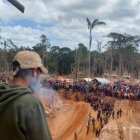
What came next, according to sources Sanchez consulted and shared with VOZ, was a pact: order in exchange for money. Miners, millers, traders and buyers of gold were summoned. They offered a reduction in structural violence in exchange for a fixed system of "contributions" to Tren de Guayana, plus guarantees of continuity for informal and illegal mining. The fee, they say, is still in force, of ten grams of gold per month per mill.
The scheme is well thought out for those who charge "vacunas." From the processing of the ore in the mills, gold sands remain, a by-product that is sent to recovery companies concentrated in the Nacupay sector. These recovery companies keep 80% of the recovered gold and return 20% to the mill that took the material; of that 20%, a portion goes back to Tren de Guayana as a contribution. A former employee of these recovery companies, who asked to remain anonymous for fear of reprisals, denounced a parastatal organization that charges at every stage of the gold mining process.
The figures handled by this structure are, according to the same former worker, lucrative. In the El Perú sector, there are around 3,500 mills; in Nacupay, at least 1,200; in La Ramona, another 1,800. Added to this is the sale of mercury, prohibited by law in Venezuela since 2016, through Decree No. 2.412, whose exclusive "supplier" is, according to the source, Tren de Guayana, at the rate of twelve grams of gold per kilogram of that liquid metal. The former worker estimates that the organization moves hundreds of kilograms of gold in these sectors each month. Although it is practically impossible to verify the data independently, the number of mills and the vast precious mineral reserves in the area give an idea of the giant business that no law has yet been able to touch.
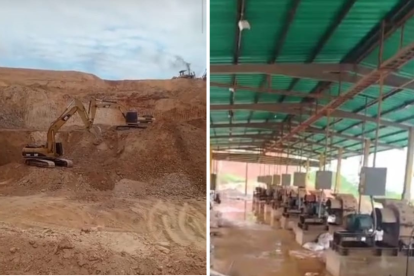
The excavation of an illegal mine (l) and several mills (r)
The former worker states that the business's control is both territorial and nominal. "Peru, because it is larger, is divided into three parts," he says. From Las Palmas to La Gallera, one person is in charge; from La Gallera to Finland, another; from Finland to Caratal, a third. Each leg has its person in charge, and "this way, everything is controlled." There is not a gram of gold that is not paid to those in charge.
"Legalizing illegality"
Upon this criminal structure, the CVM constructed an administrative construct: the now-familiar "Strategic Alliances." In theory, they serve as a mechanism to formalize and group millers under a legal umbrella. In practice, according to environmentalists, activists, and sector workers who speak out anonymously due to the danger involved in raising their voices, they are merely a veneer.
"That has been legalizing illegality," the former worker consulted said. "The workers have no labor formality, no safety implements, no environmental impact studies, no mine closure or environmental remediation plans. It is only a veneer of control and payments to CVM and Tren de Guayana."
Basically, in practice, the same entity of the Rodríguez regime that is in charge of negotiating with the U.S. companies the sale of Venezuelan gold is the one that, on the ground, operates a collection system (extortion) that coexists with that of the criminal gangs in the area.

World
Trump to send high-level mission to Venezuela: Jarrod Agen to lead key oil and mining deals
Andrés Ignacio Henríquez
The trade of fifteen grams
At the end of April, while investor delegations were received with great pomp and circumstance in Miraflores, a much less glamorous document was circulating in El Callao: Notification No. CVM GF-PM032.04/2026, of the Sector El Callao, dated April 28, 2026, and signed by lawyer Luice D. Alvarez H., identified as General Manager of the Bolivar Region of the Venezuelan Mining Corporation.
The letter, addressed to a gold trader, invokes the "Plan de Reordenamiento y Formalización de la Actividad Aurífera en el Estado Bolívar and Guayana Esequiba" and informs him that, in order to "enter the official control and traceability system," he must comply with a mandatory operational support fee of fifteen grams (15 gr) of gold per month, higher than "the vaccine" charged by Tren de Guayana. In exchange, the Venezuelan State promises a "Certificate of Registration of Minerals Trader" that would grant "legal recognition before the security and mining authorities" and "protection against closure measures." The mineral must be delivered on fixed days of each month.
The consequence of not paying? Immediate closure of the premises and seizure of the ore.
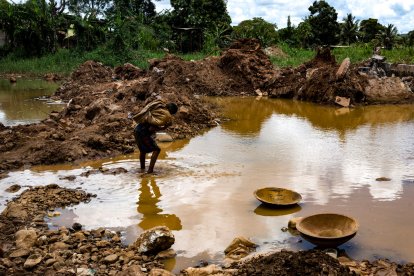
A child miner works in an open-pit mine in search of gold to later sell in El Callao
It is, in short, a state charge in gold, monthly and mandatory, as a condition to operate "legally." The word "traceability" appears on the paper right next to the requirement of fifteen grams. The request generated outrage among traders.
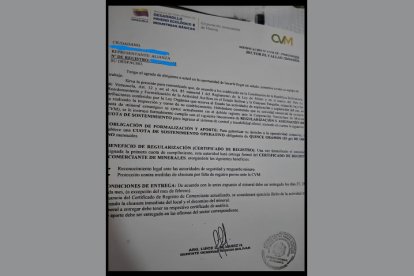
A notice (N.º CVM GF-PM032.04/2026) dated April 28, 2026, signed by the general manager of the CVM (Venezuela's state mining corporation) for the Bolívar region
On April 20, the Guasipati Gold Buyers introduced a "Recurso de Impugnación de Cobro Impositivo" addressed to CVM. In the document, received with official seal on April 30, they reject the charge with four arguments: lack of public consultation, double taxation ("the new charge overlaps with municipal and national taxes" that they already pay), economic impact (the pressure encourages informality and diverts commerce away from Guasipati) and lack of legal basis. They ask for the immediate suspension of the charge and a dialogue table. The appeal bears the guild's seal and the signatures of dozens of affected merchants.
One of those buyers claims that the CVM already controls the mining areas through Tren de Guayana and now also intends to control the sale and purchase of gold. "But the fact is that the companies buying and selling gold in the region are already formal and we pay our taxes by law as such," he states. "In El Callao alone there are more than 800 businesses that work with gold as currency."
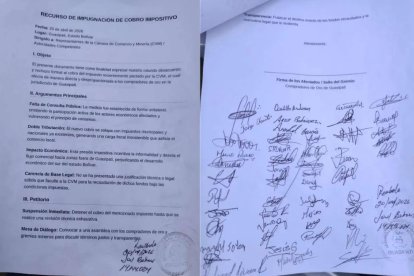
"Tax Charge Appeal" ("Recurso de Impugnación de Cobro Impositivo") filed on April 20, 2026, by the Guasipati Gold Buyers against the CVM
A fragmented territory
El Callao is just one case, not an exception. The south of the Orinoco is divided into enclaves controlled by different armed structures. According to the mapping maintained by Fritz Sanchez, "Ronny Matón" dominates El Callao; cells of Tren de Aragua extend towards Tumeremo; "Negro Fabio" controls El Dorado; "El Ciego" operates in La Paragua and El Manteco; "Juancho" manages the kilometer 88-Las Claritas axis; and the National Liberation Army (ELN), the largest Colombian guerrilla still active, has a presence in areas of Amazonas and in western Bolivar, in the Cedeño municipality, where Angel Sandoval lost his leg.
This is no secret to observers. “Caracas is not the de facto authority in these mining regions," Bram Ebus, a consultant researching Venezuelan illegal mining for the Amazon Underworld project, told The New York Times. “So they can write up a nice mining legislation, but when you go to these mining districts, there’s other armed authorities you need to deal with.”
The new mining law, passed unanimously by the National Assembly on April 9, 2026, the same one that, according to Burgum, Rodríguez promised to write for U.S. investors, provides licenses for up to 30 years, international arbitration for disputes and the creation of four oversight entities, including a specialized unit of the National Guard to monitor mining areas. But, so far, authorities have not explained to the public how they intend to retake control of regions where the State does not impose the law, but, on the contrary, it only appears to divide one more piece of the cake. A group of fifteen Venezuelan non-profit organizations warned that the law represents "a serious threat" to the environment and could aggravate deforestation and abuses against indigenous mining workers, many of them displaced or in a situation of neo-slavery, as mining has devastated ancestral territories and theoretically protected areas.
For now, there is also a tremendous cost that appears in no memorandum: the environmental and human toll. Illegal extraction in the Orinoco Mining Arc has destroyed forests, altered the topography of entire regions with heavy machinery, and contaminated strategic watersheds, such as the Caroní River watershed, on which a large portion of the country's hydroelectric power generation relies on, with mercury. Furthermore, it has encroached upon national parks like Canaima and other protected zones that, by law, cannot be granted as concessions. In short, it is a systematic ecocide that has been unfolding and expanding for years. Sánchez constantly issues warnings on "X" about rafts and dredges destroying ecosystems in the Caroní basin, Caura National Park, and La Paragua, all without any intervention by the Bolivarian National Armed Force. "There is no political will to slow down illegal mining in Venezuela," he asserts. "The expansion of mining operations could further exacerbate the impact on the forests and rivers south of the Orinoco."
Blood gold and its new U.S. visa
On the provenance of this gold, Sanchez is clear on what to call it: "Blood gold."
Minerven, the former state mining company, absorbed two months ago by CVM, "has not invested for years, its infrastructure is on the floor, the only mine that is operational and with minimum production is Mina Colombia," Sánchez says. To remove it from CVG and attach it to CVM aims at "being able to channel all the gold that CVM receives from the Strategic Alliances and other organizations, having in common its obscure origin."
Thus, traceability is, without a doubt, impossible to guarantee as of today. With Minerven's "formal" production at minimum levels, various actors consulted by Sanchez fear that illegally extracted gold will be mixed with the scarce legal production, thereby allowing export quotas to be met and facilitating its entry into international markets, including the United States. The former employee of the recovery firms goes so far as to suggest, though this remains unverified, that a portion of the network of recovery companies belongs, either directly or through proxies, to high-ranking officials within the national executive branch; among those he names are the Rodríguez brothers themselves.
"If I lived in Caracas I think I would have seen fewer ministers and politicians than those who have landed in Nacupay, Delcy, Jorge, Héctor Rodríguez, many generals and a couple that today reside in a jail in Gringolandia," the source jocularly said, referring to Nicolás Maduro and Cilia Flores, who are currently imprisoned in the U.S. awaiting trial.
However, the U.S. is moving forward in the legal framework. On March 6, 2026, one day after Burgum concluded his visit to Caracas, the U.S. Treasury's Office of Foreign Assets Control (OFAC) issued General License 51, which authorized U.S. entities to engage commercially with Minerven, sanctioned since 2019 precisely "for operating in the gold sector of the Venezuelan economy." On March 27, License 51A was replaced and expanded, along with licenses 54 and 55, extending the opening to the export, purchase, storage, and transportation of Venezuelan minerals, including gold. The licenses require, among other conditions, contracts governed by U.S. law and due diligence reports on the mineral's chain of custody.
That is the underlying problem: the U.S. Treasury requires due diligence on the origin of Venezuelan gold, while the state counterpart of that chain - the CVM - is the same one that issues official letters demanding fifteen grams per month to traders in a region where the mills pay "a vacuna" per engine and mercury is sold by several armed gangs and terrorist groups such as the ELN.
That is a delicate fact, because today U.S. companies are signing memorandums worth billions of dollars, betting on contracts of up to 30 years in a territory still dominated by Tren de Aragua, Tren de Guayana, the ELN and other groups. It is a risky bet, since a law custom-made in Caracas is not enough to tame an illicit economy consolidated during a decade, with guerrilla presence, armed control by sectors and an accomplice State. The honeymoon between the gold firms and the interim regime of Delcy Rodriguez takes place, for now, in hotels in Caracas and palaces with television cameras. The problem is that gold is not extracted there. It is mined in the hills, where lead rules today.
LATEST