ANALYSIS
Democratic autopsy discusses Harris' defeat in 2024, but ignores debate over Joe Biden
Nearly two years later, the Democratic National Committee (DNC) released a lengthy 192-page autopsy-like document. According to DNC Chairman Ken Martin, the document does not represent the institution's official position but rather a preliminary analysis prepared by Democratic strategist Paul Rivera.
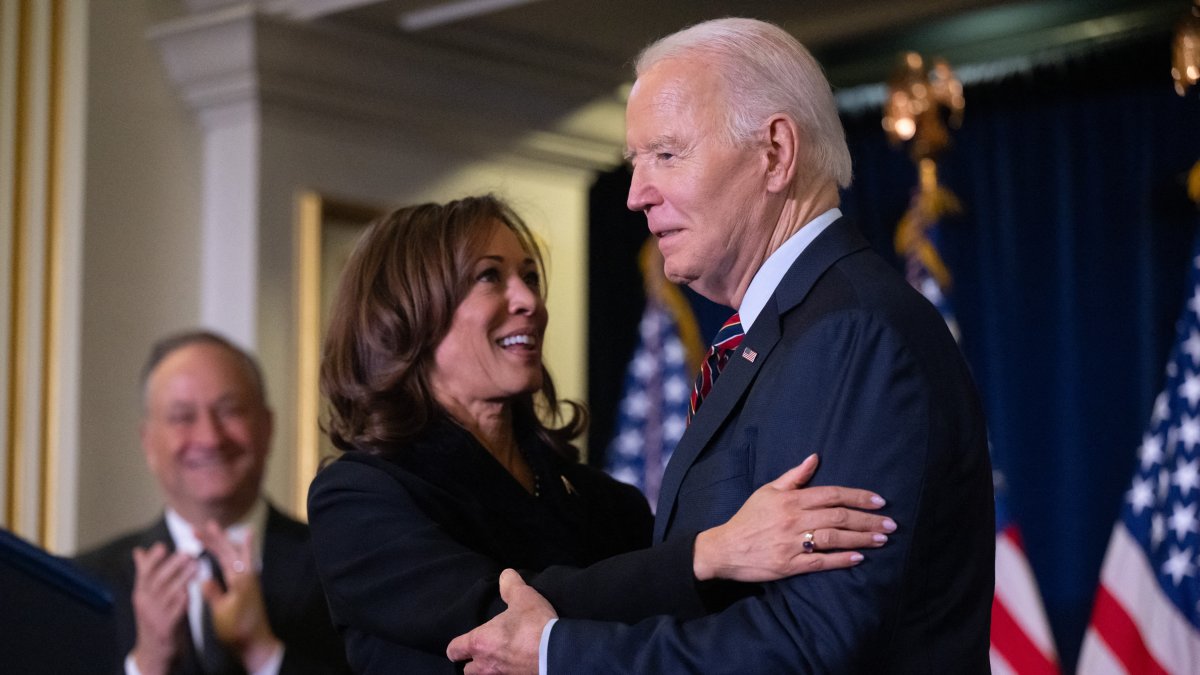
Kamala Harris and Joe Biden in Washington, D.C./ Saul Loeb.

The Democratic Party is still looking for answers for the defeat of Kamala Harris in 2024. Nearly two years later, the Democratic National Committee (DNC) released a lengthy 192-page autopsy-style document. According to DNC chairman Ken Martin, the document does not represent the official position of the institution, but a preliminary analysis prepared by Democratic strategist Paul Rivera.
The post-mortem attempts to explain the main reasons behind the 2024 results, when Democrats lost the Senate and the White House. Although it is written in a light most favorable to Harris, it does not address one of the most important, perhaps the most important, factors in that election cycle: Joe Biden's decision to seek re-election and the support he received from the party until the now-remembered debate with Donald Trump.
Another major absence from the report is the stance many Democrats took on Gaza, criticizing Israel. "When it arrived in my inbox, I immediately clicked on it, used the search function, and searched for Gaza. Came up as zero," Halie Soifer, executive director of the Jewish Democratic Council of America, told Politico.
The document takes aim at the Biden White House for allegedly not doing enough to support Harris, paints an unoptimistic picture going forward, and calls on Democrats to move as far away as possible from what it describes as "identity politics."

Politics
Trump 37-0: President's endorsed candidates sweep 2026 Republican primaries
Carlos Dominguez
The main conclusions of the Democratic autopsy on 2024
In response to the document's release, Ken Martin stated that he had initially decided not to release the report to avoid it becoming a distraction. "But by not putting the report out, I ended up creating an even bigger distraction. For that, I sincerely apologize," he wrote.
"For full transparency. I am releasing the report as we received it, in its entirety, unedited and unabridged. It does not meet my standards, and it won’t meet your standards, but I am doing this because people need to be able to trust the Democratic Party and trust our word," Martin added.
Need for deep introspection
While acknowledging a close election, the document calls for coming to terms with defeat and using that experience to engage in deep introspection, rather than making superficial changes.
"In the face of misinformation and disinformation, our candidates have proven incapable of projecting strength, unity, and leadership, and voters have drifted away. Indeed, many of our critical Democratic wins can be attributed to negative partisanship — where Republicans have nominated deeply flawed candidates," the document reads.
Misdiagnosis of Trump
Rivera's report also cites a widespread failure to plan a communications strategy against Trump, attributed to an initial misdiagnosis. According to the report, Democrats believed that Trump was a practically bad word for undecided voters, so a simple contrast would be enough to defeat him.
In addition, the paper points to an overconfidence about the momentum of urban and suburban voters, supposedly sufficient to offset defeats in rural areas.
"The Harris campaign appears to have relied on Trump being unacceptable rather than building an affirmative case for Harris. (..) Harris struggled with definition beyond ‘not Trump’ and ‘prosecutor vs. felon'. The truncated campaign timeline didn’t help, but the campaign did not quickly resolve on how to tag Trump and define Harris."

Politics
X-ray of the Democratic voter: Radical minority eclipses large centrist majority
Carlos Dominguez
The Trump ad that the Harris campaign didn't know how to respond
"Kamala Harris is for they/them, President Trump is for you," the voiceover said in one of the most viral ads of 2024, titled "I Don't Want." As Charlie Kirk himself admitted, that was the most effective ad against Kamala Harris.
According to the post-mortem, the ad was a crushing blow, which they failed to respond to without angering the more progressive voter base: "They all recognized the attack as very effective, and felt the campaign was boxed. If the Vice President would not change her position — and she did not — then there was nothing which would have worked as a response."
Indeed, campaign pollsters unanimously acknowledged that "the attack was very effective."
Less identity politics and more focus on the middle class
The report also blames identity politics, which Democrats have been resorting to for several election cycles. Instead, it gave as an example candidates in key states who, according to the analysis, knew how to dodge that question and argue from the issues that really concern the group of undecided voters.
For example, Josh Stein in North Carolina, Elissa Slotkin in Michigan and Ruben Gallego of Arizona. They demonstrated how "year-round presence, economic messaging, and addressing cost-of-living concerns resonate more than identity politics." Specifically, there is an emphasis on finding candidates who can empathize with their district or state.


Biden v. Harris?
Without questioning Biden's decision to seek re-election, the paper criticizes White House strategists for failing to adequately prepare for a candidate change, describing the situation as "a missed opportunity."
"As a result, at the time of the candidate change, the polling team discovered that there was no research of its own on the vice president to guide the development of research tools," the report reads.
Spend the money earlier!
Another point cited in the analysis is the decision to allocate substantial funds to the campaign's final weeks. The recommendation suggests that Democrats spend their resources more steadily and early in the election cycle.
This coincides with a criticism made by Kamala Harris and her team. According to the book "2024: How Trump Retook the White House and the Democrats Lost America," written by journalists Josh Dawley, Tyler Pager and Isaac Arnsdorf, both the vice president and her campaign were upset by the decision to save much of the fundraising for the final weeks of the campaign.
"Republicans are focused on winning elections"
Finally, Rivera's postmortem acknowledged that Republicans did a better job than Democrats in 2024, although he remarked that this is a trend he has observed for years. He asserted that Democrats focus on winning "debates" while Republicans work to "win elections."
"Democrats operate in an ecosystem defined by reason even in cycles when the electorate is defined by rage. (...) The difference is right-wing interests take a longer-term approach and amplify polarizing messaging and candidates within the Democratic family with the intention of 'othering' all Democrats. Without aggressive pushback and tactics, it works," Rivera wrote.
"The GOP's victory in 2024 largely came down to its ability to learn more from President Obama's victory than Democrats did. The GOP's campaign was powered by data, amplified by social media, and enabled by ardent supporters at every level," he concluded.
LATEST