Mexico is resigned to living in fear of drug cartels
Nearly a hundred mayors have been assassinated in Mexico since violence broke out in 2006. The murder of Carlos Manzo, however, marked a before and after in Claudia Sheinbaum's fight against narcos.
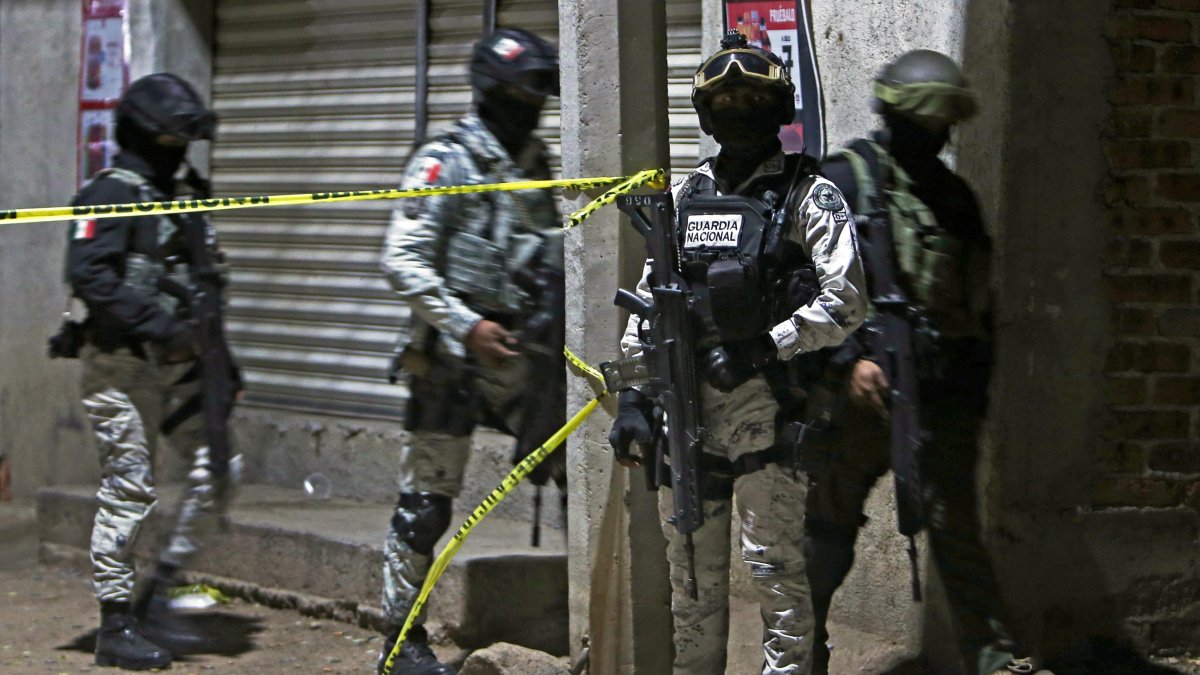
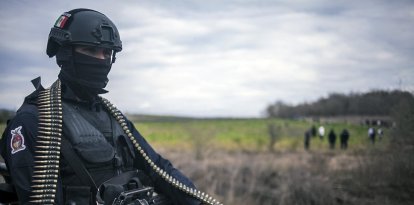
National Guard members at the scene of a mass shooting that left 11 dead in Mexico.

Residents of the Mexican city of Uruapan take to the sidewalks to go shopping and out to eat. The illusion of normalcy collides with simmering fear and an intimidating military presence.
The murder of its mayor six months ago outraged Mexico and forced President Claudia Sheinbaum to step up her offensive against narcos. But the deployment of thousands of troops in Uruapan and the capture and death of the country's biggest drug lord have exposed the limits of state power against drug cartels.
Nearly a hundred mayors have been assassinated in Mexico since violence broke out in 2006. Carlos Manzo's murder, however, marked a before and after in Sheinbaum's fight against drug trafficking .
In Michoacán alone, the western Mexican state where Uruapan is located, 12,000 military personnel were deployed.
Inhabitants are resigned to living with violence.
"One learns to live with fear," 24-year-old Natalia Miranda tells AFP. "You can't be out on the streets so late anymore" because "you don't make it out of the assaults alive," adds the young woman, who is studying education.
"Sometimes you say, 'I'd better stay at home for safety,'" says Teresa Silva, 50, as national guard soldiers in camouflaged uniforms and rifles patrol the streets of this city surrounded by hills cleared for avocado plantations.
Michoacán, the size of Costa Rica, is the epicenter of an avocado industry valued at $5 billion annually, as well as a strong lemon industry.
Here, as in much of Mexico, prosperity also attracts the illegal economy which flourishes amid extortion, drug trafficking and the forced recruitment and training of vulnerable youth by cartels.
Manzo was a colorful mayor who always wore cowboy hats, challenged organized crime and demanded a tough hand from Sheinbaum. "They have to be taken down, we must not have any consideration for these scourges of society," he claimed in relation to the narcos.
A 17-year-old boy allegedly recruited by the powerful Jalisco Cartel - New Generation (CJNG) shot him several times in the middle of a public square during Mexico's big holiday, the Day of the Dead.
Days earlier a leader of wealthy local lemon growers was also murdered after claiming extortion by the cartels.
Three months after reinforcing the security strategy, authorities launched an operation against Nemesio Oseguera, "El Mencho," in the neighboring state of Jalisco. Mexico's most wanted drug lord and leader of the CJNG was wounded and died while being transferred to Mexico City.

Society
Former Sinaloa security secretary arrested in Arizona on drug trafficking charges
Joaquín Núñez
History of violence
In Uruapan, life goes on under a deceptive normalcy.
In the central plaza, people chat in front of a monument commemorating Manzo, erected by the mayor's office. Engraved in the marble is one of the phrases he used to refer to his fight against narcos: "Not one step back." Several photos of the late mayor wearing the cowboy hat that became his political trademark surround the memorial.
It was in Uruapan that armed groups threw five human heads onto a dance floor in 2006, one of the milestones that inspired the so-called "war on drugs" of then-President Felipe Calderón. Thus began the spiral of violence that has shaken Mexico for the past 20 years, experts agree.
"Michoacan came to be on the border of a failed state," Governor Alfredo Ramírez Bedolla tells AFP in his office in the state capital, Morelia.
He recalls that farmers set up self-defense groups, but the result was more violence.
"Cartels control Mexico"
Sheinbaum changed the "hugs, not bullets" strategy of her predecessor and political mentor, leftist Andrés Manuel López Obrador, who was betting on fighting the causes of violence such as poverty and marginalization, rather than directly confronting criminals.
The operation against "El Mencho," originally from Michoacán, was carried out with the support of U.S. intelligence.
The CJNG's reaction was furious, with fires and highway blockades in two-thirds of the country, images that went around the world.
But the authorities doubled down on the bet, and then dealt new blows to the cartel with the arrest of Audias Flores "El Jardinero," alleged successor of the deceased leader, and his accountant, among others.
Since Sheinbaum came to power in October 2024, authorities arrested 52,628 people on suspicion of drug links, seized 392 tons of drugs and dismantled 2,337 narco-laboratories, Security Secretary Omar García Harfuch said on Tuesday.
However, 60% of Mexicans feel unsafe, according to a recent survey.
The leftist leader is under pressure from her U.S. counterpart, Donald Trump, who claims that "cartels control Mexico" and warned that he will act on his own if Mexican authorities "don't do their job."
Despite Sheinbaum's ability to show results, the United States is not letting up the pressure and pointed out another of Mexico's historical scourges: narco-politics.
New York prosecutors in April charged Sinaloa Governor Rubén Rocha Moya, a member of the ruling Morena party, with drug trafficking. But Mexican authorities refused to arrest him for lack of evidence.
"We cannot forget"
Manzo's widow, Grecia Quiroz, has governed Uruapan since her husband's death. With no political experience, she used the power turned into a symbol of resistance and demand for a firmer stance from Sheinbaum's government.
"We cannot forget what happened. ... This woke up not only Michoacán, it woke up all of Mexico," Quiroz tells AFP, surrounded by bodyguards who prevent approaching her.
Arrests for Manzo's death
Silva, a housewife, rests on a bench in Uruapan's plaza, just a few feet from the memorial to Manzo and a military checkpoint. "It's a little quieter," she admits.
As a result of the violence, she leaves her home less often, but she has no choice but to live with the fear.
"We can't do anything but live," she says.
LATEST