ANALYSIS
How China facilitates sanctions evasion for Russia, Iran and North Korea
A report by the Congressional Economic and Security Review Commission (USCC) exposed the Chinese communist regime's strategies aimed at favoring its allies sanctioned for corruption and terrorist activities.

Senior commanders of the Russian and Chinese militaries.

Congress presented a detailed report this week exposing an international network organized by China to evade trade and financial sanctions issued by Washington against the regimes of Russia, Iran and North Korea.
The document was prepared by the U.S.-China Economic and Security Review Commission (USCC), composed of 12 Republican and Democratic lawmakers from both chambers.
The report revealed that the Xi Jinping regime is a blatant and decisive facilitator of sanctions evasion by countries belonging to the "axis of autocracy."
In recent years, according to the report, Hong Kong has taken advantage of its status as a world trade and financial center to become a major hub for sanctions evasion and export control.
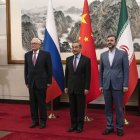
JNS
Congressmen express 'deep concern' over Chinese supply of material to Iran for manufacturing rocket fuel
JNS (Jewish News Syndicate)
According to lawmakers, the communist regime continues to maintain a high volume of trade with countries under heavy sanctions, establishing transport and payment networks tolerated by the Chinese Communist Party to continue importing and exporting controlled goods.
Some CCP networks to evade sanctions
- A "ghost fleet" of tankers carrying sanctioned oil from Iran and Russia has found refuge in the Asian country, where a group of independent refineries accepts discounted energy resources, whose origin is falsely declared in customs data.
- China is the largest supplier of dual-use technology items, whose sale has enabled Russia to build and maintain its military operations in Ukraine.
- As with the sanctioned oil trade, China's shadow networks help North Korea to launder the profits of its state-sponsored transnational cybercrimes.
According to the report, with scalable and sustained economic influence, Beijing has become the gravitational pole around which the axis of authoritarian and anti-democratic countries is coalescing.
This continually evolving network of industrial-scale sanctions and export evasion poses a series of challenges to policymakers in the legislative and executive branches of United States, both strategically and tactically, per the report.
China's sophisticated tactics
- Barter trade:
According to the report, Chinese car dealers have accepted grain as payment from Russian customers. Although inefficient, the direct exchange of goods occurs outside the reach of sanctions and circumvents financial networks.
- Direct clearing in RMB:
In combination with China's alternative payment and clearing networks, this allows trade and financial transactions to bypass the global reach of the U.S. financial system.
- Alternative payment and clearing systems:
- Cryptocurrencies:
- Shadow fleet:
The tankers hide their activities through opaque ownership, registering under different maritime flags, turning off their automatic identification systems (AIS) and conducting dangerous transfers from ship to ship at sea.
Most of the Russian and Iranian oil transported by the clandestine fleet is destined for China, specifically ports in the province of Shandong, where a group of independent refineries known as "teapots" process the crude for the domestic market.
- Complex money laundering networks:
China has enabled destabilizing practices
The report concludes that the role of the Chinese communist regime, by allowing "axis of autocracy" states to trade, purchase weapons, obtain dual-use goods and access the international financial system, has dramatically eroded the effectiveness of sanctions and export controls imposed by the U.S. and its multilateral partners.
Since the illegal invasion of Ukraine, the Chinese regime has offered support to Russia through increased purchases of oil and gas, as well as supplying dual-use technology that has steadily headed for the battlefield.
Similarly, Chinese banks and account holders are essential players in the process that allows Iran to convert its revenues into dollar- and euro-denominated assets.
The report also notes that, despite the near-complete disruption of official trade during the pandemic, Chinese nationals continued to facilitate the smuggling of sanctioned goods into and out of North Korea, helping North Korean cybercriminals launder stolen cryptoassets.
According to the report, material and financial support obtained through China's help in evading economic restrictions has enabled these regimes to maintain their destabilizing practices.
LATEST