Trump shares a "51st state" map of Venezuela and throws the transition back into the spotlight
The publication came a day after President Trump told Fox News co-host John Roberts that he is "seriously" considering annexing Venezuela as the 51st state of the United States.
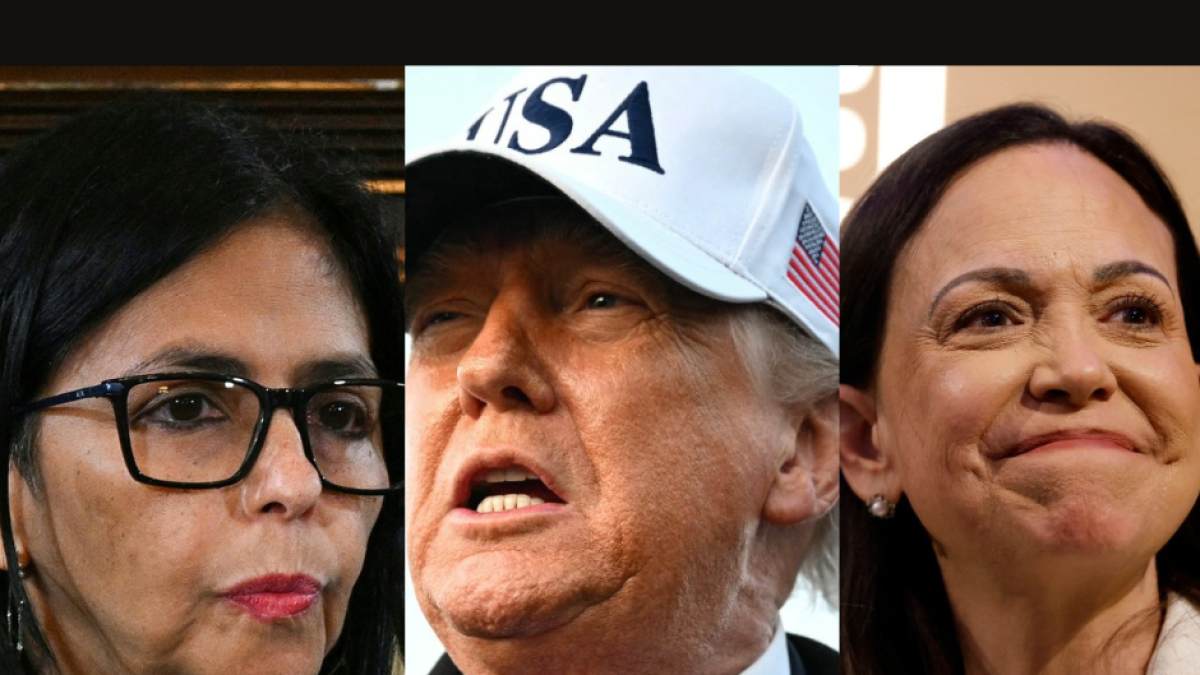
Photo collage with Delcy Rodriguez, Donald Trump and Maria Corina Machado.

President Donald Trump posted this Monday on his Truth Social account an image of the map of Venezuela painted with the U.S. flag and the caption "51st State", an image that the White House amplified from its institutional account on 'X' (formerly Twitter) rekindling the discussion on the direction of the transition and the future of this South American country.
The publication came a day after President Trump told Fox News co-host John Roberts that he is "seriously" considering annexing Venezuela as the United Statess 51st state.
"He told me he is seriously considering a move to make Venezuela the 51st state," Roberts wrote on 'X' after holding a conversation via telephone with the president.
Roberts cited two reasons Trump would have given for annexing Venezuela: 1. "There is $40 trillion in oil there"; 2. That Venezuelans "love him," a claim that polls, for now, corroborate, as the president is a popular figure in the South American country. However, in recent weeks, Trump's image has deteriorated as he praises the interim dictator, Delcy Rodriguez, successor to ex-dictator Maduro.
The Rodriguez regime responds.
From The Hague, Delcy Rodriguez herself rejected the idea of Venezuela becoming a U.S. annexed territory. "That is not foreseen. It would never be foreseen, because if there is something we Venezuelans have is that we love our independence process,"she told a journalist.
Rodriguez was speaking after the International Court of Justice (ICJ) hearings on the Essequibo dispute, a disputed territory between Venezuela and Guyana. Many noted that Trump's published map of Venezuela was incomplete, as the Essequibo did not appear within Venezuelan territory, not even with claim stripes, in line with Guyana's claim at the ICJ.
World
Rick Scott assures that Delcy Rodríguez 'is despicable' and demands free elections in Venezuela
Andrés Ignacio Henríquez
A conversation that had been going on
The idea of the "51st state" applied to Venezuela is not new in the discourse of President Trump or those close to him. The president, who has played with this proposal in his second term applying it to Canada and Greenland, also put Venezuela in the eye after Operation Absolute Resolution of January 3, 2026, when a Delta Force unit captured former dictator Maduro and his wife, Cilia Flores, in Caracas before transferring them to a New York federal court on narcoterrorism charges. From then on, the U.S. began a process of tutelage against interim leader Rodriguez, who has the transitional backing of the Trump Administration to govern the country in the current transition period.
Trump's own first message using the label "51st state" for Venezuela came on March 17, after the Venezuelan national team's 4-2 victory over Italy in the semifinals of the World Baseball Classic. "They are looking really great. Good things are happening to Venezuela lately! I wonder what this magic is all about? STATEHOOD, #51, ANYONE?", he said on Truth Social. A day later, after the Venezuelan victory against the United States in the championship final, he completed the idea by posting a single word: "STATEHOOD!". At the end of March, during a cabinet meeting, Trump even joked about running for the Venezuelan presidency against Delcy Rodríguez, arguing again that she is very popular in Venezuela.
Politics
The US accelerates the roadmap in Venezuela and is already analyzing ways towards a 'democratic transition'
Andrés Ignacio Henríquez
World
Se desploma la gratitud hacia Trump en Venezuela por su relación con Delcy Rodríguez
Andrés Ignacio Henríquez
Political Prisoners: Trump's Promise and Reality
This Tuesday, May 12, before embarking on an official trip to China, Trump again referred to the issue in a press conference in front of the White House.Asked by ABC correspondent David Alandete about the situation of Venezuelan political prisoners, the president promised: "We are going to get them all out".
He then added: "We, as you know, allowed them to release many, and they have released many of the political prisoners."
The figures, however, contradict the optimism shown by the president so far. According to the Penal Forum, in Venezuela there remain 457 political prisoners: 414 men and 43 women, 270 civilians and 187 military. The NGO also documents 19,092 political detentions since 2014 and more than 11,000 people subject to restrictive measures of freedom. The Inter-American Commission on Human Rights (IACHR) specified last week that only 186 people obtained full freedom under the amnesty law, while 554 others were released from prison under precautionary measures.
Amnesty questioned
The amnesty law was approved in February by the Chavista-controlled National Assembly and officially terminated by Rodríguez on April 24. Although the interim regime claims that more than 9,000 people were benefited, the Penal Forum denounced that the application became "a funnel to slow down or paralyze the freedom of many".
The slowness of the process is one of the points that the State Department itself recognizes. In his appearance before the House Western Hemisphere subcommittee, the head of the Bureau of Western Hemisphere Affairs, Michael Kozak, admitted that Washington is not relying on the good faith of the interim regime but on its ability to pressure Caracas. "We're not relying on them, but relying on our ability to pressure them to do this," he said, referring to U.S. control over oil revenues. Rep. María Elvira Salazar (R-FL) was the one who questioned Kozak and exposed her doubts about the current process without the active participation of the US: "They are just trying to buy time. They don't want to reconcile. They are Maduristas. So it's up to us."
The situation of María Corina Machado
The opposition leader and Nobel Peace Prize María Corina Machado, who escaped from Venezuela in December 2025 after 16 months in hiding, still has a pending debt: her return. In her show of force in Chile, during the inauguration of Jose Antonio Kast in March, Machado said her return would be in "harmony" with her allies. This week, in an interview to El País, she confirmed that, precisely, her return to Venezuela will be in coordination with the United States.
That coordination, as confirmed by Kozak before Congress, is one of Washington's central objectives: ensuring that Machado can return and eventually participate in free elections. The latter is the process that the vast majority of Venezuelans are waiting for according to the most recent polls, where Machado remains, along with Rubio and Trump, the most popular political figure in the country while the US role in the transition is well regarded by Venezuelans.
LATEST