The mystery of the Ursa Major: Explosions, nuclear suspicions and what appears to be sabotage off the coast of Spain
An international investigation suggests that a Russian cargo ship may have been carrying nuclear reactor components to North Korea before sinking in the Mediterranean.
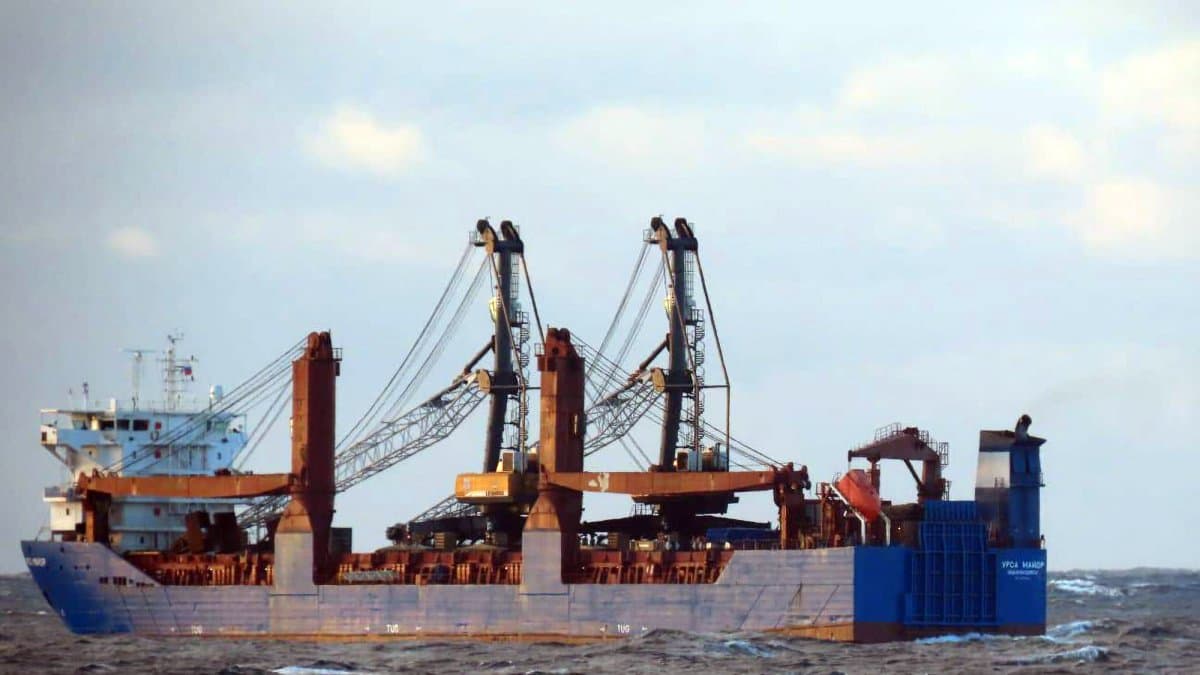

On December 23, 2024, Russian cargo ship Ursa Major sank in the Mediterranean, off the coast of Cartagena (Spain), after registering a series of explosions in its structure. The incident left two crew members dead and forced the evacuation of the remaining 14 survivors.
According to a journalistic investigation attributed to CNN, the ship reportedly emitted an emergency signal after suffering three explosions on its starboard side, possibly near the engine room. Hours later, new detonations allegedly preceded its definitive sinking.
The ship belonged to the Russian state-owned company Oboronlogistics, linked to the Ministry of Defense.
A suspicious route and unusual cargo
The Ursa Major had sailed from the port of Ust-Luga and St. Petersburg with an official destination of Vladivostok in the Russian Far East. However, its declared trajectory and cargo have been the subject of doubt from the start.
The ship's manifest included two large industrial cranes, 129 empty containers, and two pieces described as "manhole covers."
According to the media investigation, this cargo is difficult to justify from a logistical and commercial point of view, as sea transport of such material would have been unnecessary in the face of much more efficient overland alternatives in Russia.
Military escort and transit through European waters
One of the most relevant elements of the case is the presence of Russian military escorts during part of the journey. The vessel was accompanied by Russian Navy units such as the Ivan Gren and the Aleksandr Otrakovsky.
This level of protection is unusual for a civilian freighter, which has fueled the hypothesis that the ship was carrying strategic or highly sensitive material.
During its passage through European waters, the vessel was tracked by Portuguese and Spanish forces before the final incident.
World
South Korea detects a dozen unidentified ballistic missiles launched by North Korea
Carlos Dominguez
The critical moment: Speed reduction and explosions
On Dec. 22, the Ursa Major slowed down sharply in waters near the Iberian Peninsula. Spanish maritime authorities contacted the vessel by radio, receiving a response that there were no problems on board.
However, less than 24 hours later, the ship issued a distress call after explosions were recorded on its starboard side. The incident resulted in the death of two crew members.
The survivors were rescued by Spanish services and taken to the port of Cartagena, where they were questioned by the authorities.
Four days after the sinking, Oboronlogistics called the incident a "targeted terrorist attack"and confirmed that three explosions had occurred on board.
According to the company's statement, the hull showed a hole measuring approximately 50x50 centimeters, with metal deformations facing inward, which would suggest an external explosion. The company further added that the ship's deck was covered with shrapnel.
The most controversial hypothesis: Nuclear reactors for North Korea
According to sources cited by CNN, the captain subsequently reportedly suggested that the "manhole covers" could correspond to structural elements of reactors similar to those used in Russian nuclear submarines.
The possible destination of the cargo would have been the North Korean port of Rason, which fits with the growing military rapprochement between Russia and North Korea.
In recent years, both countries have strengthened their military cooperation, including arms transfers and logistical support in the context of the war in Ukraine.
A high-tension geopolitical scenario
The case comes at a time when North Korea has stepped up its naval nuclear program. In 2025, the regime of Kim Jong Un showed images of a purported nuclear-powered submarine, albeit without evidence of an operational reactor.
Analysts cited in the journalistic investigation believe that Pyongyang does not yet have the technical capability to independently develop naval nuclear propulsion systems, making any possible external transfer relevant.

World
The head of Space Command warns that Russia may be considering deploying a nuclear weapon in space
Luis Francisco Orozco
The final sinking and subsequent explosions
After the evacuation of the crew, the ship reportedly suffered further explosions in the area, before finally sinking.
Other sources quoted in the report claim that a Russian military intelligence vessel, the Yantar, reportedly remained in the area for several days.
Subsequently, new detonations have reportedly been recorded on the seabed, which has fueled the suspicion that the incident did not end with the sinking.
U.S. interest and nuclear surveillance
These flights are designed to detect traces of radioactive material in the atmosphere, although they do not in themselves imply the existence of nuclear contamination.
Their presence, however, confirms Washington's strategic interest in the incident.
Hypotheses about the sinking
The causes of the sinking remain unclear. The main hypotheses include:
- accidental internal explosion,
- sabotage by means of a mine or attached explosive charge,
- covert intelligence operation,
- or possible military intervention.
Some sources suggest the use of high-speed underwater weapons, while others point to less sophisticated explosives placed on the hull.
So far, no theory has been officially confirmed.

A case without closure
More than a year after the incident, the wreck of the Ursa Major remains some 2,500 meters deep, making any direct investigation difficult.
The Spanish government has indicated that recovery of the ship's recorders would be extremely complex. The absence of access to the sunken ship keeps all hypotheses open.
The only clear thing is that the case combines elements of Russian military logistics, possible nuclear technology transfer, naval intelligence, and a highly tense geopolitical environment.
Between evidence and uncertainty
The sinking of the Ursa Major has become an example of how contemporary conflicts play out in gray zones, where information is fragmentary and official versions compete with leaks and intelligence analysis.
Whether or not the ship was carrying nuclear components to North Korea remains unproven. But the level of secrecy, the military escort, the explosions and the subsequent reaction of multiple state actors have made this case one of the most opaque and politically sensitive maritime episodes of recent years.
The bottom of the Mediterranean, for now, retains the answers that no government has been willing or able to confirm.
🛠 Do you think there is an error in this article?
Recommendations







LATEST