LIVE | Iran claims to have re-closed Strait of Hormuz
Meanwhile, diplomatic moves in the region have intensified and partial signs of openness have begun, such as the limited opening of Iranian airspace, in a scenario marked by uncertainty about the continuity of the ceasefire.

American destroyer in the Strait of Hormuz

The tension in the Middle East is again escalating in real time. Iran announced that it is retaking strict control of the Strait of Hormuz after accusing the United States of reneging on commitments, while Washington insists on maintaining the blockade of Iranian ports if an agreement is not reached.
Meanwhile, diplomatic moves in the region have intensified and partial signs of openness have begun, such as the limited opening of Iranian airspace, in a scenario marked by uncertainty over the continuity of the ceasefire.
All timestamps are Eastern Standard Time (EST).
The Trump Administration prepares operations to intercept vessels linked to Iran
The outlet The Hill reported Saturday that the U.S. military is preparing for potential interception and boarding operations targeting vessels linked to the Iranian regime, including the possible seizure of commercial ships in international waters. According to the report, a source familiar with the internal planning, who spoke on condition of anonymity, said the White House could carry out the operation in the coming days as President Donald Trump seeks to intensify a naval blockade around the Strait of Hormuz.
These preparations come as U.S. forces are already enforcing restrictions in the Gulf of Oman, where 23 vessels attempting to depart Iranian ports were forced to turn back earlier this week. The Hill noted that the next phase of enforcement could unfold in a context in which Iran has effectively restricted access to the strategic waterway, which handles roughly 20 percent of global oil shipments, contributing to rising energy and fuel prices worldwide.
Trump says Iran cannot “blackmail” the U.S. over Strait of Hormuz threats
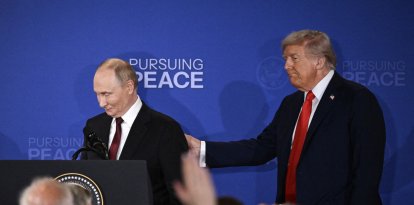
President Donald Trump warned on Saturday that Iran cannot “blackmail” Washington with its shifting stance on the Strait of Hormuz, after Tehran declared the strategic waterway closed again.
“We’re talking to them. They wanted to close up the strait again, you know, as they’ve been doing for years, and they can’t blackmail us,” Trump said during an event at the White House.
The president added that there would be some information on Iran later in the day.
Israel sets “yellow line” in Lebanon
The Israeli military has established a “yellow line” of demarcation in southern Lebanon, similar to the one used in the Gaza Strip to define the area under its control.
In a statement on the second day of the ceasefire, the military said it struck individuals approaching from the north toward this “yellow line,” which had not been previously disclosed.
Iranian boats open fire on tanker in Hormuz
Iranian fast boats opened fire on a tanker in the Strait of Hormuz on Saturday, the U.K. Maritime Trade Operations (UKMTO) said.
The tanker’s captain reported being intercepted about 23 miles northeast of Oman by two vessels belonging to the Islamic Revolutionary Guard Corps. Without any radio warning, the boats “opened fire on the tanker,” according to UKMTO.
No date set for new Washington–Tehran talks
Iranian Deputy Foreign Minister Saeed Khatibzadeh said there is still no date set for the next round of negotiations between Tehran and Washington.
Speaking at a diplomatic forum in southern Turkey, the senior official also remarked that President Donald Trump “tweets and talks a lot.”
Iranian naval forces ready to inflict “new defeats,” says Mojtaba Khamenei
Eight oil and LNG tankers crossed the Strait of Hormuz on Saturday
Maritime tracking firm Kpler said at least eight vessels managed to transit the waterway early Saturday during the window in which Iran kept it open between Friday and Saturday.
Iran claims it has closed the Strait of Hormuz again
The central military command of Iran announced Saturday that it will resume "strict management" of the Strait of Hormuz, reversing an earlier decision to unblock that strategic lane as part of negotiations with the United States.
In a statement broadcast on state-sponsored television, the headquarters noted that Washington had reneged on a promise by maintaining its blockade of ships sailing to and from Iranian ports.
So long as the United States does not restore freedom of movement for all ships visiting Iran, "the situation in the Strait of Hormuz will remain strictly controlled," the military command said in its statement.
Trump assures that port blockade "will continue" if there is no agreement
President Donald Trump said Friday night that he will maintain the U.S. blockade of Iranian ports if no deal is reached with Tehran.
Aboarding Air Force One, Trump assured that he would suddenly "not extend" the ceasefire with Iran that ends Wednesday. "But the blockade will continue," he told reporters.
Politics
Trump says US blockade of Iran's ports 'will continue' if there is no deal
Virginia Martínez
Pakistani officials close high-level visits to push for Middle East peace
Pakistan's prime minister and army chief on Saturday announced the closing of high-level diplomatic visits as part of efforts to bring an end to the war in the Middle East.
Marshal Asim Munir, the powerful Pakistani army chief of staff, concluded a three-day visit to Iran, where he met with senior officials. Meanwhile, Prime Minister Shehbaz Sharif announced the end of a tour of Saudi Arabia, Qatar and Turkey.
Iran partially reopens its airspace
Iran on Saturday partially reopened its airspace to international flights crossing the eastern part of its territory, the country's Civil Aviation Authority said.
Highlights of the Middle East conflict so far:
Politics
Trump claims Iran agreed to dismantle its nuclear program, though Tehran denies it
Andrés Ignacio Henríquez
LATEST