Operations against Iran continue "unabated," White House says
Confusion created by the Iranian parliament speaker's denial of an ongoing negotiation with Washington slightly dampens market optimism about an early resolution to the conflict.
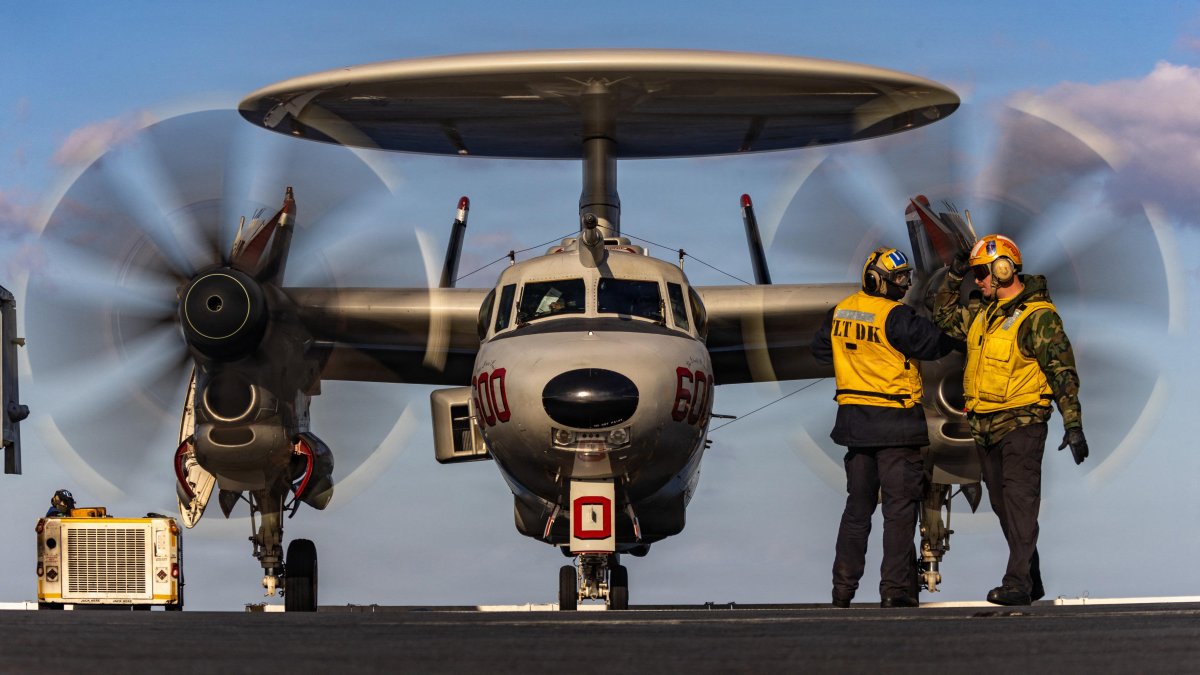
US Navy sailors signaling to an E-2D Hawkeye aircraft
The earthquake triggered by Donald Trump's announcement of the start of "positive and productive" negotiations with Tehran to end hostilities has been marred by denials in the Iranian media and by the speaker of parliament that talks are taking place. However, the power vacuum and the number of spokesmen taking the floor in the headless ayatollahs' regime seem to indicate that at least one sector would be in contact with the U.S., including through mediators such as Turkey.
This has caused a bipolar effect on the world economy. While stock markets continue the upward path initiated after Trump's announcement, uncertainty has turned around the fall in oil prices, which increased again during the Asian trading session.
On the war front, attacks continue between the two sides, with accusations from Iranian media that the U.S.-Israeli coalition had attacked energy centers despite Trump's moratorium.
Times correspond to Eastern Standard Time.
Trump claims Iran gave "us a present" as part of negotiations
When asked about the negotiations, the president assured that Tehran had given him "a very big present" that would serve as a token of goodwill in the negotiations. Although he did not elaborate on details, he did say it was linked to oil and gas.
"They gave us a present and the present arrived today, and it was a very big present, worth a tremendous amount of money," he maintained in the Oval Office. He also said that meant the U.S. was negotiating with the right partner. In addition, he said the Iranian side had agreed that it would never possess nuclear weapons.
Despite questions from the press, Trump did not clarify who was speaking on behalf of the Iranian regime. Following the death of Iranian Supreme Leader Ali Khamenei, his son, chosen successor Mojtaba Khamenei, has not been seen in public.
The Republican did name the key figures on the U.S. side - JD Vance, Secretary of State Marco Rubio, special envoy Steve Witkoff, and Trump's own son-in-law Jared Kushner.
Operations against Iran continue "unabated," White House says
The White House said Tuesday that the U.S. continues to conduct its military operations against Iran "unabated," while evaluating "new" diplomatic alternatives, AFP reported.
"As President Trump and his negotiators explore this newfound possibility of diplomacy, Operation Epic Fury continues unabated to achieve the military objectives laid out by the Commander in Chief and the Pentagon," spokeswoman Karoline Leavitt said in a statement.
French Economy Minister warns of a "new oil crisis"
The conflict in the Middle East is triggering a "new oil crisis" that could slow economic growth in France, warned France's economy minister, Roland Lescure during his speech to the National Assembly on Tuesday.
"If this energy crisis persists beyond a few weeks, the crisis could spread more broadly to the economy and be, at bottom, more systemic in nature," the minister told the Finance Committee.
Greek shipowners risk crossing the Strait of Hormuz despite conflict
Some Greek shipowners have managed to get their cargo ships through the Strait of Hormuz despite the conflict in the Middle East, shipping agent Nicolas Vernicos told AFP on Tuesday.
According to the Kpler consultancy, maritime traffic in the area has plummeted by 95% since the beginning of March, with only a few cargo ships and tankers managing to cross the strait in recent weeks.
"Large commercial vessels are still crossing the Strait of Hormuz," the owner of Vernicos Maritime Group said in an interview. Sailors "accept this risk" because of the "high pay," explained Vernicos, a fourth-generation businessman.
"Sailors working on Greek ships know they have contracts that provide for high wages," said Vernicos, whose ships, he said, are not in the area.
Chinese Foreign Minister tells his Iranian counterpart that "talking is better than fighting"
China's top diplomat told his Iranian counterpart in a telephone call on Tuesday that "talking is always better than continuing to fight," after Tehran denied U.S. President Donald Trump's claim that negotiations had taken place.
"All parties are expected to seize every opportunity and window for peace and to initiate the peace talks process as soon as possible," Wang Yi told Abbas Araghchi, according to a statement from the Chinese Foreign Ministry obtained by AFP.

Israel announces that it will take control of an area in southern Lebanon
The Israeli Army delineated on Tuesday a "security zone" in southern Lebanon which it will take control of. The area extends to the Litani River, located some 30 kilometers north of the border between the two countries.
The Hebrew Army maintained a buffer zone here between 10 and 20 km deep until its complete withdrawal in 2000, according to AFP.
Israeli forces are "maneuvering inside Lebanese territory to seize an advanced line of defense" as far as the Litani River, Defense Minister Israel Katz, in charge of the announcement, said.
"The hundreds of thousands of residents of southern Lebanon who were evacuated to the north will not return south of the Litani as long as the security of the inhabitants of northern Israel is not guaranteed," Katz added.
Iran appoints former Revolutionary Guards commander as head of Security Council to replace Larijani
Iran appointed Mohammad Baqer Zolqadr, a former Revolutionary Guards commander and loyalist of the late Ali Larijani, to replace the latter as head of the Supreme National Security Council, state television reported Tuesday.
U.S. and Israeli strikes killed Iran's supreme leader, Ali Khamenei, and leaders of the Islamic republic's political and military elite in the first three weeks of war.
Israeli Prime Minister Benjamin Netanyahu claimed last week that Iran is "being decimated" and the Israeli military described it as a "crumbling house of cards."
Uncertainty pushes oil back above the $100 a barrel mark
The price of Brent crude oil rebounded on Tuesday and was back above $100 a barrel, a day after a drop of more than 10% triggered by Trump's announcement of talks with Tehran, although the Islamic republic denied it.
In Asian trading, international benchmark North Sea Brent was up 3.89% to $103.83. Meanwhile, West Texas Intermediate (WTI), the U.S. market benchmark, soared 3.89%, to $91.53.
Asian markets rise buoyed by Trump's announcement
Asian stock markets opened higher on Tuesday following Trump's statements about "very good" negotiations with Iran, which however denied such a scenario.
In Tokyo, the Nikkei index was up 0.74% after two consecutive sessions of sharp declines, while Seoul's Kospi advanced 1.87%.
USS Gerald R. Ford arrived in Crete after leaving the Middle East to undergo repairs
The aircraft carrier USS Gerald R. Ford, the world's largest, docked at a naval base in Greece for "repair" and "maintenance" work, days after reporting a fire in the laundry area during its deployment to the Middle East as part of the offensive launched Feb. 28 alongside Israel against Iran.
"This arrival in port allows the ship to be subjected to efficient evaluation, repair and resupply," the Sixth Fleet explained, before insisting that the ship "remains fully capable of carrying out missions" and that "the USS Gerald R. Ford continues its overseas deployment," with no further details on the period of time it is scheduled to spend at the Souda Bay base in Crete.
Iranian press denounces attacks on energy plants despite moratorium announced by Trump
Iranian energy infrastructures were targeted by Israeli and U.S. airstrikes, the official Fars news agency claimed Tuesday, hours after President Donald Trump's unexpected u-turn to suspend bombing of power plants.
The facilities in Isfahan, in the center of the country, suffered "partial damage" and a shell hit in the nearby vicinity of a processing station of the Jorramshahr gas pipeline in the southwest, according to Fars.
U.S. strike eliminates at least 15 pro-Iranian ex-paramilitaries in Iraq
A "U.S. strike" in western Iraq killed 15 fighters of the Popular Mobilization Forces (Hashd al-Shaabi) early Tuesday morning, according to an updated balance sheet released by this alliance of ex-paramilitaries that includes pro-Iranian groups.
Among the victims is "the commander of operations in (the province of) Al Anbar for the Hashd al-Shaabi, Saad Dawai," the alliance, which is integrated into the regular forces of the Iraqi state but whose armed groups are known to act on their own, said in a statement.
Six injured in Tel Aviv in Iranian attacks
Six people were slightly injured Tuesday morning in Tel Aviv, where several explosions occurred following an Iranian missile alert, reported the Magen David Adom, the Israeli equivalent of the Red Cross.
The agency released videos of a partially shattered building and burning vehicles.
Tuesday morning, Iranian state television announced that Tehran fired a "new wave of missiles" at Israel. Later, the Israeli military said it was trying to intercept them.
Chevron CEO warns that the Middle East conflict "hurt global oil markets more than the Russia-Ukraine war"
Oil companies and the world's largest energy consumers face an incredible challenge to rebuild global oil supply chains and inventories once the critical Strait of Hormuz bottleneck opens, warned Chevron CEO Mike Wirth at the CERAWeek by S&P Global conference in Houston, in remarks picked up by Politico.
For Wirth, the Middle East war "hurt world oil markets more than the war between Russia and Ukraine."
"We have a lot of oil and gas now that is not flowing into the market. The physical supply chains are not responding immediately, so even if the strait opens at some point, it will take time to rebuild inventories of the right grades of crude and the right types of fuel."
Iran again attacks its neighbors
Saudi Arabia announced early Tuesday that it had destroyed about 20 drones in the east of the country, without giving further details. For its part, the Kuwaiti army claimed it was responding to "drone and missile threats."
Netanyahu believes Trump's deal with Tehran will ensure Israel's security, but warns they will continue to strike "both in Iran and Lebanon"
Israeli Prime Minister Benjamin Netanyahu said Monday that he spoke with Donald Trump and that the U.S. president believes joint military achievements can be translated into a negotiated agreement that protects Israel's interests, but vowed to continue attacks.
"We are continuing the strikes in both Iran and Lebanon," he said.
Everything that has happened in the war so far, here

LATEST