ANALYSIS
The communist flotilla arriving in Cuba to whitewash the regime: a safari to the people's misery
The most controversial case is that of Pablo Iglesias, former Vice President of the Government of Spain, who recorded messages from the Grand Suite of the Gran Hotel Bristol Habana Vieja, a luxurious five-star establishment in the heart of Havana. From there, overlooking the Capitol, Iglesias defended the regime's management and minimized the country's difficulties.
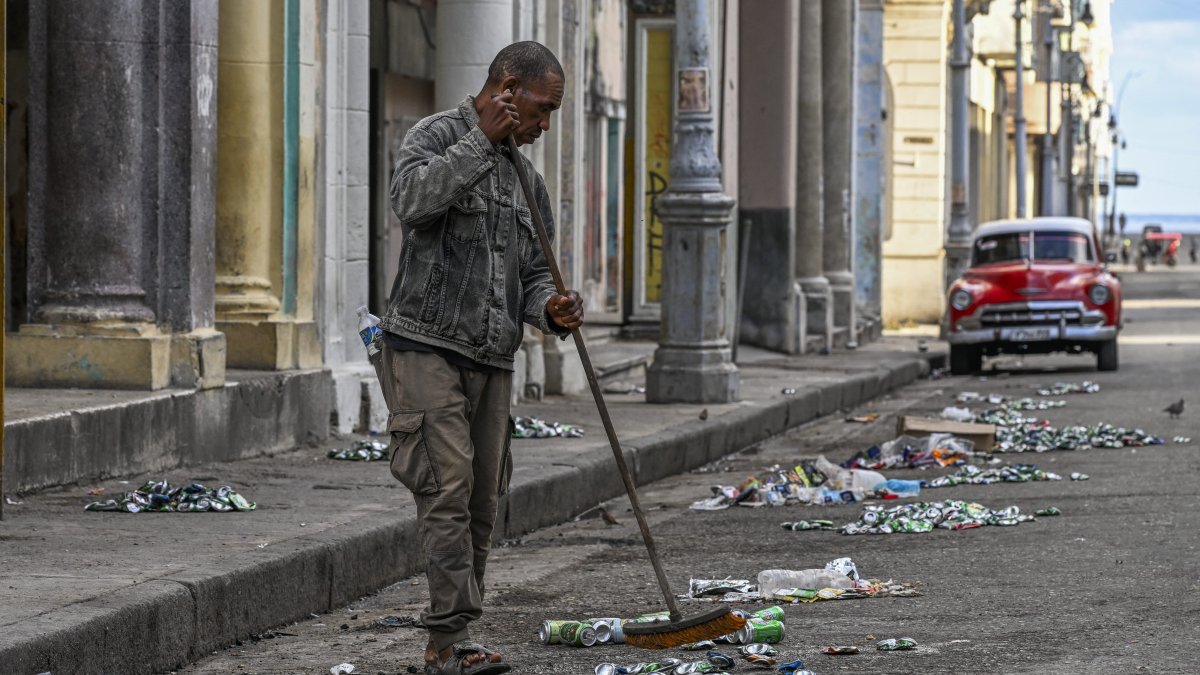
A man tries to clean up the streets of Havana.

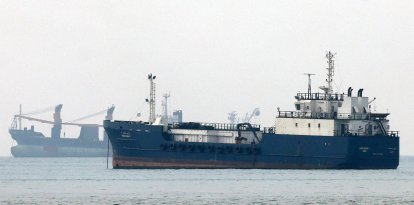
Part of the flotilla Our America has already arrived in Havana, and what they have sold as a humanitarian gesture has become a focus of controversy. The denunciations have spread on the networks, and the first impression after seeing the images circulating from the Cuban capital is that the initiative, promoted by leaders of the international left, is nothing more than a propagandistic operation that serves as an alibi for Miguel Díaz-Canel, while the Cuban people continue to live in extreme conditions of poverty, blackouts and shortages. This is nothing new.
A controversial disembarkation
The convoy, which originally promised to transport some 20 tons of food, medicine and hygiene products, has been questioned by Cuban exiles in Spain and other parts of the world. "This is an insult to those of us who seek real change and an end to the dictatorship that is suffocating the country," said an exile spokesman from Madrid, where demonstrations were held in front of the European Parliament headquarters.
Critics point especially to the symbolic character of the flotilla: many of the international leaders who support it, such as Jeremy Corbyn and Pablo Iglesias, arrived in Cuba by plane and not by boat, joining the convoy once in Havana. They did arrive, but in first class. This decision, critics say, is evidence that the operation seeks more media attention than real assistance.
">Los miembros de la flotilla VIP de Pablo Iglesias y Hasan Piker le arrojan comida a niños cubanos para que bailen mientras ellos graban videos para sus redes sociales.
— Agustín Antonetti (@agusantonetti) March 22, 2026
Ya han cruzando todos los limites, se piensan que tratan con animales. Cuba no es un safari para extranjeros. pic.twitter.com/4owL7nBTRq
Mariela Castro -daughter of the dictator Raul Castro and curiously one of the strategic advisors of the famous initiative- has also met with the activists in the Caribbean capital: from the privilege of the few kilowatts that today light up some buildings on the island, they can be heard chanting the same worn-out slogans.
Safari of privileges
The most controversial case is that of Pablo Iglesias, former vice president of the Spanish government, who recorded messages from the Grand Suite of the Gran Hotel Bristol Habana Vieja, a luxurious five-star establishment in the heart of Havana. From there, overlooking the Capitol, Iglesias defended the regime's management and minimized the country's difficulties.
">🇨🇺 "Nos estuvieron contando la situación que es ciertamente difícil pero tampoco como se está presentando desde fuera".@PabloIglesias, director de Canal Red, desde La Habana, Cuba.
— El Tablero | Canal Red (@ElTablero_TV) March 20, 2026
📺 EL TABLERO | https://t.co/SlXy7sJe3T pic.twitter.com/Be3kiaZG9I
The price per night in those rooms is around $230 a night: an average Cuban has to survive with 11 dollars a month.
For the world, the common mortals, the scene was insulting: while millions of Cubans live on miserable wages, suffer daily blackouts of up to 19 hours and stand in endless lines for food, foreign leaders are shown as "privileged spectators" of the misery.
It is a political safari on the poverty of the Cuban people. The more than 400 'visitors' have been seen strolling and photographing the streets flooded with garbage to the rhythm of congas, shouting that "Cuba is not alone," while from their seats in electric buses they move forward in a collapsed city, which also has no transportation. Even so, they ignore the real situation, and sell empty promises on their social networks. Could it be that they have not looked the other way?

World
Cuba's electricity system collapses again, causing the third blackout this month
Emmanuel Alejandro Rondón
Real help?
True aid is not handouts, but structural changes that restore freedom and dignity.
Historical and political context
This flotilla is reminiscent of the 'Freedom Flotillas' organized towards Gaza, but in Cuba it takes on a more complex political dimension. The island is going through a multidimensional crisis: economic, social and demographic. With more than six decades of communist rule, the population faces chronic shortages of basic commodities, blackouts, massive migration and systematic repression.
Analysts point out that the international left has turned Cuba into a romantic and propagandistic symbol, ignoring the reality of misery and social control. Meanwhile, Cuban exiles preserve the historical memory, sustain remittances that support millions of families and denounce before the international community the political manipulation of initiatives such as this flotilla.
The truth is that none of the pseudo-activists has asked about the more than 1200 political prisoners on the island today, nor have they joined the 'cacerolazos' that for more than two weeks have been spreading throughout different cities of the country as a sign of protest and symbol of the historic end that is looming over the system.
World
Opening to exiles on a dark island: Cuba seeks investment amid electricity collapse
Diane Hernández
The dilemma of change
The challenge now is to separate real aid -if any- from propaganda. For any intervention to have a genuine impact, experts insist on the need to push for transparency, access to the population and structural reforms. The risk, they warn, is that the flotilla will serve only to whitewash the regime, while Cubans remain trapped in a system that concentrates wealth and privileges in the hands of a few.
The latest survey by the Observatorio Cubano de Derechos Humanos (OCDH) has put it in figures: 92% of Cubans are against government measures. The regime has eroded credibility and now has to import communists, with donations, because it has few 'revolutionaries' left on the mainland.
The arrival of the flotilla in Cuba illustrates, once again, the profound disconnect between those who observe the country from luxury suites or from exile, and those who live the daily agony of a nation trapped in the decay of its own political and economic model.
LATEST