White House stresses that several Caribbean and Latin American countries support Trump Administration's anti-drug offensive
During the press conference, when questioned by the press on whether the massive deployment suggests a possible offensive against Venezuelan military installations, the White House spokeswoman avoided speculation and limited herself to indicate that she would not pre-empt the president with respect to any military action."

White House press secretary Karoline Leavitt.

At a press conference held Thursday in Washington, the White House underlined the backing of numerous Latin American countries for the U.S. military initiative, which calls for a large deployment of ships and Marines in the Caribbean.
This operation ordered by President Donald Trump, seeks to combat drug trafficking, in which, according to the Trump Administration, the Venezuelan regime is involved.
The White House spokeswoman, Karoline Leavitt, emphasized that "many Caribbean nations and many nations in the region have applauded the administration's counter drug operations and efforts.” She further added that President Trump "is prepared to use every element of American power to stop drugs from flooding into our country and to bring those responsible to justice."
🚨ÚLTIMA HORA🚨
— Carlos Salazar (@calestophoto) August 28, 2025
“Nicolás Maduro no es presidente, es un terrorista fugitivo y será traído a la justicia norteamericana por ser la cabeza del Cártel del Sol responsable de miles de muertos por drogas y violencia en EEUU”. Asegura la Secretaria de Prensa Karolina Leavitt @PressSec… pic.twitter.com/ryum5oOy7I
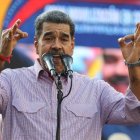
Leavitt reaffirmed Washington's position that the Maduro regime lacks legitimacy as the government of Venezuela, describing it as a drug trafficking cartel. According to the spokeswoman, Maduro is not a legitimate president, but the fugitive leader of this criminal organization, facing charges in the United States for drug trafficking into the country.
For his part, Secretary of State Marco Rubio had revealed this week during a cabinet meeting that the operation has the explicit support of nations such as Argentina, Paraguay, Ecuador, Guyana and Trinidad and Tobago.


According to Rubio, these governments have expressed their willingness to collaborate in joint actions against drug trafficking, which strengthens the regional legitimacy of the U.S. initiative.
The decision comes in response to the designation of cartels such as the "Cartel de Los Soles," composed of Venezuelan military, as a terrorist organization by the U.S.

During the press conference, when questioned by the press on whether the massive deployment suggests a possible offensive against Venezuelan military installations, Leavitt avoided speculation and limited herself to indicate that she would not "get ahead of the president with respect to any military action or questions about that ever.”
Trump administration deploys an impressive military contingent
The military contingent deployed by the Trump Administration is impressive: more than 4,000 troops, including some 2,000 Marines, P-8 Poseidon surveillance aircraft, ships and missile systems.
Featured ships include the destroyers USS Gravely, USS Jason Dunham and USS Sampson; the amphibious transports USS Iwo Jima, USS San Antonio and USS Fort Lauderdale; the missile cruiser USS Lake Erie; and the nuclear-powered submarine USS Newport News.
These assets operate in international waters in the southern Caribbean.
This offensive aligns with directives signed by Trump in August, ordering the Pentagon to prepare military options against Latin American cartels designated as terrorists, including the Sinaloa cartel in Mexico and the Tren de Aragua in Venezuela.

In addition, the Department of Justice (DOJ) has doubled the reward for Maduro's capture to $50 million and seized assets worth $700 million, such as private jets and luxury vehicles linked to the regime.
The Maduro regime's response
LATEST