Foro Madrid points to Spain and the EU as part of the 'external lifeline' that sustains the Cuban regime
A report by the organization examines Havana's debt to Spain, European cooperation, investments linked to the GAESA military conglomerate and the island's foreign trade, and urges that relations with Cuba be made contingent on democratic progress and the release of political prisoners.
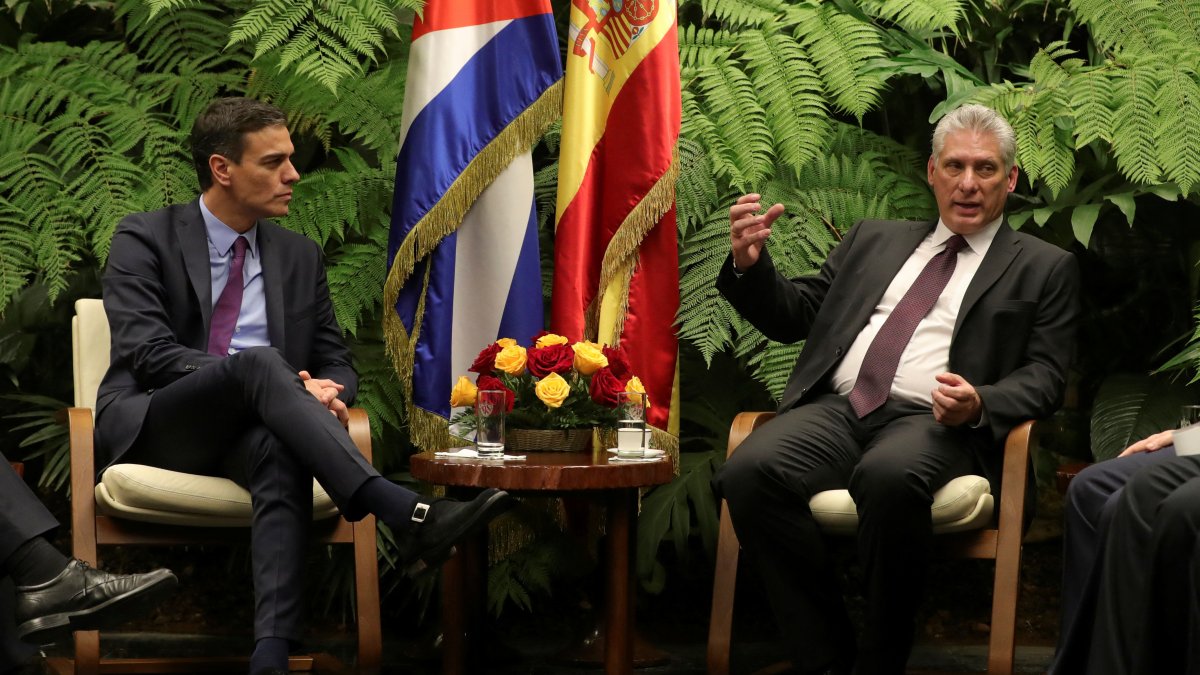
Cuban dictator Miguel Diaz-Canel (right) and Spanish Prime Minister Pedro Sánchez

Foro Madrid published a comprehensive report on Cuba in which it argues that the survival of the communist regime for more than six decades cannot be explained solely by its internal apparatus of control and repression, but also by a succession of economic, political and commercial support from abroad.
The document, titled "Cuba: A Criminal Regime Sustained from Abroad," was released to coincide with the centennial of the birth of Fidel Castro and directs much of its criticism toward Spain and the European Union, calling on them to review their policy toward Havana and to make cooperation and political dialogue contingent on the release of political prisoners and concrete steps toward a democratic transition.
Foro Madrid is an initiative of the Disenso Foundation and defines itself as an international alliance dedicated to defending democracy, freedom, and the rule of law against authoritarian regimes and the rise of the radical left in Ibero-America.
">📃 NUEVO INFORME: En el centenario del nacimiento de Fidel Castro, Foro Madrid presenta:
— Foro Madrid (@Foro_MAD) August 13, 2026
“Cuba: un régimen criminal sostenido desde el exterior”
La dictadura no ha sobrevivido durante décadas por sus propios medios. Ha sobrevivido porque siempre ha encontrado quien la financie,… pic.twitter.com/qhoVDMboKf
From Moscow and Caracas to the current situation of isolation
One of the report's central arguments is that the Cuban economy has repeatedly depended on resources from abroad.
Foro Madrid first reviews the subsidies received from the Soviet Union during the Cold War and, subsequently, the close economic relationship with Venezuela during the administrations of Hugo Chávez and Nicolás Maduro. According to the document, this succession of benefactors made it possible for decades to offset some of the Cuban economy's productive shortcomings.
Following the collapse of the Soviet Union, Cuba suffered a severe economic contraction during the so-called Special Period. Years later, Venezuela came to play a decisive role by supplying oil on favorable terms and making payments for Cuban professional services deployed in that country, particularly in the areas of health, education, and government consulting.
The report argues that the reduction in this support has once again left Havana facing the need to find new sources of financing and foreign trade.
Spain, at the center of criticism
One of the most extensive chapters is devoted to the economic relationship between Spain and Cuba .
Foro Madrid asserts that successive Spanish governments have contributed, through loans, debt renegotiations, public export insurance, cooperation, and investment support, to providing resources that have directly or indirectly benefited the Cuban state.
The document notes that, in a 2020 parliamentary response, the Spanish government reported on the funds owed by Cuba to Spain. The existence of that inquiry and the official response is recorded in the records of the Congress of Deputies.
Foro Madrid estimates the Cuban debt recognized at that time by the Executive at 1.97 billion euros and also reviews successive restructuring processes.
Among these, it mentions the agreements reached in 2015 and 2016, during the administration of Mariano Rajoy, as well as subsequent conversion and renegotiation operations. The report interprets these measures as a transfer of economic risk to Spanish taxpayers.
Spanish companies and the role of GAESA
Another point emphasized by the study is the relationship between foreign investment and Cuban state-owned enterprises.
Foro Madrid places particular emphasis on GAESA, Grupo de Administración Empresarial S.A., a conglomerate controlled by the Revolutionary Armed Forces with a significant presence in sectors such as tourism, commerce, finance and logistics.
The report argues that some Spanish investments in Cuba end up being made in partnership with entities affiliated with the Cuban state and military apparatus and questions whether the risks associated with certain projects have been covered by the Spanish government.
It also cites journalistic investigations into the financial resources controlled by GAESA and argues that economic concentration in the hands of military structures limits the possibility that foreign investment will directly benefit the private sector and Cuban citizens.
Society
GAESA’s goal: The battle to undermine the economic power of the Castro regime
Diane Hernández
EU cooperation: 80 projects totaling 155 million euros
The report also questions the European Union's cooperation policy with Cuba.
Foro Madrid notes that there are approximately 80 EU-funded projects totaling roughly 155 million euros. This figure coincides with information published by the European External Action Service itself, which indicates that European cooperation focuses, among other areas, on sustainable agriculture, food security, renewable energy and economic modernization.
The difference lies in the interpretation.
While Brussels presents these programs as tools to promote sustainable development and improve the well-being of the population, Foro Madrid argues that Cuba's institutional structure allows the state to control a significant portion of how resources are channeled and suggests that such cooperation may end up indirectly strengthening the government apparatus.
The report also notes that the Political Dialogue and Cooperation Agreement between the EU and Cuba contains provisions related to human rights and calls on Europe to use these mechanisms to exert greater pressure on Havana.
World
EU pumps another 10 million euros into Cuba despite concerns about how funds are managed
Diane Hernández
The report cites allegations made by the Food Monitor Program
The document notes that FMP accused Cuban authorities of diverting products received as humanitarian aid from Mexico during the first months of 2026 into state-controlled commercial channels.
Foro Madrid uses this case to support its proposal that foreign aid intended for Cubans be delivered through mechanisms independent of the government whenever possible.
In this regard, the report highlights models in which religious organizations or independent entities participate in the direct distribution of humanitarian aid.
The U.S. embargo does not prevent all trade
Another relevant section of the report addresses one of the Cuban government's most recurring arguments: the impact of the U.S. economic embargo.
Foro Madrid rejects the term "blockade" commonly used by Havana and emphasizes that U.S. sanctions contain numerous exceptions that allow for certain exports, particularly of food, agricultural products and medicines.
Official data confirm that trade is not completely halted.
According to the U.S. Census Bureau, the United States exported approximately $809.6 million worth of goods to Cuba in 2025, while U.S. imports from the island totaled about $17.5 million.
Therefore, it is more accurate to speak of an embargo and sanctions regime with exceptions than of an absolute ban on trade between the two countries.
Political repression, a problem documented beyond the report
The allegations of repression in Cuba are not limited to opposition organizations.
United Nations experts have documented allegations of arbitrary detentions, the criminalization of dissent, coercion and forced exile targeting human rights defenders, activists, and artists.
The U.N. Committee on Enforced Disappearances also recorded 2025 new urgent cases in 2025 involving individuals detained allegedly by State Security agents, without their families initially receiving sufficient official information regarding their whereabouts.
In its report, Foro Madrid cites a figure of 1,260 political prisoners, based on the Prisoners Defenders registry from April 2026. However, that number has since been exceeded.
The organization reported on July 9, 2026, that it had documented 1,306 political prisoners, including 40 who were minors at the time of their arrest.
Medical missions are also under scrutiny
Although it is not the main focus of the report, the debate over foreign currency inflows into Cuba is also related to the state-sponsored export of professional services.
For years, the U.S. State Department has collected testimonies from Cuban doctors stationed abroad who described the withholding of documents, restrictions on movement, surveillance, threats, and the withholding of part of their salaries, circumstances that Washington considers indicators of forced labor. The Cuban government rejects these accusations and maintains that the missions are voluntary and constitute international cooperation programs.
The existence of conflicting positions requires careful attribution of the accusations, especially when legal concepts such as human trafficking, slavery or forced labor are used.
Washington has not ruled out military intervention on the island
LATEST