Venezuela's interim government and the 2015 National Assembly agree to a complete restructuring of the Supreme Court
The economic and infrastructure agenda also took center stage in the technical committees' deliberations.
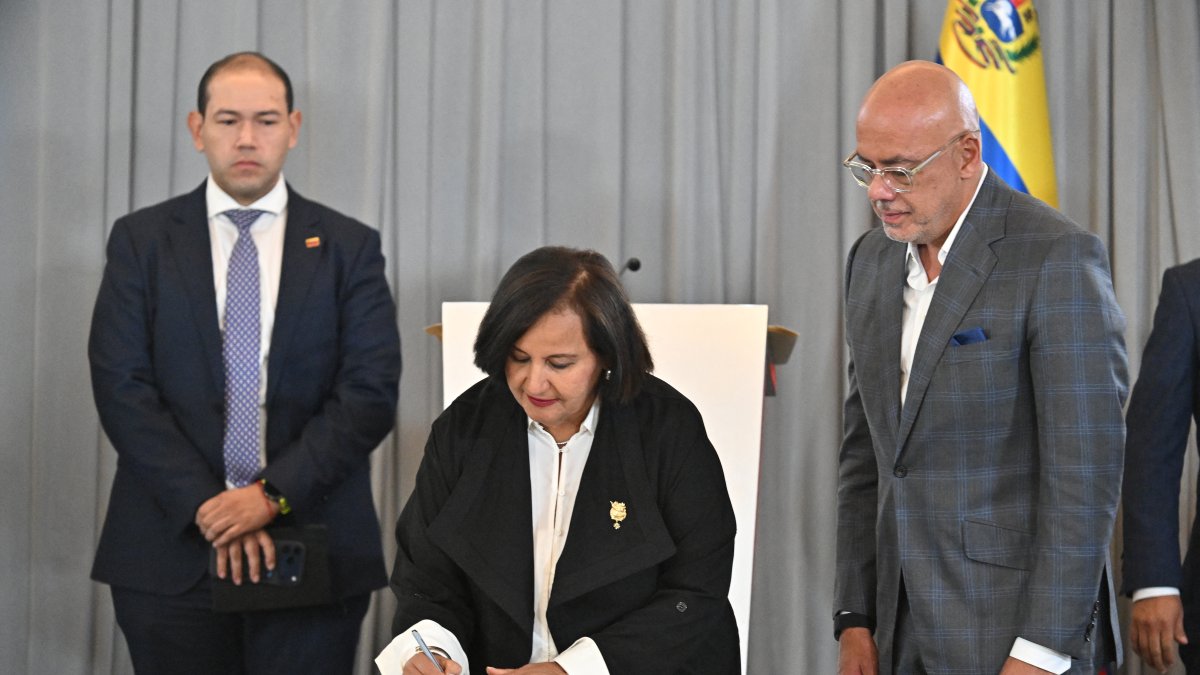
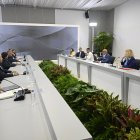
Dinorah Figuera and Jorge Rodríguez at the signing of the agreements reached on August 12.

In Venezuela, the dialogue committee, composed of representatives of the interim government and the Delegate Commission of the 2015 National Assembly, agreed to a comprehensive restructuring of the Supreme Court of Justice (TSJ), halting prior processes to make way for a joint reform of the organic law governing the highest judicial body.
The negotiation mechanism, promoted under the influence of the U.S. government, thus concluded the first phase of its permanent sessions that began on August 6.
The consensus reached requires modifying and expanding the Judicial Nominations Committee and opening a new call for nominations to fill the 32 seats on the TSJ, under the scrutiny of a newly created credentials review council.
This move overturns the unilateral course charted by the Chavista majority in the 2025 National Assembly in May, when it increased the number of justices from 22 to 32.
Although the list of candidates was already in the challenge phase under the leadership of Chavista Deputy Giuseppe Alessandrello, the committee's dynamics and the situation resulting from the double political upheaval on June 24 forced the suspension of that plan.
The quest for gold in London and the neglect of political prisoners
The economic and infrastructure agenda also took center stage in the technical committee deliberations.
In light of the severe damage to housing and public services caused by the earthquakes in Caracas, La Guaira, Miranda, Aragua, and Falcón, the head of the Chavista delegation, Jorge Rodríguez, announced a coordinated strategy to attempt to recover the gold assets held at the Bank of England.
According to the statement, the use of these funds will be structured through audits and traceability mechanisms aimed at reconstruction.
Despite the expectations generated in the preceding days, the joint announcement omitted any resolution regarding the release of the country's political prisoners.
The president of the Delegate Commission, Dinorah Figuera, previously met with relatives of the detainees, as well as with labor groups and the National Union of Press Workers (SNTP), but the humanitarian demands were omitted from the final list of agreements that both leaders read.
Seven hours of confinement and a media blackout
The agreement's finalization was preceded by a tense atmosphere around the hotel complex. Union protesters attempted to break through the security perimeter to demand decent wages, free presidential elections, and the release of dissidents, but were held back by a deployment of the Bolivarian National Police.
The press conference, originally scheduled for noon, was delayed by more than seven hours due to the prolonged closed-door discussions.
At around 7:50 p.m., Rodríguez and Figuera appeared before reporters, limiting themselves strictly to reading the final document.
The delegations left the hall amid mutual applause but refused to answer questions from the national and international press, while Bolivarian National Guard checkpoints maintained security outside the venue. Political leaders plan to resume negotiations in September.
World
The Venezuelan regime is moving away from pro-Iranian rhetoric and signing a historic agreement with Israel
Andrés Ignacio Henríquez

World
End to 16 years of harassment: Venezuelan regime permanently closes high-profile case of judge persecuted by Hugo Chávez
Andrés Ignacio Henríquez
LATEST