Ukraine teaches the US a lesson in modern warfare: The Pentagon was outmatched by Ukrainian drones in a military exercise
A joint exercise in Germany revealed that U.S. forces have not yet learned the lessons of the war between Russia and Ukraine, while Washington continues to suffer casualties from Iranian drone attacks in the Middle East.

Pete Hegseth during a press conference (file photo)

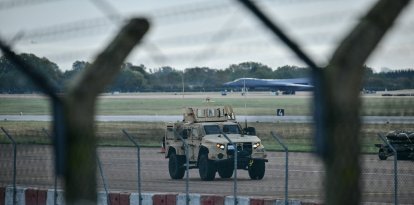
Ukrainian drone operators defeated a contingent of the U.S. Army during the Combined Resolve exercise, held between April and May in Hohenfels, Germany.
According to an exclusive report by The Wall Street Journal, some 3,500 U.S. troops, mostly from the 3rd Combat Team of the 1st Cavalry Division's Armored Brigade, were tasked with attacking a position defended by troops from the 412th Unmanned Systems Regiment of Ukraine, known as "Nemesis."
The result was clear: the Ukrainian drones located and "eliminated" the U.S. armored vehicles and troops so quickly that the units had to be reintroduced into the simulation as if they were new in order to continue the exercise. The heavy armored vehicles, which kicked up dust as they moved, proved to be easy targets for the Ukrainian reconnaissance drones, which were then followed by drones loaded with explosives and first-person view (FPV) drones capable of striking their targets directly.
The Ukrainian strike not only impacted the U.S. According to the WSJ, during similar exercises conducted last year in the Baltic region, with participation from the UK, Estonia, and other NATO members, the result was the same, with easy victories for the Ukrainian drone teams.
Eliot Cohen, a scholar at the Center for Strategic and International Studies, explained that recent battlefield experience shows that drones of all types are indispensable in modern warfare, and that the U.S. Army does not yet appear to have mastered them

World
Trump changes his stance and will not authorize Ukraine to manufacture its own Patriot missiles
Emmanuel Alejandro Rondón
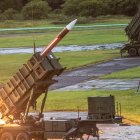
The failure in Germany is part of a broader pattern for the U.S., which has also suffered actual casualties from Iranian drone attacks since the war began in late February. The deadliest incident occurred on March 1, when an Iranian direct-attack drone struck a makeshift tactical operations center in the port of Shuaiba, Kuwait, killing six U.S. Army Reserve soldiers—the first U.S. casualties of that conflict. Air defense systems failed to intercept the drone, and the warning sirens did not go off before the strike. By July, the official tally of U.S. military personnel killed on the various fronts of that war—Kuwait, Jordan, Saudi Arabia, and Iraq, among others—had risen to at least 18, according to the Pentagon.
The combination of these two incidents—a training exercise and actual combat casualties—highlights a gap that the Pentagon has failed to close despite its investment.
In recent years, according to the WSJ, the U.S. has allocated billions of dollars to new drone and counter-drone technology and has formed specialized units to operate it. Even so, the rotating troops deployed to Germany had only standard electronic warfare and counter-drone systems at their disposal, whereas the new Mobile Brigade Combat Teams, equipped with the latest technology and tactics, achieved better results in other exercises.
These warnings, however, have been beneficial, as the Trump administration has begun to take note. Secretary of War Pete Hegseth reported to senators in May that he had increased the number of U.S. personnel sent to Ukraine to study drone warfare. In addition, the U.S. is already testing Ukrainian drones with a view to a potential purchase, and has used counter-drone systems tested on the Ukrainian front to bolster the defense of its troops in the Middle East.
Ukraine, which has been fighting Russia for nearly four and a half years, has thus become an unexpected trainer for the armed forces of its own allies—first for the United Kingdom, Estonia, and Sweden, and now for the U.S. Army itself.
LATEST