ANALYSIS
Hunger and repression: Protests in Havana's neighborhoods
Deep within Cuban communities that had gone more than 72 hours without electricity and nearly a week without water, the discussion wasn't about who was better off. The urgency lay elsewhere: preserving food, cooking, bathing, feeding the children, and enduring entire nights without power, plagued by mosquitoes, under the sweltering temperatures of the Cuban summer.
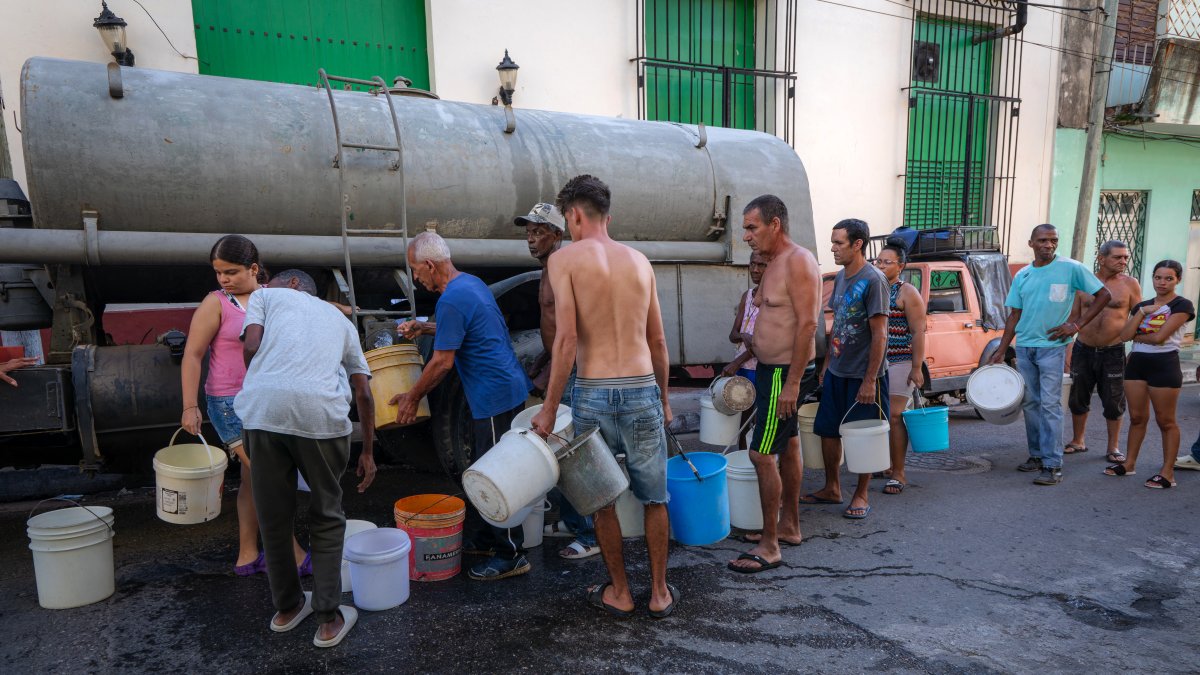
Residents of a Cuban neighborhood suffer from a lack of drinking water in their homes (File photo)
In the capital's Guanabacoa municipality in Cuba, the shortage of electricity, water, and food has undergone a sort of metamorphosis, evolving from a simple abstract phenomenon in the urban landscape into specific names and coordinates. This is where inner-city neighborhoods such as La Hata, El Naranjo, and El Roble come into play, settlements marked by extreme marginalization within the context of Havana, which do not appear in tourist brochures and have recently become one of the most telling indicators of a crisis that government rhetoric insists on downplaying.
Nighttime protests accompanied by selective repression and coldly calculated intimidation have brought popular resilience into direct conflict with the inefficiency of public services, state neglect, and institutional repression. One need not be a social science scholar to conclude that the anatomy of inequality in Guanabacoa is evident in the urban landscape itself. In these very same blocks, families relocated from makeshift shelters and tin shacks live in the shadow of better-equipped military buildings.
The contrast is more stark than meets the eye: the cracked concrete of working-class sidewalks, riddled with potholes and debris, stands in stark contrast to the gleaming tiles and well-manicured gardens of the military officers' homes. However, even that inequality is insufficient to explain the source of the discontent.
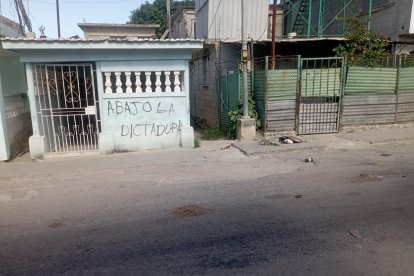
Image of anti-regime graffiti in Cuba (Courtesy of the Food Monitor Program)
Deep within communities that had gone more than 72 hours without electricity and nearly a week without water, the discussion did not revolve around who lived better. The urgency lay elsewhere: preserving food, cooking, bathing, feeding the children, and enduring entire nights without power, plagued by mosquitoes and sweltering Cuban summer temperatures. After weeks of complaints, phone calls, and broken promises, protest emerged as the last resort available to those who had exhausted all other options.
One of the witnesses recalls the moment when tension began to spread:
Right in front of us, a motorcycle pulled up next to a patrol car and told the driver that there were "people lying" in the street at the Parque de los Judíos. They immediately turned around and drove off. The police officer, a mixed-race man, didn't even roll down the window all the way; he made a gesture with his hand and sped off. Behind us, an old man shouted, "Snitch! That's what you are, you piece of shit!" The patrol car slammed on the brakes. I thought they were going to pick us up. But they didn't get out. They knew they couldn't take half the neighborhood with them.

A few days earlier, the mounting tension had sparked yet another of the now all-too-common pot-banging protests in the La Hata neighborhood. These protests no longer just lead residents to bang their pots in protest from their homes, but have expanded to gathering points involving several families and, in the most significant cases, spanning several blocks.
The discontent is palpable; as you walk, you hear comments of disgust being voiced openly, and it seems as though a fight could break out again at any moment from the slightest spark. We hear complaints about the situation, but also criticism and insults directed at the authorities and law enforcement.
Street corners are also witnesses to the unrest, mainly at intersections where two blocks meet, popularly known as "cuatro esquinas," we find makeshift barricades built from trash that the authorities no longer collect—trash that residents turn into bonfires at night, gathering there to pass the blackout "badmouthing the government and waiting for the Americans to come," as a young girl from the neighborhood recounts.
And on some houses, one can also see anti-government graffiti that in the past would have been removed immediately but today remains until a large enough crowd gathers in support, or until the graffiti appears on the busiest streets.
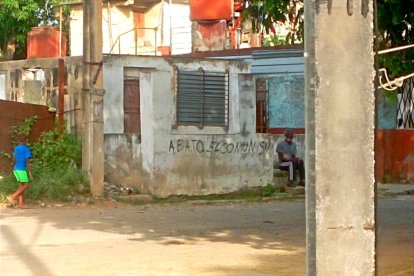
Houses painted with anti-regime graffiti in Cuba (Image courtesy of the Food Monitor Program)
According to residents, the police strategy consisted of containing the protest at the neighborhood's entrances and waiting for dawn to disperse the demonstrators. Then another phase began—one that would be quieter yet proportionally just as ruthless as in the worst totalitarian regimes.
A neighbor, who asked to remain anonymous for fear of reprisals, described what happened as follows:
"The police stayed on the outskirts of La Central de la Hata because people were fired up. It was pitch black; you couldn't see anyone. But the next day, they went house to house. I heard that they went to about twenty homes, breaking in to look for people. That's because there were snitches among us."
The lists, the searches, and the fear
Then began the lists, the searches, and the fear. The home searches, subsequent identity checks, and police visits demonstrated once again how community surveillance continues to be one of the main instruments of social control.
The darkness that protected those who went out to protest ceased to serve its purpose at dawn because of the repressive apparatus and neighbors who, like them, suffer from the blackouts and their problems but choose to side with the repressors for various reasons: political favors, a promotion at work, payments in kind, or perhaps the perverse and all-too-human pleasure for which a segment of the Cuban people is so often accused—the desire to "gouge out one's own eye to blind you."
This is how selective repression worked in this area of Havana where, according to several residents, rapid-response brigades were infiltrated in plain clothes to record with cell phones who was participating in the protests and who was not. A perverse deterrent aimed at pacifying Cubans, but hunger, thirst, and blackouts have one characteristic that is uncomfortable for any state control apparatus: they always return.
World
The window is closing: The CIA creates a secret unit to step up pressure on the Castro leadership
Andrés Ignacio Henríquez
What happened in these Havana neighborhoods goes beyond a single night of protest. It exposes the erosion of a model that for years based its legitimacy on the promise to protect the most vulnerable sectors and that, contrary to that promise, now responds with surveillance where it once promised well-being. Today, as far-fetched as it may seem, demanding water or electricity in Cuba is met first by police patrols rather than solutions, and the message Cubans are receiving is hard to ignore. They are prisoners of a state that focuses solely on managing popular discontent and NOT on resolving the causes that produce it.
A witness recounts that, in the wake of the pot-banging protests and clashes in the streets of Guanabacoa, it has become common to see convoys made up of patrol cars, motorcycles, and vehicles loaded with thugs ready to suppress any attempt at a demonstration. And that is a problem that has little to do with the blockade, foreign policies, or economic decisions. In the long run, no system can indefinitely sustain the idea of equality while everyday reality demonstrates, street by street, who deserves protection, who must wait, and who ends up being monitored for demanding the bare necessities.
LATEST