Rolex watches, yachts and a private island: Fidel Castro's privileges behind the revolutionary myth
For decades, the Cuban dictator presented austerity as a revolutionary virtue and called on the people to sacrifice their individual well-being in the name of the socialist project. However, testimonies from people in his inner circle, historical photographs and even official Cuban sources paint a very different picture.
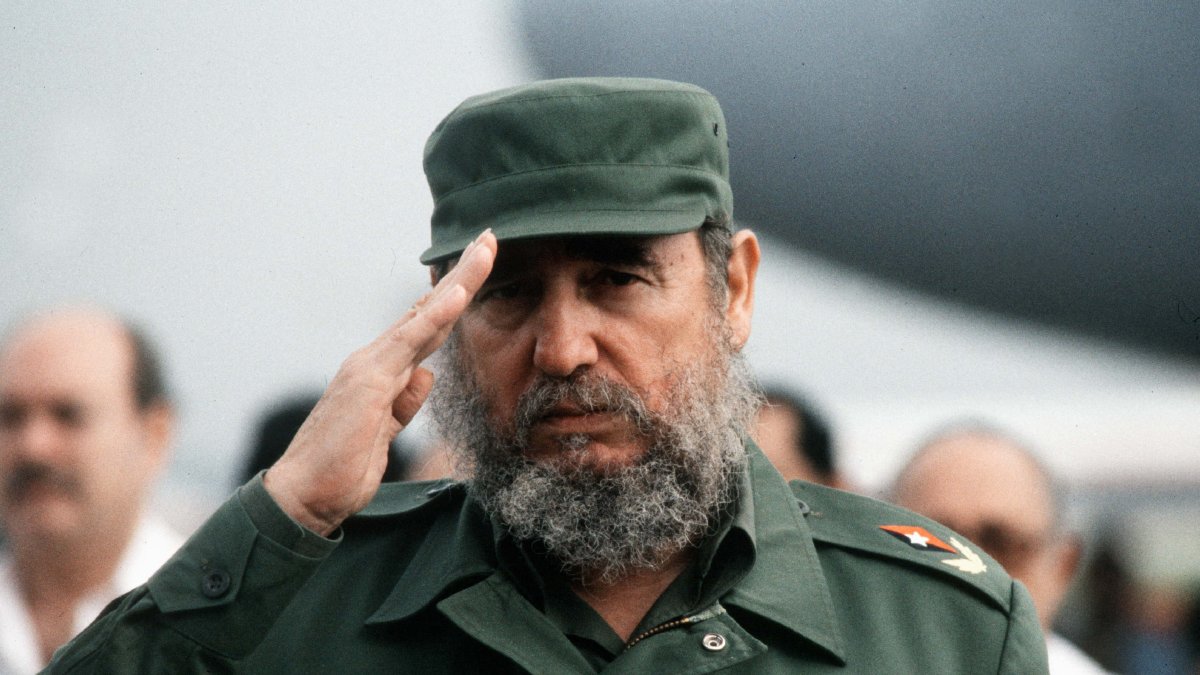
Fidel Castro, the Cuban dictator (File photo)

"There is a reason we have nothing, and there is a reason we will always be men who have nothing."
Fidel Castro uttered those words on Jan. 8, 1959, just one week after the triumph of the Cuban Revolution. That day, he also asserted that the new leaders had not fought to "live like a king," to have "a mansion," or to enjoy "the perks of power." The speech, preserved to this day by the pro-government newspaper Granma, promised that power would be understood as "a sacrifice" and that revolutionaries would renounce privileges.
The decades that followed raised a much more uncomfortable question: Did Fidel Castro truly live by that principle?
The available evidence compels us, at the very least, to question it.
Behind the public image of the commander dressed in olive green lay a world to which very few Cubans had access: exclusive properties, boats, cars, specially selected foods, cigars originally intended for his personal consumption and vacations far from the public eye.
Not all the details can be substantiated with financial records, and some of the most extraordinary revelations come from former members of his security circle. But many of them coincide with photographs, subsequent testimonies and even information from official Cuban agencies and companies.
And the contrast is particularly stark when looking at Cuba today.
The revolutionary with the Rolex
One of the most visible contradictions was literally on his wrist.
Numerous historical photographs show Fidel Castro wearing Rolex watches, especially sports models such as the GMT-Master and the Submariner. Specialized research on watchmaking has even identified photographs in which Castro appears wearing these models during the early years of the revolution.
It was not exactly a proletarian accessory.
Rolex was already an internationally renowned Swiss brand at the time, and its sports models were associated with pilots, explorers, divers and consumers with high purchasing power.
There are even more striking images in which Castro is seen wearing two watches at the same time, a habit that has fueled the interest of collectors and historians of the brand for years.
A Rolex alone does not prove personal wealth. It does, however, demonstrate something simpler: the man who turned socialist equality into a doctrine was not exactly wearing the kind of watch the average Cuban worker could afford.
Cohiba: Fidel's cigar before it became the world's cigar
Something similar happened with one of the most famous Cuban luxury products of all time.
You don't need to turn to a dissident or an exile to learn this story.
Habanos SA itself acknowledges that Cohiba was created in 1966 for Fidel Castro and that for years its cigars were intended exclusively for the president and as gifts for foreign leaders and dignitaries. It was not until 1982 that international sales began.
The Cuban company currently describes Cohiba as its most prestigious brand, crafted from a selection of the finest leaves from the Vuelta Abajo tobacco-growing regions.
Before becoming one of the international symbols of Cuban luxury, Cohiba was, quite literally, the cigar reserved for Fidel Castro and his diplomatic circle.
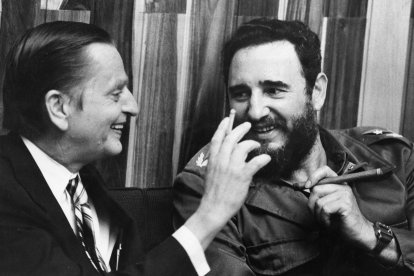
Swedish Prime Minister Olof Palme and Fidel Castro during Palme's visit to Cuba on July 2, 1975
Castro quit smoking in the 1980s, but for years the cigar was an inseparable part of his image.
Cayo Piedra: The paradise Cubans couldn't see
The most detailed revelations about Castro's private life came from Juan Reinaldo Sánchez, who was a member of his security team for 17 years.
In his book on the private life of the Cuban leader, Sánchez described a particularly significant location: Cayo Piedra, in southern Cuba.
According to his account, Castro used that enclave as a private retreat, accompanied by family members and select guests. The site reportedly included a residence, a guest house, a swimming pool, facilities for raising marine animals and areas dedicated to leisure.
The Guardian, in reporting on the former bodyguard's revelations, described the enclave as a sort of "Garden of Eden" used by Castro to relax and go spearfishing.
Sánchez stated that Castro spent many weekends and part of his vacations there, far removed from the daily routine experienced by the rest of the Cuban people.
The former bodyguard also reported that there was a maritime exclusion zone around the area and that Castro could travel from there to Havana by helicopter when his duties required it.
The significance of this episode goes far beyond whether a pool was a certain size or exactly how many facilities the key had.
For decades, revolutionary propaganda portrayed Fidel Castro as a man consumed by his work, without vacations or bourgeois pleasures.
Sánchez maintained that this image was false.
Aquarama II: Sailing through the revolution with four engines
To reach his Caribbean retreat, Castro didn't rely on just any old boat either.
Sánchez identified one of his boats as the Aquarama II, a yacht used by the leader to sail to Cayo Piedra and go on excursions.
According to the report published by The Guardian, the boat was built with wood from Angola and equipped with four engines, which were reportedly supplied by the Soviet Union.
The former bodyguard even recalled Castro sitting in a large leather chair while sailing and drinking Chivas Regal whiskey. This detail comes from Sánchez's testimony and, therefore, should be understood as such, not as an official inventory of the leader's assets.
But the Aquarama II appears repeatedly in accounts of the Cuban leader's private life.
Sánchez also stated that there were several fishing and recreational boats linked to the complex used by Castro.
While generations of Cubans were taught that individual consumption must be subordinated to collective needs, the leader of the Revolution could disappear for days to a enclave inaccessible to virtually any citizen of the island.
Properties, Mercedes and reserved spaces
Sánchez's claims go even further.
The former bodyguard claimed that Castro had at his disposal around 20 properties or facilities, including Punto Cero, his well-known residence in Havana; recreational facilities; homes in various provinces; hunting grounds; a marina; and areas related to his security and medical care.
He also spoke of a facility where several Mercedes-Benz cars were stored.
There is no public asset registry that would allow one to determine which assets legally belonged to Fidel Castro, which were registered in the name of the state, and which were simply part of the infrastructure assigned to the head of government.
But from the perspective of a citizen subject to rationing, it probably mattered less who was listed on the deed than who could actually use them.
That is precisely one of the problems that for decades plagued any attempt to calculate Castro's wealth: in a system where the state controlled hotels, companies, homes, vehicles, boats and numerous economic resources, determining where public assets ended and the leader's personal use began was extraordinarily complicated.
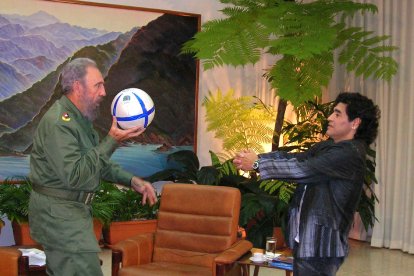
Fidel Castro welcomed Argentine soccer star Diego Armando Maradona in Cuba (Archive)
Was Fidel Castro really a multimillionaire?
In 2006, Forbes estimated Fidel Castro's fortune at about $900 million, after having calculated it at approximately $550 million the previous year. The magazine included him among the world's richest leaders.
Castro reacted furiously.
During an extensive television appearance, he denied having any bank accounts abroad and challenged Forbes to prove that he had even a single dollar deposited outside the country. He went so far as to say he would resign if the magazine could prove it.
But the debate over his bank account may distract from a reality that is much easier to document. Castro did not need to appear as the owner of a yacht, a residence, a Mercedes, or an island to enjoy them. The system was at his disposal.
Fidel called for sacrifices
The contrast with his public rhetoric could hardly be greater.
From the early months of 1959, Castro presented individual sacrifice as one of the moral pillars of the Revolution.
In March of that year, he said that Cubans would in the future reap "the best fruits of the sacrifices and labor" they were undertaking. Days later, he spoke explicitly of the "sacrifice" the government was asking of workers to conserve resources and secure foreign currency.
In September 1960, he once again praised a people capable of sacrificing "all individual interests" for a revolutionary ideal.
The word "sacrifice" would become a constant in Cuban political discourse. Sacrifice in the face of the embargo. Sacrifice in the face of economic difficulties. Sacrifice during the energy crises. Sacrifice to protect the Revolution. Sacrifice during the so-called Special Period.
But austerity was not distributed equally.
From Fidel's paradise to a Cuba of scarcities
Nearly seven decades after the triumph of the revolution and a decade after the death of Fidel Castro, Cuba is undergoing one of the deepest economic and social crises in its recent history.
The United Nations World Food Program notes that Cuba's GDP contracted by about 15% over the past six years (2020–2026) and warns of persistent inflation, fuel shortages, difficulties importing food and delays even in the distribution of the state-provided basic food basket.
Poverty figures are more difficult to determine because Cuba does not regularly publish a national poverty indicator comparable to those of many other countries.
An independent assessment by the Cuban Human Rights Observatory, conducted between June and July 2025 through 1,344 interviews in 70 municipalities, estimated that 89% of respondents lived below its definition of extreme poverty.
But even setting that figure aside, the depth of the crisis is difficult to hide. Millions of people face power outages, water shortages, difficulties in buying food and deteriorating public services.
The real luxury wasn't having $900 million
Perhaps the question of whether Fidel Castro had $900 million is, in the end, the least important one.
In a capitalist country, wealth means having enough money to buy a mansion, a yacht, luxury cars, exclusive foods, or private vacations.
In the system built by Fidel Castro, there was another form of wealth: not needing to buy those things.
Meanwhile, citizens were told that renouncing consumption was a moral virtue and that individual sacrifice was essential to ensuring the Revolution's survival. That may be the most revealing legacy of Fidel Castro's luxuries, not that the existence of a massive secret bank account has been proven.
But rather that the man who claimed in 1959 that he would never live "like a king" built, from day one, a system in which he did not legally need to own a kingdom to have it at his disposal.
LATEST