Iran strikes container ship in the Strait of Hormuz with drone: Attack halts shipping and drives up oil prices
The strike on the vessel directly contradicted President Trump’s claims that Iran did not control the strait.
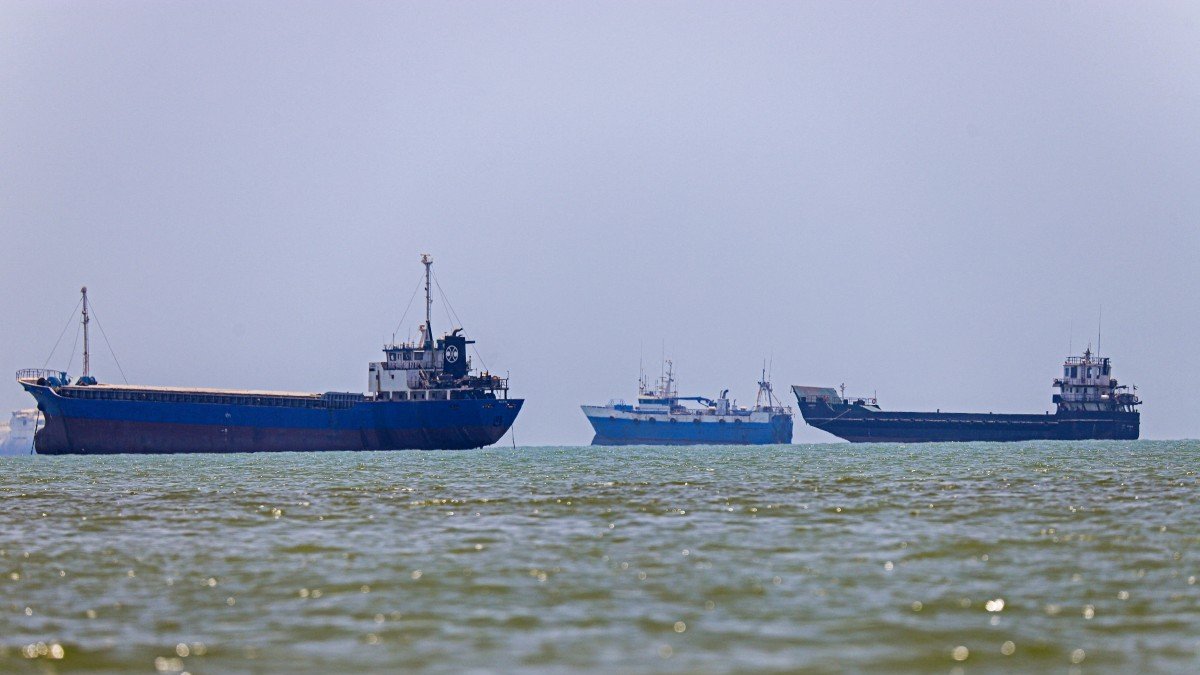
Ships anchored in Bandar Abbas along the Strait of Hormuz

Despite diplomatic efforts, tensions remain high in the Strait of Hormuz. On Thursday, Iranian armed forces attacked a container ship passing through the strait, once again paralyzing maritime traffic and directly defying President Donald Trump's statement that the strait was open to navigation and outside Iranian control.
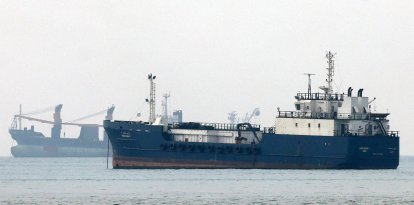
The attack was confirmed by U.S. and Iranian officials cited by The New York Times, which reported the incident alongside The Wall Street Journal, the first media outlet to break the story. According to a U.S. official who spoke to the NYT on condition of anonymity, the vessel was reportedly struck by a drone, although the exact nature of the projectile was not officially confirmed. The United Kingdom Maritime Trade Operations organization, administered by the British Royal Navy, reported that a cargo ship had been struck by an “unknown projectile” that damaged the bridge, at a location 7.5 nautical miles southeast of Dahit, in Oman.
The vessel struck is believed to be the Ever Lovely, owned by the Taiwanese shipping company Evergreen Marine, according to the Equasis database. The secretary-general of the International Maritime Organization, a United Nations agency, Arsenio Domínguez, did not identify the vessel in his statement, but he specified that it was not part of the evacuation operation the organization had planned for crew members stranded in the Persian Gulf. Following the attack, the agency suspended that plan.
The attack on the vessel directly contradicted President Trump’s claims, who maintained that Iran did not control the strait. After the news broke, the market and oil prices reacted immediately: the price of a barrel of Brent crude, the global benchmark, rose more than 2% to around $75, while West Texas Intermediate, the U.S. benchmark, also rose more than 2%, to about $72.


The attack came hours after the Iranian Revolutionary Guard had warned ships that the only authorized route was the one crossing its waters, apparently referring to vessels sailing close to the coast of Oman. In a statement released by the Iranian news agency Tasnim, which is linked to the military corps, the Revolutionary Guard Navy described that alternative route as “unacceptable and extremely dangerous” and warned that measures would be taken against those who did not comply with its instructions.
An Iranian official, who asked not to be identified, told the NYT that the decision to act was in response to Oman’s offer of an alternative route that angered Tehran and undermined its control over the passage. The Iranian regime insists that coordination with its forces is “mandatory” for any passage, a requirement it has maintained since last week’s announcement of the framework peace agreement with Washington.
The incident dealt a severe blow to the ongoing negotiations. Secretary of State Marco Rubio was in Bahrain on Thursday, the final stop on a tour that also took him to the United Arab Emirates and Kuwait, where he sought to allay the concerns of Gulf allies. Speaking before the ministers of the Gulf Cooperation Council, Rubio rejected Iran’s claim to control the waterway and defended the principle of freedom of navigation.
According to analyst Noam Raydan, a senior fellow at the Washington Institute for Near East Policy, Iran seeks to impose a navigation order on its own terms.
Traffic through the strait had surged this week after months of a near-total standstill. Nearly 70 vessels crossed the strait on Wednesday—including 29 oil tankers—marking the busiest day since March 1, according to the maritime data firm Kpler. Before the war, 130 or more ships passed through daily.
LATEST