Trump personally signed the memorandum of understanding with Iran during a dinner at Versailles: 'I didn’t want to see an economic catastrophe'
The last-minute signing rendered the main ceremony—which had been scheduled for next Friday in Geneva—obsolete.

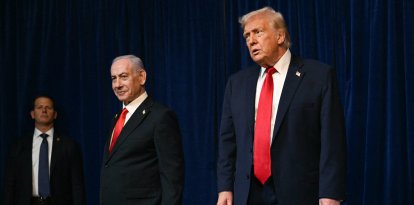
President Donald Trump gestures as he arrives at the Palace of Versailles

President Donald Trump personally signed the memorandum of understanding with Iran on Wednesday night, during a dinner hosted by French President Emmanuel Macron at the Palace of Versailles, marking an unexpected conclusion to the agreement aimed at ending the conflict between Washington and Tehran.
A White House official confirmed to Fox News that it was Secretary of State Marco Rubio who presented the document for the president’s signature, thereby formally bringing the agreement into effect. Deputy Chief of Staff Dan Scavino posted a video of the moment on the social media platform ‘X,’ in which Trump is seen signing the document to the applause of the guests. In the footage, Rubio shakes hands with Macron—who applauds and cheerfully says “Bravo”—before taking the document away.
A photograph of the agreement was sent to the Iranians and the mediating countries, according to the same official. As he was leaving the dinner, French journalists asked Trump if he had already signed it. “It's signed. We signed it in Versailles. We just signed it”, the president replied.
The impromptu signing rendered the main ceremony—which had been scheduled for next Friday in Geneva—superfluous, Reuters reported. On the Iranian side, President Masoud Pezeshkian signed the agreement, while Iranian Foreign Ministry spokesperson Esmaeil Baghaei stated that the negotiating teams will still travel to the Swiss city despite the cancellation of the formal ceremony. A source close to the negotiations, cited by the Tasnim news agency—affiliated with the Iranian Revolutionary Guard— as reported by Iran International, stated that Tehran also demanded that a Persian-language version of the text be prepared and signed, which is now recognized as official alongside the original document.
Hours earlier, during the G-7 summit in Évian-les-Bains, Trump had defended the agreement on economic grounds. The president acknowledged that the rise in the markets influenced his decision and that he did not want to go down in history as Herbert Hoover, who was in office during the 1929 stock market crash that led to the Great Depression. "He was always the one I didn’t want to be," he said of his predecessor, before admitting, "I didn’t want to see an economic catastrophe."
The peace agreement, although it had been in the works for several weeks, was finalized in a remarkable turn of events. Just last month, when asked whether the financial situation of Americans was pushing him to end the conflict, Trump had responded clearly: “Not even a little bit.” The three-month conflict drove up energy prices in the middle of an election year and cost him the support of some Republican allies and the MAGA, who accused him of abandoning his “America First” policy. However, others praised the president’s international leadership, which has yielded several military successes in recent months in the Americas, Africa, and the Middle East.

World
Vance Responds to Criticism of the Iran Deal: Promises Nuclear Inspections and the Destruction of the Highly Enriched Arsenal
Emmanuel Alejandro Rondón
The president, however, did not back down from his threats. He warned that he would attack Iran again if it fails to comply with the agreement: “If they don’t honor that, we’ll probably go back to bombing them until they honor it.”
The memorandum stipulates that Tehran must reopen the Strait of Hormuz in exchange for the United States lifting sanctions on its oil, with an initial 60-day period free of charges for commercial vessels. Iran reiterated its commitment not to seek a nuclear weapon—something it has promised repeatedly—and, if it meets U.S. demands, could gain access to financial relief that would amount to a $300,000,000 fund for postwar reconstruction. U.S. officials emphasized, according to The Wall Street Journal, that this is not a final agreement and that either party can withdraw before a full deal is reached.
LATEST