Ceuta and Europe's strategic blindness
If Europe is serious about defending its borders, it must realize that it has a Trojan horse in its midst. It is not Spain as a nation; it is Pedro Sánchez as its prime minister
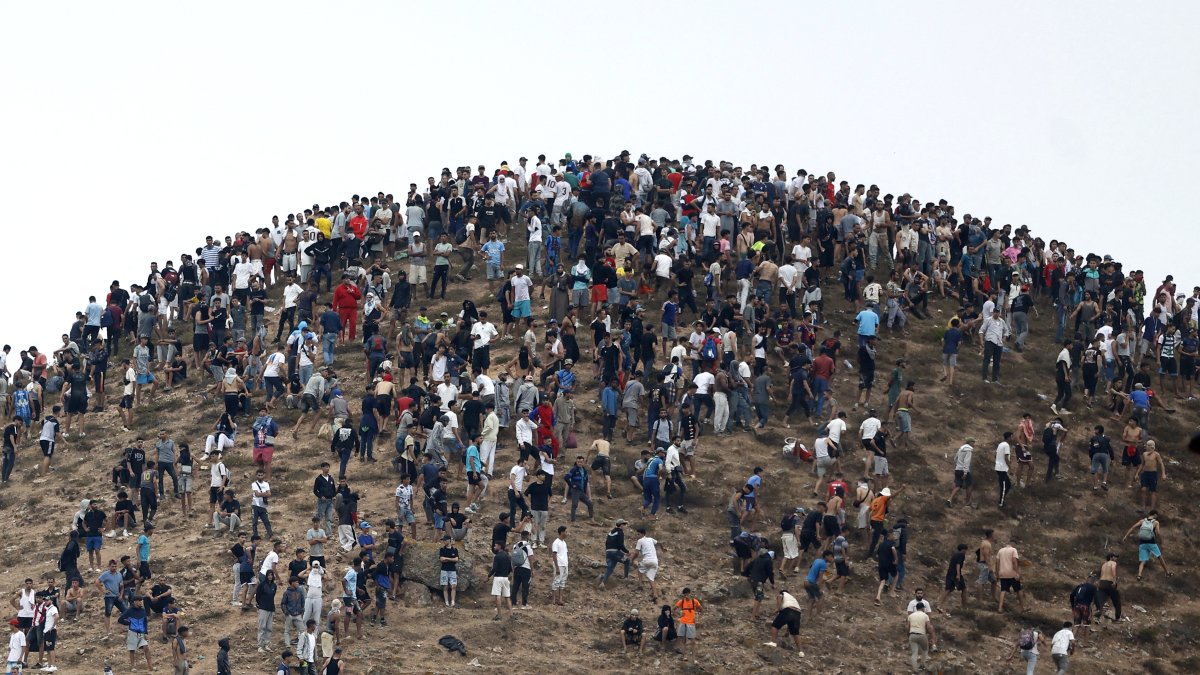
Thousands of migrants from Morocco have crossed the walls of Ceuta in the last few hours
In the current crisis in Ceuta, two issues have become intertwined, and it is important to distinguish between them if Spain and Europe want to draw the appropriate lessons to prevent a recurrence of the situation we have just experienced, with tens of thousands of people illegally making their way from Morocco onto Spanish—and therefore European—soil.
The first thing to be clear about is that this new surge is part of a long-standing Moroccan policy of pressure on Spain, in which the use of migration flows has been a constant. It was with the Green March of 1975 that Morocco occupied what had until then been Spanish Sahara; it was in 2021, in protest of the medical treatment received by the leader of the Sahrawi Polisario Front at a Spanish hospital, that—through its active border chaos—thousands of young people forcibly entered Ceuta and Melilla. Now, it has happened again now with the invasion of Ceuta—a city of barely 80,000 inhabitants—by more than 60,000 civilians from the Moroccan side of the border, under the complicit gaze of Moroccan border guards.

World
Geopolitical 'coincidences': What happens before Spain faces a migration crisis
Alejandro Baños
Therefore, this situation cannot be characterized as a migration crisis. In reality, it involves the use of civilians to achieve political, foreign policy and strategic objectives. It is yet another example of what is now called hybrid warfare—a tactic the Russians have already tested on the borders of Poland and Finland.
The fact that a large majority of those who stormed the Spanish city last Friday, July 30, have returned to Morocco makes it clear that, for the authorities in Rabat, this was merely a limited act of aggression, a sign of discontent over Spain's recent rapprochement with Morocco's big rival, Algeria, and a serious warning regarding their enormous capacity to create problems for the Spanish government, regardless of who serves as prime minister.
Therefore, the first strategic issue to be clear about regarding this act against Spain's national sovereignty is that it is a matter confined to bilateral relations between Madrid and Rabat. When Spain accommodates Morocco, migration flows are under control; when it does not, the Moroccan authorities open the floodgates at will. And in that sense, Europe need not fear a flood of immigrants as occurred in 2015 after Angela Merkel decided to open the E.U.'s doors.
The second issue that obscures the true nature of the temporary influx that Ceuta has experienced does indeed directly affect Europe, and that is the immigration policy of the current Spanish government, which is willing to regularize the status of hundreds of thousands of illegal immigrants and absolutely opposed to curbing new arrivals through stricter control of Spain's borders—which, thanks to Schengen, are also Europe's borders.
But we must also be very clear about the reason behind this open-door policy pursued by Prime Minister Pedro Sánchez. Sánchez is not in power because he won the election (something he has never achieved by an absolute majority through the popular vote), but rather because he rigged a Frankenstein-like coalition in parliament that allowed him to become Spain's leader. That coalition has become increasingly unstable over time, and today he lacks the parliamentary majority needed to pass any legislative measures. Furthermore, corruption cases within his party and among his inner family circle are putting him under legal pressure, and polls consistently show a loss of support even among his most traditional voters. That is why he needs to pull an ace out of his sleeve to hold on to power.
One tool he has in mind is the overhaul of the voter rolls. And the only way to carry this out is by bringing in new voters who are grateful to him for their naturalization and the social benefits they immediately gain access to. That is why the mass regularization of 2026—supposedly intended for half a million undocumented immigrants on Spanish soil, but which the police already estimate at over 1 million— hence the new grandchildren law that will grant passports and voting rights to another 1.5 million people who have never set foot in Spain—and he'll come up with whatever else it takes to expand his base of potential voters.

World
EU countries call for ‘urgent’ talks on migration crisis in Spanish city of Ceuta
Diane Hernández
This immigration policy does clash head-on with the new guidelines of the E.U.'s member states, and that is what should concern the E.U. Under the guise of do-goodism, solidarity with the world's dispossessed and the generosity of the wealthy, what Sánchez is hiding is his personal need and ambition to remain in power at any cost.
If Europe is serious about defending its borders, it must be aware that it has a Trojan horse in its midst. It is not Spain as a nation; it is Pedro Sánchez as its prime minister. True, it is up to the Spanish people to remove him from power, but the E.U. has mechanisms to prevent the policies of a modern-day Nero or Caligula from undermining European efforts to control its borders. And it is not merely a matter of expelling Spain from the Schengen Agreement, but, above all, of preventing the authoritarian impulses of the 21st-century left from taking root in the very heart of the E.U.—as liberal and democratic as it likes to define itself.
In any case, we cannot overlook the strategic warning posed by the recent invasion of Ceuta: the use and manipulation of the civilian population by governments to achieve objectives that have nothing to do with the well-being or security of their citizens is a reality that is here to stay. The state forces or instruments that must be established or strengthened to first deter and then fight to protect is a question that must be answered urgently.
And let's not be naive: Today, border chaos is the result of a left-wing ideology that views immigration—especially Muslim immigration—as the new proletariat with which to destroy our traditional way of life, our values and our well-being
But the European right has been complicit—out of its own self-interest—in the availability of cheap labor and its ideological capitulation to the left, whether social-democratic or radical. Europe needs to secure its borders, but it also needs Europeans to reclaim their national pride and their identity—and to recognize that being anti-racist and being a multiculturalist are two very different things. No civilization survives by accepting multiculturalism.
And what applies to Europe is equally valid for America. J.D. Vance was right in his now-famous speech at the Munich Security Conference last year when he warned of the E.U.'s authoritarian and anti-Western drift. And President Trump is right not only in denouncing the risk of uncontrolled immigration and the virtue of having policies and resources that secure national borders, but, above all, in his recent proposal to establish an Alliance for the Defense of Western Civilization. It is not NATO or the North Atlantic that is at stake. It is our entire Judeo-Christian civilization. Whether we like it or not.
LATEST