Spain declares Ceuta crisis under control following arrival of thousands of migrants, announces marine barrier
The Spanish government says that more than 48,000 people have already returned to Morocco and that no new arrivals were recorded overnight. The barrier installed at Tarajal will be nearly a third of a mile long, though it will extend only 3 feet underwater.
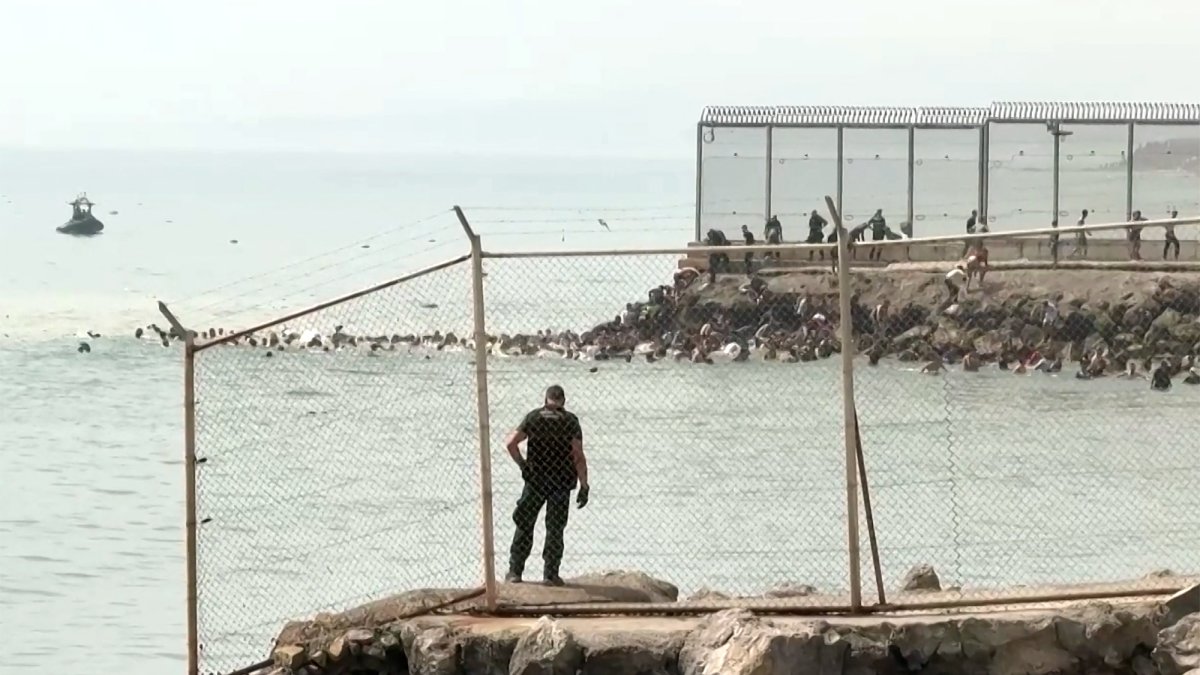
Image of migrants in Ceuta

The left-wing government of Pedro Sánchez declared the migration crisis in Ceuta virtually over on Saturday after asserting that irregular crossings "have ceased entirely."
The announcement comes after an unprecedented influx that allowed the arrival of more than 50,000 migrants from Morocco in just 24 hours and exposed serious failures in the surveillance and preparedness of the Spanish border.
The government itself acknowledged that it did not foresee the magnitude of the crisis, even though security forces had previously detected an increase in entry attempts.

A 0.3-mile barrier on the Tarajal breakwater
As part of the measures adopted to reinforce the border perimeter, Madrid announced that an inflatable barrier would be installed on the Tarajal breakwater.
Work began at 7:50 a.m. and involves the deployment of a structure nearly a third of a mile long.
The barrier protrudes between 1-2.3 feet above the water's surface and has a submerged section that extends up to 3 feet deep.
The barrier will be accompanied by a line of anchored buoys provided by the Spanish Navy. A channel will be maintained between the two elements to allow Civil Guard vessels to conduct surveillance and protect the installation.
The government maintains that the system will strengthen maritime control around Tarajal, one of the areas used during the mass influx.

World
Geopolitical 'coincidences': What happens before Spain faces a migration crisis
Alejandro Baños
Spanish government states that more than 48,000 migrants returned to Morocco
According to the report released by Spanish authorities, there were no new crossings during the night from Friday to Saturday, while returns to Morocco continued "without any notable incidents."
Of the thousands of people who crossed into Ceuta irregularly, more than 48,000 have reportedly already returned to Moroccan territory in less than 48 hours, according to official figures released on Saturday.
The government also stated that none of the people who entered irregularly managed to travel from Ceuta to the Spanish mainland.
"They would not have been able to do so," Spanish government sources stated, citing the existence of a "double border filter": one at the border with Morocco and another at the ports and airports connecting the autonomous cities in Africa with the rest of Spain.
Authorities noted that passengers traveling from Ceuta or Melilla must present identification to the National Police and that shipping and airline companies are required to verify their documentation.
Is the Schengen area protected?
Citing this argument, the Spanish government assured that "the integrity of the Schengen area is fully guaranteed," amid strong reactions sparked by the crisis among several European Union governments.
Italy temporarily suspended its Schengen cooperation with Spain, while other European countries announced or considered additional controls amid fears of migrants making it to the European mainland.

Government rejects linking crisis to regularization process
The Spanish government also denied that the influx is related to the extraordinary regularization process it had recently promoted.
According to the government, individuals wishing to apply for the program must prove that they were residing in Spain before Jan. 1, 2026, and that they had remained in the country for at least five consecutive months prior to submitting their application.
Although Moncloa presents the situation as under control, the arrival of more than 50,000 people in a single day raises questions about the government's ability to anticipate new crises, the effectiveness of a submerged barrier that is barely 3 feet deep and the extent of Spain's dependence on Morocco's cooperation on migration.
LATEST