Agreement with Iran: Squaring the circle?
Is it possible to take a less dramatically pessimistic view of this initial agreement? I believe so, if it’s viewed as a starting point rather than a final destination. The media and the usual experts are treating it as the final agreement, but it isn’t.
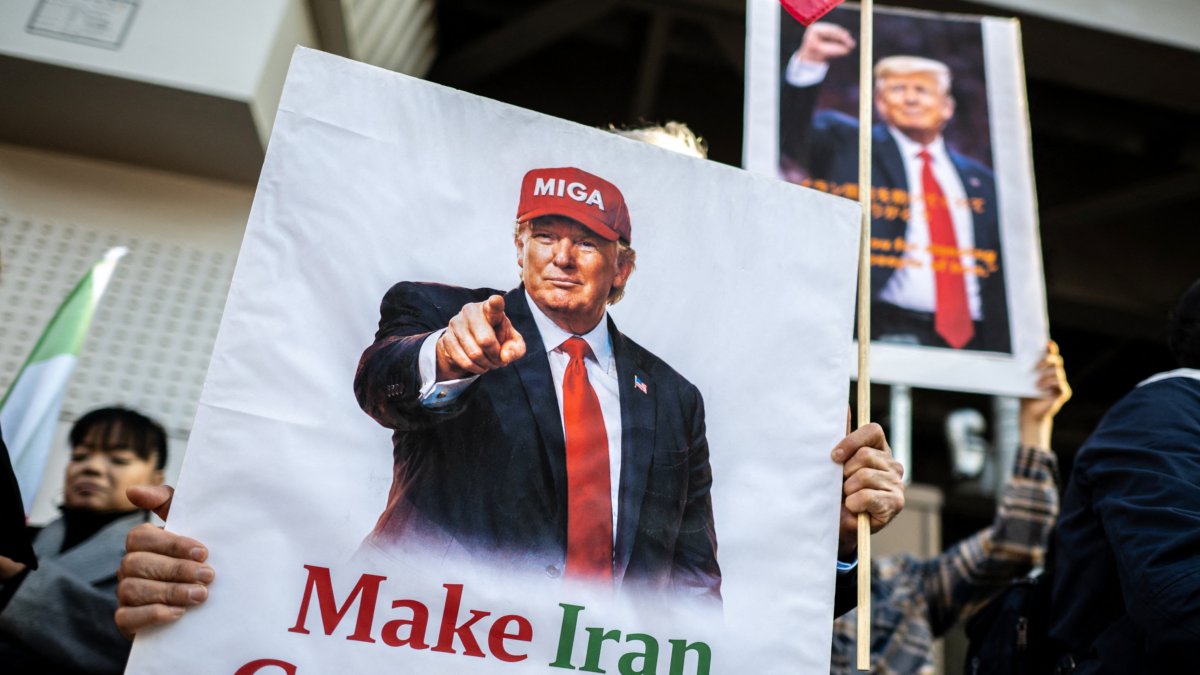
Poster featuring Trump and the slogan “Make Iran Great Again”
If nothing changes by then, this Friday, June 19, the United States and Iran will sign a framework agreement that will pave the way toward a peace agreement that will definitively and formally end the ongoing conflict that began in 2025 with the so-called Twelve-Day War and continued in a second round last February with Operation Epic Fury, culminating on April 7 in a ceasefire and the blockade of the Strait of Hormuz. Since then, amid numerous skirmishes, limited attacks and counterattacks by both sides, an agreement has been negotiated indirectly to end the conflict—which, let us not forget, was begun to put an end to Iran’s military nuclear program.
The announcement of this preliminary agreement by Donald Trump on the very day before his 80th birthday sparked all kinds of reactions. The most negative and critical voices argue that American negotiators have made excessive concessions, that the real winner of this round of talks is the new Revolutionary Guard Corps regime in Iran, and that the big loser is Israel.
It must be said that, so far, the Memorandum of Understanding (MoU) remains secret, so what is known about it comes from leaks, which, as is usually the case, serve particular interests and agendas that we are unaware of. Therefore, until the actual terms are known, the most we can do is speculate. With that caveat in mind, I would like to offer some basic observations before praising or condemning Donald Trump’s skills—or lack thereof.
First, we must remember that this conflict has deeply divided the U.S. president’s inner circle.
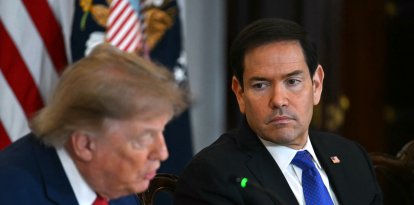
On one side were those who opposed any military action in a region they do not consider strategically important enough to override their vision of what “America First” means politically. Everyone points to Vice President Vance as one of the leaders of this faction. His silence throughout the conflict has been interpreted more as passive resistance than as support for Trump himself, and his current role in the negotiations is bringing him back into the spotlight against his main rival, Secretary of State Marco Rubio. Opposing them is a second group, favorable to going all the way, either through increased financial pressure or through new military action, in order to bring the new Iranian leadership to its knees and force a clear capitulation, just as Trump himself demanded on social media at the start of hostilities.
In other words, this war has generated two types of impatience: the first called for doing whatever was necessary to open the Strait of Hormuz; the second, to set a time limit on the negotiations and, if a satisfactory agreement were not reached, to resume offensive military actions until Tehran’s final defeat. If this were to bring about regime change, so much the better.
It should be added that these two forms of impatience have not been limited to the power brokers in Washington, but also reflect the diverse perspectives and interests of other international actors, ranging from China and Southeast Asia—which have been severely affected by the oil chokehold at Hormuz—to Europe, which is under inflationary pressure due to its energy shortages, or Israel, motivated to try to exploit the situation to put an end to the array of threats coming from Iran—beyond the nuclear threat—primarily through Iranian proxies on its borders, particularly Lebanese group Hezbollah.
In the midst of this maelstrom is President Trump, who has had to try to appease all sides—from his MAGA base to his allies—sometimes in contradictory or incomprehensible ways. This is even more baffling if one does not keep in mind all the groups involved with their own conflicting interests.
Finally, in these preliminary considerations, one must not overlook the political agenda behind many of the comments being made these days, whose sole objective has little to do with Iran, but rather with the attempts to politically destroy both Donald Trump and Benjamin Netanyahu, the two devils of the international left and of all the enemies of the civilized world.
Having said all this: Is this MoU that is about to be signed the apocalypse that many are claiming, or the beginning of the “Big Beautiful Deal” that Trump wanted?
Those who condemn this Memorandum of Understanding and warn of the victory it represents for Tehran tend to believe that the new Iranian regime emerges politically, militarily and strategically strengthened, that it maintains its ability to open and close the Strait of Hormuz at will, and, even worse, that it has not wavered in its determination to accelerate its nuclear program… in part thanks to the money that will be given to Iran to aid in its reconstruction.
I’m not sure that analysis is the most realistic. For starters, even if we accept that nuclear ambitions and aspirations for regional hegemony remain alive among Iran’s current leaders, their capabilities to realize them may not live up to their expectations, neither now nor for a long time to come. Despite its narrative of victory, the Iranian regime has suffered enormously in this new war—the most intense in terms of airstrikes and targets bombed of any recent conflict. In the first 100 hours of the war, more than 4,000 targets were struck. In total, Israel carried out nearly 11,000 strikes, dropping 10,800 bombs on 4,000 targets. The U.S. carried out some 13,000 strikes. Missile facilities, missile component factories, drone manufacturing plants and warehouses, as well as radar systems and air defense components, have been damaged or destroyed. Added to this is the complete disablement of the uranium enrichment facilities achieved last year. To think that Iran is militarily stronger today is pure fantasy. It is impossible for it to rebuild its nuclear program in the short term or to manufacture missiles in numbers that would be truly intolerable for Israel.
A little over a year ago, Iran was capable of producing nearly 3,000 missiles a year. If it were to reach a few dozen today, that would be a tremendous achievement.
Second, the new Iranian regime is often portrayed as a consolidated and coherent entity, but that is far from the truth. Its highest-ranking and most experienced leadership has been decimated. The new supreme leader still has not appeared in public (something vital to his legitimacy) and may not be playing any role at all; the visible leaders clearly represent conflicting interests that must be painstakingly negotiated. Moreover, control over internal repression does not appear as monolithic as it is portrayed. Recruitment for security forces is scarce, and the regime’s need to rely on elements with no ties to the civilian population and on foreign militias casts doubt on its actual domestic power. True, there have been no large demonstrations like the ones we saw a few months ago (which were brutally suppressed), but as a general rule, it can be said that an internal revolution does not occur in the midst of a war—while bombs are falling on the country—but rather when the peacetime government is unable to provide solutions to postwar problems. And in Iran, there are many such problems.
Added to these domestic problems is the lukewarm response from Iran’s supposed allies, Russia and China, who are either incapable of or have no interest in contributing financially to Iran’s military reconstruction. Not to mention the state of Tehran’s regional pawns: the Houthis, now greatly weakened; militias in Iraq that are becoming more Iraq-centric and less at Iran's service; Hamas on the verge of being completely destroyed; and the crown jewel, Hezbollah, which is progressively being marginalized within Lebanon and seeing its military potential diminished. Iran has been left without a patronage network with which to threaten its neighbors. Hence the shift in the strategic equation we are witnessing: instead of mobilizing Hezbollah to defend its interests, Iran must commit to directly attacking Israel to save Hezbollah.
In any case, Lebanon is the most critical point in all that is being said about the MoU and the future peace agreement between the United States and Iran. For now, it appears that Tehran has managed to get Trump to effectively accept the link between the agreement and a ceasefire between Israel and its northern neighbor, even though Israel is not at war with Iran, but rather with the terrorist group Hezbollah, which has not been involved in the talks between the U.S. and its patron. It is true that various officials in the U.S. administration, starting with the secretary of state, have denied that there is any link between the MoU and the cessation of Israeli military action. However, Trump himself has expressed dissatisfaction with these talks, going so far as to suggest that Syria should deal with Hezbollah, given that Damascus has a keen interest in eliminating the group that fought so hard to save Assad.
Amid this confusion—whether deliberate or not on the American side—there is one indisputable fact: Israel is heading toward new legislative elections, where Netanyahu’s future is once again at stake. Portraying him as a docile figure who has had to bow to Trump’s orders is a natural tactic for an opposition that has so far failed to unseat him in any way, whether politically or legally.
The belief that “Bibi” will not act against Israel’s enemies if the need arises—out of a desire not to confront the American president—has no basis whatsoever in his past behavior.
That being the case, is it possible to take a view of this initial agreement that isn’t dramatically pessimistic? I believe so, if it is viewed as a starting point rather than a destination. The media and the usual experts are treating it as the final agreement, but it isn’t. It is simply the first chapter in a long series. What has been done is to define the playing field—not who will sit down to play. And the next step will be to start moving the pieces.
My prediction here is that the 60-day deadline will be extended repeatedly, and that, in all likelihood, we’ll find ourselves in the fall (midterms in the United States, legislative elections in Israel) before we’re in a position to have clarified issues, bridged differences and reached an agreement. Or quite the opposite: a breakdown in talks and a return to the threat of a new open conflict. Nothing can be ruled out at this point.
Trump has achieved something that seemed impossible: giving everyone something for their immediate satisfaction. But he has also achieved the unthinkable: refusing to back down from his opposition to Iran’s nuclear program. If Iranian leaders believe they can push him to a point where he accepts uranium enrichment and the potential to acquire a bomb many years down the line, I think they are mistaken. Trump has stood firm on this issue for many years.
It is true that those who saw regime change in Iran as within reach—the very same people who rightly argue that the problem lies not only in Iran’s capabilities but also in its ambitions—will feel frustrated.
But it would be naive to think that those with even the slightest ability to indirectly influence the country’s future will not do so. If Iran does not have an atomic bomb today, it is not for lack of means, but because successive covert actions have prevented it year after year. The future of a weakened regime, mired in internal conflict, unable to meet the basic needs of its population, etc., may be affected by actions that go beyond the military sphere.
In any case, and looking ahead to a round of negotiations set to formally begin this Friday—about which we know almost nothing—what will matter is not the words spoken by one side or the other, but the actions taken. And for me, the U.S. military deployment in the region will serve as a good barometer of the agreement’s health.
Warning of possible strategic errors when negotiating with Iran is justified. Crying foul over what is said to be a capitulation by Trump strikes me as premature and unfair. It plays right into the hands of the defeatists among us, the image that the leaders of the Revolutionary Guard Corps want to project—that they are the victors—and all those who prefer to see Trump humiliated rather than as a winner. Not to mention Netanyahu.
The time for justice has yet to come.
LATEST