ANALYSIS
France: Marine Le Pen's RN celebrates 'historic breakthrough' in local elections, while radical left is deflated
Le Pen personally congratulated her party's candidates: "Bravo to all our candidates, whatever the result in each municipality: you can be proud of the work done, and tonight dozens of R.N. mayors and thousands of R.N. municipal councilors have been elected."

Jordan Bardella next to Marine Le Pen

Marine Le Pen and Jordan Bardella's Rassemblement National (R.N.) party proclaimed on Sunday a "historic breakthrough" after the runoff local elections in France.
Jordan Bardella, president of the R.N., stated bluntly, "Never before have the R.N. and its allies held so many elected offices throughout France. In dozens of municipalities. We are asked to show what we are worth." For the young leader, Sunday's results represent "the biggest breakthrough in the entire history" of the party and "a turning point" against the establishment. "These successes are not an end, but a beginning," he added.
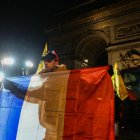
The party scored victories in at least 50 municipalities, solidifying its presence in regions such as Alsace, Carcassonne, Montargis, Orange, the Pyrenees and Pas-de-Calais. They highlighted symbolic victories such as La Flèche (Sarthe), a Socialist stronghold for nearly four decades, and Nice, France's fifth-largest city, where Éric Ciotti, an R.N. ally, was victorious. The party also won in Montauban with Didier Lallemand.
Marine Le Pen personally congratulated her party's candidates on X: "Bravo to all our candidates, whatever the result in each municipality: you can be proud of the work done, and tonight dozens of R.N. mayors and thousands of R.N. municipal councilors have been elected."
While the R.N. celebrates, the traditional establishment is suffering an evident setback. Candidates aligned with Macron and from Les Republicans, such as Rachida Dati and François Bayrou (the former prime minister recently expelled from the government), were defeated.
The left fractured
The local elections deepened the already existing fracture on the left, especially now that the Socialists and the radical left party La France Insoumise (LFI), led by Jean-Luc Mélenchon, are jockeying for position to lead a unitary candidacy in the run-up to 2027.
Despite the electoral success of 2024 in a united front together with the Green and Communist Parties, both contested the municipalities separately and, in most cities where they united such as Toulouse or Limoges, they lost.
World
France is sending 10 warships to the Middle East in an 'unprecedented' mobilization
Emmanuel Alejandro Rondón
Socialist candidates who aligned with LFI also lost in cities such as Clermont-Ferrand and Brest, while those who rejected the alliance prevailed in Marseille and Paris.
Socialist Party Secretary General Pierre Jouvet summed up the fiasco in a statement to France 2: "My conclusion tonight is that LFI wins nothing, and the worst thing is that LFI provokes defeat." Former Socialist President François Hollande was even harsher, calling the alliances with LFI a "cul-de-sac" ("dead end") and called for "a time of clarification."
"The left has been toxic to itself in this campaign," asserted Green leader Marine Tondelier, whose party lost many cities won in 2020 during the "green wave," although it managed to keep Lyon.
No consensus on the left heading to 2027
Like Tondelier, Socialist leader Olivier Faure advocates an alliance of left-wing forces for 2027. However, leading figures in his own party are opposed and stress that they managed to win in Paris and Marseille without LFI.
Gatestone Institute
Welcome to the 'EUSSR': Unpopular European Regimes Grasping for Power Crack Down on Dissent
Robert Williams
Within LFI, no one questions that Mélenchon will again be their presidential candidate, after coming third in 2022. However, since then, his constant controversies have been damaging his image in France.
"The left cannot split in the first round if it wants to reach the ballot next year. But who can be the candidate? If it's Mélenchon, they will probably lose," notes Éric Maurice, of the European Policy Centre think tank.
After local elections, Bardella soars and political landscape is fragmented
Constitutionally barred from seeking a third term, Macron leaves the parties immersed in working out their strategies for a year from now. According to a Toluna Harris Interactive poll published Sunday, Jordan Bardella would lead in the first round with between 35% and 36% of the vote.
Macron's arrival at the Elysée in 2017 broke the traditional bipartisanship between the moderate left and the right. The rise of sovereigntist Marine Le Pen and radical leftist Jean-Luc Mélenchon further transformed the political map.
LATEST