ANALYSIS
The hidden infrastructure of surveillance: How Chinese technology boosts Iran's repression machine
China has become one of Iran's most influential strategic partners in technology and security, which, according to human rights organizations, has helped strengthen the Iranian regime's ability to monitor, censor and repress its population.
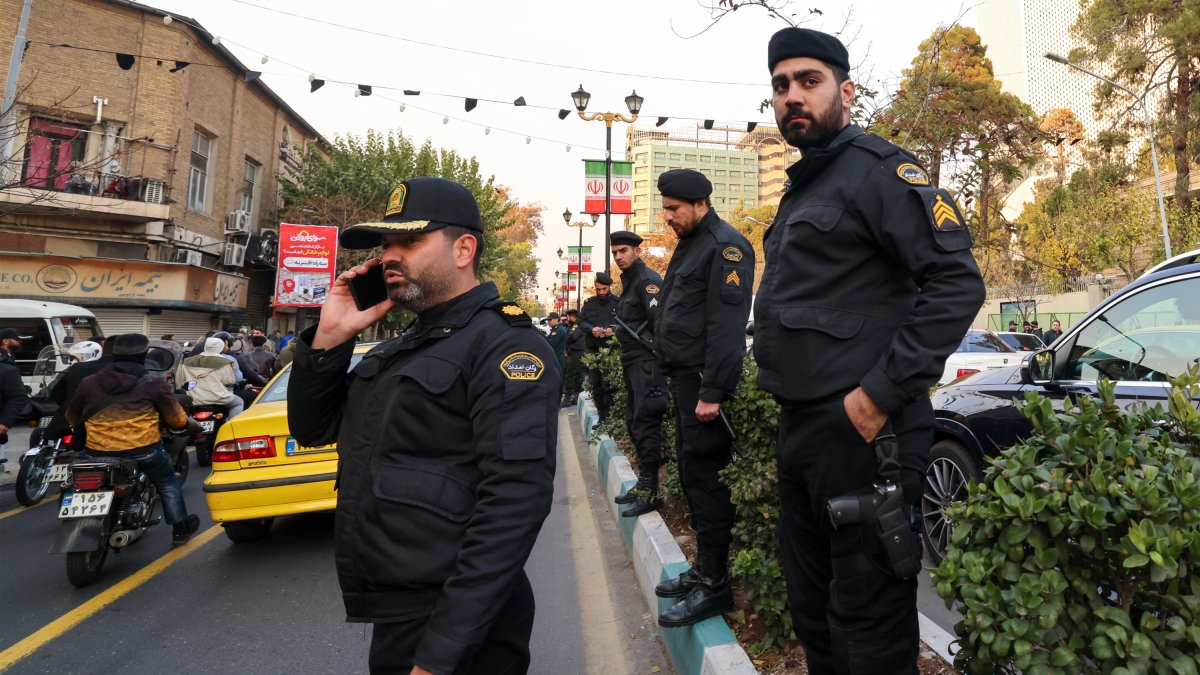
Iranian police-File Image.

The strategic alliance between China and Iran has become one of the most influential and controversial geopolitical axes of the last decade. At a time when Tehran faces international sanctions, diplomatic isolation and mounting domestic pressure, Beijing has emerged as its main economic and technological mainstay.
According to a recent analysis published by Politico, based on data from market intelligence firm Kpler, in 2025 the Iranian regime solidified its position as China's second-largest oil supplier, behind only Saudi Arabia, exporting 520 million barrels directly.
In exchange for the steady flow of discounted Iranian oil, China committed in 2021 to investing some $400 billion in Iran over 25 years, including in sectors such as telecommunications as well as information and communication technology.
From cheap oil to total control: The surveillance network that links China and Iran
China has become one of Iran's most influential strategic partners in technology and security, which, according to human rights organizations, has contributed to strengthening the Iranian regime's capacity to surveil, censor and repress its population.
The report, "Tightening the Net: China's Infrastructure of Oppression in Iran," recently published by the London‑based international human rights NGO Article 19, claims that the brutal crackdown on recent protests in Iran, in which there were at least 30,000 dead and more than 53,000 arrests, was largely made possible by the use of Chinese-origin technological tools, which allowed the Iranian regime to identify protesters, block communications and coordinate security operations with unprecedented efficiency.
"Emulating China’s infrastructure of oppression helps Iran entrench power, sidestepping accountability and exercising full control over the information environment," warns Mo Hoseini, Article 19's head of resilience. "That way, dissent is not just silenced, it is prevented from ever surfacing."
The study documents that, over the past decade, cooperation between the two countries has intensified in the area of digital control. It also explains that Chinese telecommunications companies have supplied Iran with surveillance equipment, facial recognition systems, deep packet inspection (DPI) technologies and mass monitoring platforms.

World
Trump temporarily lifts sanctions on Russian oil to ease the flow of crude amid war with Iran
Emmanuel Alejandro Rondón
According to The Times, the most striking image of the January protests against the Iranian regime was "a video clip of a black-clad protester shuffling precariously along a thin girder over a city highway" on a mission to disable a traffic camera "enabled by Chinese tech to feed facial recognition data back to a Tehran control centre."
The British newspaper points out that, thanks to Chinese technology, "the kit links to national ID databases, tracks movement patterns and can predict behaviour patterns in real time."
A system that legitimizes censorship and state control
For more than a decade, China has assisted the Iranian regime in building its National Information Network (known in Persian as Shoma), a controlled intranet system designed to isolate the country's internet from the rest of the world, filter content, monitor communications and execute mass disconnection.
"From Chinese companies embedded inside Iran’s infrastructure, to Iran’s support for China’s ‘cyber sovereignty’ principles based on censorship and surveillance, both countries align in their ambition," explains Michael Caster, director of Article 19's Global China Programme. This ambition, he says, is "to disconnect their populations from the open, global internet."

JNS
Iranian-linked hacker group targets Michigan-based technology company
JNS (Jewish News Syndicate)
China's involvement in Shoma's development began in the early 2010s, when companies such as Huawei, ZTE, Tiandy and Hikvision participated in the modernization of the Iranian telecommunications infrastructure.
This technological cooperation was complemented by a 2014 meeting between Chinese and Iranian state officials in which it was agreed that China would assist Iran in the implementation of Iran's National Information Network.

Although the network is the Iranian state's own project, the first technical phases, especially in surveillance, filtering and traffic control, relied on technology and expertise sourced from the aforementioned Chinese companies, according to the Article 19 report.
The invisible network of technological cooperation that shielded censorship in Iran
The study documents how technology transfer from Chinese companies has fueled the "infrastructure of oppression" for more than a decade that allows Tehran to filter content, block internet access and surveil its population on an unprecedented scale.
In December 2010, Chinese company ZTE signed a contract with the Telecommunications Company of Iran (TCI) to "provided tools to monitor voice calls, SMS, email, chat ... internet traffic, including through Deep Packet Inspection (DPI) technology." This technology, widely used in China to control the flow of information, became a key part of the Iranian censorship and monitoring system.
World
US loses military aircraft in Iraq during an operation against Iranian-linked assets
Sabrina Martin
Huawei followed a similar path. Around the same time, the company offered its own DPI technology to MobinNet, then the only national wireless broadband provider in Iran. According to Reuters documents cited by Article 19, the alliance allowed Huawei to provide support for "special requirements from security agencies to monitor in real time the communication traffic between subscribers."
According to the NGO, although public data does not allow verification of whether the partnership came to fruition, sources familiar with the matter claim that the company began using Huawei's DPI tools when it started operations.
The cooperation was not limited to ground surveillance. Article 19 notes that in 2015, China signed a memorandum to begin exporting its Beidou satellite navigation system to Iran. A decade later, in 2025, Iranian authorities announced their intention to abandon the U.S. Global Positioning System (GPS) and adopt the Chinese alternative entirely.
The NGO also documents that China's Tiandy Technologies has "equipped" the Islamic Revolutionary Guard Corps (IRGC) and other entities accused of targeted surveillance and human rights abuses with monitoring technology.
Digital Silk Road (DSR)
The Article 19 report warns that China has become an important ally and business partner for Tehran in technology transfer and regulatory exchange under the Digital Silk Road (DSR).
Launched by China in 2013 and formally announced as the "Information Silk Road" in 2015 by Xi Jinping, it is a strategic effort to expand Chinese influence in the global digital arena by exporting Chinese infrastructure, technology and standards to developing countries, especially in Asia, Africa, the Middle East, Latin America and Eastern Europe.

According to Article 19, "he partnership between China and Iran, part of wider networked authoritarianism that includes Russia and North Korea, poses a serious threat to global internet freedom and international human rights, especially the freedom of expression and information."
The NGO revealed that following the internet blackout during the January protests against the Iranian regime, Starlink's satellite connectivity was severely affected. According to the report, "up to 80 percent of traffic was reportedly disrupted, conveying a level of sophistication only achieved by military grade equipment."
Just The News
Red Defection: CIA deploys new video seeking to lure Chinese soldiers to U.S. amidst PLA turmoil
John Solomon
An analysis cited by Article 19 points to the blackout being made possible by the likely use of Russian systems, backed by broader technological cooperation between China, Russia and Iran.
Chinese model replicated in Tehran
The report highlights that Iran has modeled its digital control institutions on China's example. The Supreme Council of Cyberspace (SCC), created in 2012, performs similar functions to the Cyberspace Administration of China (CAC): it oversees digital infrastructure, issues mandatory regulations and coordinates security agencies.
"Both operate under highly centrali[z]ed leadership – Supreme Leader Ali Khamenei and Xi Jinping, respectively – and enforce repressive internet control. At the normative level, Iran’s National Information Network closely aligns with the Great Firewall of China," the report claims.
China argues that internet governance is a natural extension of national sovereignty and, according to the NGO, this alliance with Iran reinforces "the notion that states have absolute control over their internet governance ecosystem—challenging human rights law and internet freedom principles."
Article 19 stresses that "under their embrace of cyber sovereignty, both regimes centrali[z]e censorship, surveillance, and information manipulation, promoting state and Party-approved digital ecosystems while suppressing free expression and access to information."
LATEST