ANALYSIS
The race for rare earths: How did China take the lead... and how does Trump plan to overtake it?
Beijing dominates the extraction, production and import of a group of key elements for the production of everything from computers to missiles. Washington has mobilized agencies, investments and alliances to wean itself off its dependence on its strategic rival.

Rare earth processing plant in Jiangxi, China

The White House launched a multi-agency, multi-million dollar, international campaign to search for minerals "vital to our national security and economic prosperity." You’re holding them in your hand as you read this sentence.
According to some estimates, a cell phone has about 16 rare earths. Out of a total of 17. They make it vibrate, glow with green, red and blue colors, and even light up. Something similar is true for a computer: they improve sound, enable more efficient and smaller hard drives....
In addition to your phone or computer, these chemical elements are critical to radars, missiles, night vision goggles, electric vehicles, wind turbines, MRI equipment and many, many others.
Their great value is that their properties are often unique, or replaceable only at high cost. They are not, as their name would seem to imply, infrequent. They abound, but in few areas. And that is, in large part, the problem that worries Washington. For they abound, but mostly in China.
It is likely that the rare earths that make up your phone or computer or tablet or watch were mined and processed on Chinese soil. More than a third of these reserves are in China.
Beijing controls the market: it produces about 60% of these minerals and has 90% of the world's processing capacity. This is the conclusion of a report by the think tank Council on Foreign Relations (CFR), which also magnifies U.S. dependence:
"In 2024, the United States was entirely reliant on imports for twelve of fifty identified critical minerals, and imported over 50 percent of total demand for another twenty-eight of those minerals, mainly from China."
The threat of Chinese hegemony is more than theoretical: "China’s willingness to leverage its market dominance for economic statecraft exposes countries to coercion," CFR asserts, recalling that a year ago Beijing banned the export of two metals - gallium and germanium - which if not later lifted could have hurt U.S. GDP by more than $3.4 billion.
"The nation that controls vital minerals has the ability to dictate world events," asserted author and analyst Lawrence Kadish, in an article disseminated by VOZ. The possible Chinese "stranglehold" is, he wrote, "likely the topic of multiple Pentagon conferences."
"The United States needs to recognize the threat and channel its considerable resources and technology talent to ensure we are never held hostage by a hostile nation holding rare earth minerals as a weapon poised at our throats," he sentenced.

The ABC of rare earths
Outdated by earths, which remained as a legacy of ancient chemistry, which thus called certain metal oxides. Erroneous for rare, because at the time of their discovery they were thought to be scarce. They are, but only in some areas. Also because they were difficult to extract. A problem that, over time, was resolved.
Although the element properties are different, they were grouped under a single name because they are often present in the same soil, according to AFP.
Each of these minerals has its own utility for industry: europium for television screens, cerium for glass polishing or lanthanum for combustion engine catalysts. Their great value is that their properties are often unique, or replaceable only at high cost.
The 17 are: lanthanum, cerium, praseodymium, neodymium, promethium, samarium, europium, gadolinium, terbium, dysprosium, holmium, erbium, thulium, ytterbium, lutetium, scandium and yttrium.
China takes the lead
On the eve of the communist revolution in China, Washington was about to seal an agreement with Beijing, then led by the Kuomintang Party.
The negotiators' goal: to obtain cheap minerals for the U.S. nuclear program. In return, they offered to train Chinese scientists and help the Asian government develop its own program. Then the 1949 revolution broke out.
The Kuomintang retreated to Taiwan, taking Chinese and allied mining documents with them in their flight. Most geologists preferred to stay. "Governments might come and go," they thought, according to Professor Julie Michelle Klinger, "but geological knowledge would always benefit the nation, so the development of a geological enterprise was inherently patriotic."
Under a new banner, China continued to develop rare earths. Now, with Soviet collaboration. Back then the use of rare earths was focused on the arms race, plus other specialized uses such as some lighting and glassware, far from the widespread use it has today (think of your phone, your computer).
Between 1960 and the 2000s, the United States was the leading producer of rare earths. China was then focused on exporting rare raw materials and importing the finished product. Until Xu Guangxian, the father of rare earths in China came on the scene.
In A historical geography of rare earth elements, Klinger highlights two factors as decisive for the Chinese overtaking. Xu Guangxian was one: he discovered a cheaper and more efficient method of extracting rare minerals, allowing China to access its gigantic reserve. In the words of the expert, "Xu’s discovery marked the beginning of China’s technological superiority in the rare earth sector."
The other decisive factor was the one-party policy, which after the first nuclear test in 1964 reoriented research efforts toward rare earths. Deng Xiaoping, then supreme leader, allegedly synthesized this strategic vision in a famous 1994 phrase: "Which elements constitute the category of rare earths has changed over time."

Opinión
Próxima parada en la disputa entre Estados Unidos y China por el dominio mundial: la Luna
Lawrence Kadish
Between 1978 and 1989, China increased its annual production of rare earths by 40%, according to Yiying Zhang, Guoyi Han and Marie Jürisoo of the Stockholm Environment Institute. According to them, its entry into the World Trade Organization (WTO) in 2001 "created even more favorable conditions for export, leading to record high rare earths export years between 2004 and 2010."
China not only mines and produces, it also imports: it is the largest importer of rare earths in the world. To this end, it has set up an international network of public and private enterprises. A "silent cartel," according to Klara Vlahčević Lisinski, senior analyst at the New Lines Institute.
Lisinski describes an "sprawling, opaque network of Chinese cutouts and proxies" that gradually took control "of the mineral arteries running through Southeast Asia, sub-Saharan Africa, and Central Asia." Companies, in turn, driven by state funds.
"The story of the silent cartel is also a story of soft coercion," he writes, taking aim at China's model of resources in exchange for infrastructure. Beijing offers roads, railroads, ports, all in exchange for long-term mining concessions.
Washington falls asleep at the wheel
During the Cold War, the United States played a leading role. Its jewel was the Mountain Pass mine in California, then the world's largest source of rare earth reserves.
The rise of the dispute with the Soviet Union meant the simultaneous rise of the U.S. rare earth industry. The decline of the former, however, also meant the rise of the latter. Gradually, in the 1980s and 1990s, Washington was offshoring its capabilities.
While China was developing increasingly economical techniques for separating rare earths, the process was costly for U.S. refiners. U.S. refineries were also struggling with environmental regulations that were of little concern to the Chinese Communist regime.
The U.S. industry was shrinking. A magnet expert, Mitchell Spencer, was hired to open a factory in the Chinese city of Tianjin that would be a sister to one already set up in Indiana. In words to the Wall Street Journal, he claimed to be surprised when he was asked that the Chinese version would have twice the capabilities.
When he returned to Indiana, the factory there was closing its doors for good.
"There were some colleagues that were dead set against it, saying they would never help China learn our technology," another magnet expert maintained to the WSJ. He did agree to go. "When I arrived, I could not believe what I was seeing. The number of new factories being built, and the rate at which they were being built, was mind-blowing."
The White House, meanwhile, showed pangs of concern. In 2013, the Obama Administration sued China at the WTO for setting quotas to restrict the export of rare earths. A year later, the House of Representatives passed a resolution declaring that access to rare earths was essential.
However, most experts agree that the United States was asleep at the wheel. Until now. Or that, at least, is Donald Trump's wish.
White House steps on the gas
Since Trump took office, the Asian giant has twice suspended the export of rare earths to the United States. The faucet, now, is open. However, notes the Council on Foreign Relations, "The last few months have shown China’s willingness to leverage its dominance over critical mineral supply chains."
In his second term, the Republican undertook a series of measures to try to tip the balance. He sought to close deals to access reserves beyond U.S. borders, in countries such as Australia and Uzbekistan, and even made it part of its peace plan for Ukraine. If there are U.S. interests on the ground, Russia, goes the strategy, will not be encouraged to attack.
In addition, he encouraged the search in international waters. On U.S. soil he ordered to channel resources, map potential new fields and accelerate permitting.
In the middle of last month, several types of rare materials were found in the Graphite Creek deposit in Alaska. According to laboratory studies, the country's largest mineral deposit has five rare earths: neodymium, praseodymium, dysprosium, terbium and samarium.
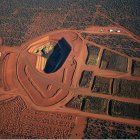
U.S. companies have also stepped up to the plate, with MP Materials leading the way:
Only time will tell if all this will be enough to cross the finish line first.
LATEST