The Munich massacre: 53 years after a tragedy that marked history
While the Olympic Games remain a symbol of hope and unity, this horrific event remains a reminder that peace is a goal that requires constant effort, and that means it is also necessary to prepare for war against evil.
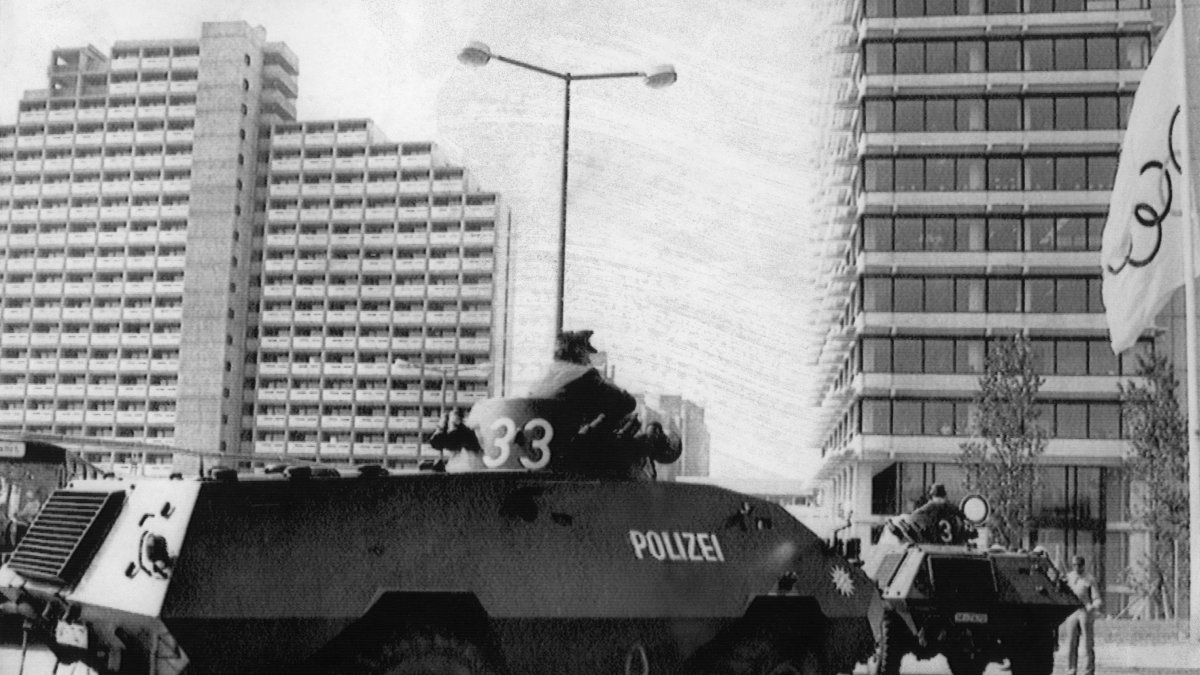
West German armored vehicles enter the Olympic Village during the Munich massacre.

Between September 5 and 6, 1972, the entire world was transfixed by one of the darkest episodes in the history of the Olympic Games. On that day, in Munich,Germany, a commando of the Palestinian terrorist group Black September stormed the Olympic Village, taking 11 Israeli athletes hostage. What began as an attempt at political negotiation ended in a massacre that left 17 dead, including the 11 athletes, five terrorists and a German policeman. Today, 53 years after those events, we remember not only the tragedy, but also its historical, political and human implications.
The context
The Munich 1972 Olympic Games were conceived as an opportunity for Germany to project an image of reconciliation and modernity after the horrors of World War II. Under the slogan "the Peace Games," the event sought to show the world a renewed nation. However, the global context was far from peaceful. The Cold War divided the world into blocs, and the Arab-Israeli conflict, exacerbated after the Six-Day War in 1967, fueled tensions in the Middle East.
The Black September group, a radical faction of the Palestinian Liberation Organization (PLO), sought to make its cause visible through a high-impact act. Their goal was clear: to take hostages to demand the release of 234 Palestinian terrorists in Israeli jails and two members of the German Red Army Faction.

World
Report | Massacres without borders: The legacy of Palestinian terrorism around the world
Leandro Fleischer
The attack
At 4:30 a.m. on September 5, eight armed terrorists scaled the fences of the Olympic Village, which lacked robust security, a reflection of the open spirit the organizers wanted to convey. They entered the building housing the Israeli delegation at 31 Connolly Street. In the initial assault, two athletes, Moshe Weinberg and Yossef Romano, attempted to resist and were killed. The other nine were taken hostage.
The world, following the Games through television broadcasts, was stunned. The images of the hooded terrorists on the balconies and the tense negotiations with the German authorities became a global spectacle in real time. Germany, still scarred by its Nazi past, faced a dilemma: it did not want to resort to military force, but the pressure to resolve the crisis was growing.
The outcome
After hours of fruitless negotiations, the terrorists demanded a plane to take them and the hostages to Egypt. The German authorities pretended to accept, but planned a rescue at the military airport of Fürstenfeldbruck. However, the operation, which began in the evening of September 5 and ended during the early hours of the following day, was a disaster. The German police, inexperienced in anti-terrorist operations, underestimated the number of attackers and lacked specialized equipment. There were no trained snipers, and communication between units was poor.
On the airport runway, the situation got out of control. The terrorists discovered the ambush and opened fire. In the chaos, the remaining nine hostages were killed, some with grenades thrown into the helicopter where they were being held. Five of the eight terrorists were killed in the firefight, along with a German policeman. The three survivors were captured, but released weeks later after the hijacking of a Lufthansa plane, an event that generated even more criticism of the crisis management.

The aftermath
The Munich massacre shocked the world and marked a before and after in several respects:
Security at international events: the Olympic Games were never the same again. Starting in 1972, security became a top priority, with measures that today include advanced technology, intelligence and special forces.
Arab-Israeli conflict: the attack intensified tensions between Israel and Palestinian terrorists. The Jewish state launched Operation Wrath of God, a series of targeted assassinations against members of Black September, immortalized in Steven Spielberg's film Munich.
Creation of anti-terrorist units: Germany created the GSG 9, an elite unit to deal with similar threats, while other countries developed their own special forces.
Legacy at the Games: the Munich Games continued after a brief suspension, but the festive atmosphere faded. The tragedy left a shadow over the event and over the Olympic ideal of unity.
Remembering the victims
The 11 Israeli athletes killed were Moshe Weinberg, Yossef Romano, Ze'ev Friedman, David Berger, Yakov Springer, Eliezer Halfin, Yossef Gutfreund, Kehat Shorr, Mark Slavin, Andre Spitzer and Amitzur Shapira. Their names ring out as a reminder that Islamic terrorism can strike anywhere, anytime.
Over the past 53 years, the International Olympic Committee (IOC) has faced criticism for failing to properly commemorate victims for decades. At the Tokyo 2020 Games, for the first time, an official moment of silence was included in the opening ceremony, a gesture that many considered belated but significant.

Opinion
US Generation Z and their support for Hamas: cowardice disguised as 'rebellion'
Leandro Fleischer
Reflection 53 years
Today, September 6, 2025, on the 53rd anniversary of the massacre, the world remembers not only the horror of that day, but also the lessons it left behind.
While the Olympic Games remain a symbol of hope and unity, the Munich massacre remains a reminder that peace is a goal that requires constant effort, and that means that it is also necessary to prepare for the war against evil, as it is being waged by the State of Israel at this moment.
On this anniversary, we pay tribute to the fallen and renew the commitment to learn from history in order to build a future free of fanaticism, ergo with more freedom.
LATEST