Netanyahu admits Israel is losing the 'propaganda war,' rebuts international criticism and threatens to sue NYT
"Our goal is not to occupy Gaza. Our goal is to liberate Gaza, to liberate it from the Hamas terrorists," the Israeli prime minister said.
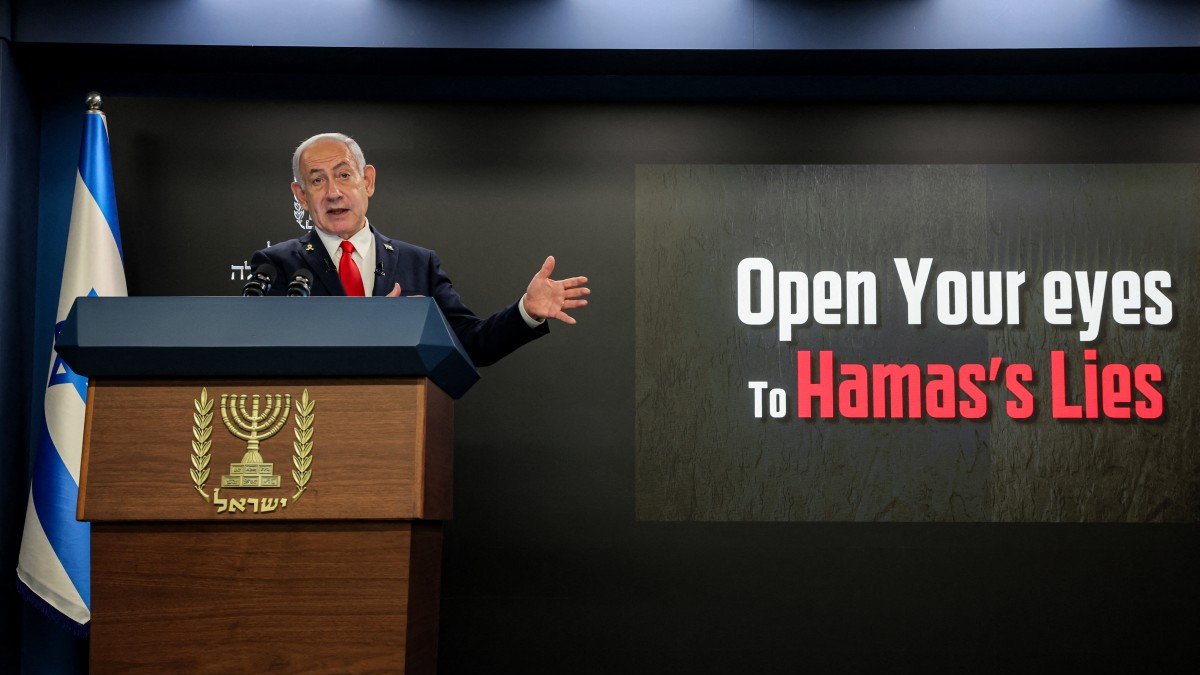
Prime Minister Benjamin Netanyahu holds a press conference this Aug. 10, 2025

In a sudden, unprecedented and extensive press conference for foreign media from Jerusalem, Prime Minister Benjamin Netanyahu defended Israel from international criticism. He elaborated on the Israeli plan to expand the military operation in the Gaza Strip, flatly denying that Israel seeks to occupy the enclave.
According to the prime minister, Israel is seeking to end the war, which is now nearing its second year.
"Our goal is not to occupy Gaza. Our goal is to free Gaza, free it from Hamas terrorists," he said. "The war can end tomorrow if Hamas lays down its arms and releases all the remaining hostages."
During the press conference, Netanyahu spelled out his post-war vision in key points: "demilitarized" Gaza with Israel retaining predominant security responsibility, establishment of a "security zone" on the border to prevent terrorist incursions, and a "civilian administration" in Gaza that does not seek to destroy the Israeli state. In his outline, Netanyahu said that the Palestinian Authority cannot be a valid option for governing the territory due to its history of conflict.
In his address, Netanyahu also ratified the plan to establish a new advance on Gaza and the refugee camps in the center of the strip. The plan, according to the Israeli leader, envisages opening corridors to evacuate civilians to "safe zones" where they would receive food, water and medical care in abundant quantities. However, the proposal faces major objections within the Israeli security apparatus itself -including senior commanders- because of the risk it poses to hostages still captured by Hamas and the operational pressure on troops exposed on the battlefield, as well as international criticism because of the massive displacement it could potentially provoke.
On the humanitarian crisis in Gaza and allegations of famine internationally, Netanyahu blasted the critics, asserting that Israel allowed in "sufficient" aid -two million tons- and accusing Hamas of having "violently looted the aid trucks" and the UN of failing to distribute aid properly. He also asserted that there is no real famine in the enclave, dismissing global allegations as Hamas propaganda that the world had fallen for "hook, line and sinker."
"If we had a starvation policy, no one in Gaza would have survived after two years of war. But our policy has been the exact opposite," Netanyahu said.
The prime minister acknowledged, however, that Israel is losing on the communications front. He denounced, specifically, that there is a "global campaign of lies" and charged that "the only ones who are being deliberately starved in Gaza are our hostages," displaying images released by Hamas of a visibly emaciated Israeli captive.
"I think that we’ve not been winning [the propaganda war], to put it mildly… There are vast forces arrayed against us," Netanyahu asserted.
He also took aim at The New York Times to task over the iconic photographs of Gaza children in an apparent state of starvation. Netanyahu said the photos showed cases with pre-existing pathologies and announced that he is evaluating legal action against the newspaper.

"I'm looking right now into the possibility of a governmental suit against The New York Times because this is outrageous," the prime minister said, noting that the newspaper later published a correction about the images.
The prime minister also criticized German Chancellor Friedrich Merz for the partial arms embargo on Israel, a move that, according to the Israeli leader, came about because of internal and external pressures against Israel's Western allies.
Netanyahu said that several European leaders have privately admitted to him that they cannot unequivocally back Israel because of public pressure.
Finally, faced with the debate over the recognition of a Palestinian state by Western allies, Netanyahu criticized the proposal as "absurd."
"Palestinians are not about creating a state, they're about destroying a state," he said, recalling previous offers that the Palestinian state "rejected."
Netanyahu's press conference comes against a delicate backdrop for Israel, with a sharp increase in domestic pressure from hostage families and harsh criticism from Western allies and the global press.
LATEST