'When I opened my eyes, I realized I was alive': Vishwash Kumar Ramesh, the sole survivor of the plane crash in India
Both Ramesh and experts are trying to understand how he walked away from the collision that left 265 dead in the populous Indian city of Ahmedabad.

Of 242 passengers aboard flight AI171, only one survived: Vishwash Kumar Ramesh. As the smoke cleared, just after the fire was extinguished, authorities said there appeared to be "no survivors" of the Air India plane's crash into a building near Ahmedabad Airport in northwestern India.
Rumors of possible survivors were dismissed as implausible in the face of images of the plane's explosion. Even more implausible seemed the murmur, accompanied by a video on social media, that there was a survivor. And even more so, that he had walked away from the wreckage.
"For a moment, I felt like I was going to die too. But when I opened my eyes and looked around, I realized I was alive," recounted Kumar to local newspaper The Hindustan Times. "I still can't believe how I survived."
Experts also wonder how this possible. "Incredibly surprising," described David Soucie, a former safety inspector and analyst for CNN. Beyond amazement he explained that the lucky guy's seat was right over the wing spar, a structural rod that runs across an entire wing, supporting its weight. In other words, he was at the intersection between the wings and the fuselage (the body of an airplane). The area is reinforced by two structures.
"I think technically this crash is probably a non-survivable crash," said Professor Edwin Galea, president of the Fire Safety Engineering Group (FSEG). On the one hand, he explains, because the plane crashed in a built-up area and on the other because "the damage to the fuselage would have been so severe."
"I don’t know how I survived. I saw people dying in front of my eyes – the air hostesses, and two people I saw near me…I walked out of the rubble."Vishwash Kumar Ramesh, passenger on flight AI171.
"Also, the huge fire after the crash would make it unlikely. The fact that one person survived seems miraculous to me," Galea adds to The Telegraph. He points out, however, that seat 11A, where the Indian press claims the survivor sat, is next to an emergency exit, making an escape easy.
"When I saw the exit, I thought I could come out," Kumar later recalls, who adds a further explanation for his good fortune: his section of the plane never took off and also never hit the building. "I tried, and I did," he says of the door. "Maybe the people who were on the other side of the plane weren’t able to."
"Where’s Ajay?"
Vishwash Kumar Ramesh was identified as a British citizen of Indian origin. This profile matched most of the passengers on the flight bound for Gatwick, London: 169 Indians, 53 English, seven Portuguese and one Canadian. There were also two pilots and 10 crew members.
Ramesh, 40, told local media that he has lived in the United Kingdom for two decades with his wife, son and brother, Nayan Kumar Ramesh, 27. "We were just shocked as soon as we heard it," the latter told the British agency Press Association.
Vishwash was not the only one from the family on the flight. Ajay Kumar Ramesh, 45, sat in another row. Both had traveled to India for a few days to visit relatives. "He was travelling with me and I can’t find him anymore. Please help me find him," Vishwash told The Hindustan Times, in a hospital packed with relatives looking for news.
A cousin of the Rameshes, speaking to P.A., recounted that when the survivor was finally able to speak to his father he was "worrying about his brother saying 'Where’s Ajay?'"
"Not very badly injured"
"He has some blood in the images, but he’s not very badly injured," Dr. Rajnish Patel, a professor and chief of surgery, told CNN. "He is very comfortable and under strict observation, no issues." Officials reported that they expect to discharge him sooner rather than later.
Identifying bodies, clarifying the facts
Indian rescue teams were working through the night. Accompanied by search dogs, they searched the rubble for remains. Hundreds of bodies were recovered, now the task of identifying them remains.
"Families and close relatives of the flight passengers, especially their parents and children, are requested to submit their samples at the location so that the victims can be identified at the earliest," said the principal secretary of the health department, Dhananjay Dwivedi. He also assured that facilities had been made operational to extract DNA samples at a hospital in Ahmedabad.
The plane was embedded in the second floor of a residence for medical staff, located between a hospital and the Ghoda Camp neighborhood. Ahmedabad is the main city in the Indian state of Gujarat, with a population of 8 million. It is a densely populated area that will complicate the tasks of identifying bodies and cleaning up the remains.
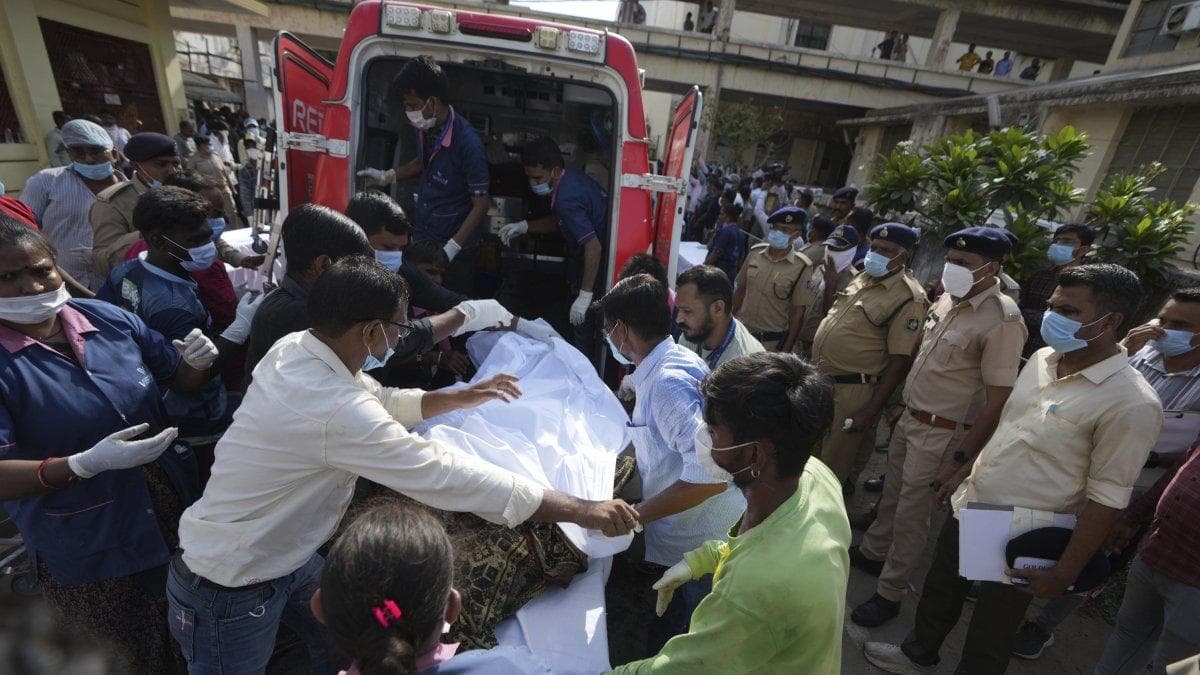
Indian rescue servicesCordon Press/AP.
At the moment, as reported by local police, 265 bodies were transported to the designated hospital center. That is, so far 24 people died on the ground. To know the final and official figures, it will be necessary to wait until the DNA tests have been completed.
In addition to the identification work, the authorities announced an investigation to clarify the facts. This Friday it was reported that investigators found the black box of the Boeing 787-8 Dreamliner. The United States and the United Kingdom will assist in the investigation.
Relief flights and financial aid
Its owner, the Indian conglomerate Tata Group, offered financial assistance of $117,000 to the families of those affected and promised to cover medical expenses for the injured.
🛠 Do you think there is an error in this article?
Recommendations






LATEST