ANALYSIS
Ali Khamenei: the leader of a theocracy forged in blood and religious fanaticism
In 1980, Khomeini appointed him leader of Friday prayers in Tehran, to be elected president a year later and eventually designated as the supreme leader's successor in 1989 after his death.

Ali Khamenei, in an archive image.
To know the complexity of some monsters, it is sometimes enough to look back to the beginning, especially when their lives come to an end. With Ayatollah Ali Khamenei it is unavoidable, given the unimaginable damage he came to perpetrate against an entire country and his sudden death following air strikes executed by Israel and the United States, his two greatest enemies.
Khamenei was only the second supreme leader of Iran since the so-called Islamic Revolution of 1979 and remained in office since 1989, consolidating for more than three decades an almost absolute power. Embedded in a complex web of rival powers, the Iranian leader had the power to veto virtually any public policy issue and to handpick candidates for public office, allowing him to shape the political system of an entire country to his convenience and worldview. As head of state and commander-in-chief of the Army - which includes the Iranian Revolutionary Guard Corps (IRGC) - his position made him a figure with powers that very few leaders throughout the world can attain.
Born in 1939 in Mashhad, the Persian nation's second-largest city, Jamenei was the second of eight children in a family for whom nothing mattered more than religion. His father was a middle-ranking cleric of the Shiite branch of Islam - Iran's dominant religious group - his education focused primarily on the study of the Quran, and he went on to earn a clerical degree at age 11. Like many religious leaders of his generation, Khamenei's role was early on as much political as spiritual, being a skilled and Machiavellian orator who would eventually join the critics of Shah Reza Pahlavi, the monarch overthrown by the revolution led by Ayatollah Ruhollah Khomeini.
For years, Khamenei lived in hiding and was arrested on several occasions. By 1980, Khomeini appointed him leader of Friday prayers in Tehran, only to be elected president a year later and eventually designated as the supreme leader's successor in 1989 after his death. It is a meteoric rise in a complex universe in which loyalty and fundamentalism are crucial to political ambition, and in which violence can strike at any moment, as it did in 1981, when a bomb attack by the opposition People's Mujahedin group caused injuries severe enough to cause him to lose the mobility of his right arm.
Promotion and control
Lacking the automatic respect of the high clergy and the charismatic popularity enjoyed by his predecessor, Ayatollah Khamenei had to tread cautiously at the beginning of his new era as supreme leader of a country that already felt betrayed and disappointed at the direction taken by the revolution. However, Khamenei would begin to weave networks of loyal officials in the judiciary, the police, the state media, the clerical elite, the parliament, the Revolutionary Guard and the intelligence apparatus, thus consolidating a system that was fiercely aligned with his figure.
As other tyrants did, Jamenei managed to achieve almost indestructible power by creating an impenetrable core of revolutionary guards illicitly enriched after the revolution, and hard-line clerics. Likewise, the supreme leader permanently showed an iron fist when responding to citizen demonstrations against his theocratic regime, with a security apparatus sufficiently ideologized to not hesitate for a second to commit all kinds of atrocities and barbarities in order to neutralize the protests and the opposition itself.
The clearest examples took place with the student demonstrations of 1999, those of 2009 against rigged elections, those of 2019 following the sharp increase in gasoline, or those of 2022 following the brutal murder of a 22-year-old Kurdish woman named Mahsa Amini, who had been arrested for the simple fact of not wearing the hijab. In each of these protests, the will of a people aware of the nightmare in which their country has become embroiled and determined to see the end of the theocracy responsible for it was crushed time and again by the forces of law and order.
Turning point and denouement
As happens in the life of almost every tyrant and his regimes, there are one or more points of no return that eventually become the events that seal his fate. In this case, the main one was his decision to develop nuclear weapons, disguised as atomic energy programs and sophisticated missiles, putting both the Middle East and the world on tenterhooks in the face of the horror of seeing a violent, interfering and terrorist-sponsoring theocracy with such weaponry.
After failed negotiations and pusillanimous agreements that only favored the ayatollah and his theocracy, we arrived at the year 2025 in which Israel took military action against the Iranian nuclear program, its scientists and facilities. Iran responded with missiles against the Jewish State and the Administration of President Donald Trump decides to join the Israeli attacks. While Khamenei vowed not to surrender, his position was weakened more than ever, to the point where his end seemed to be in sight in the face of the indomitable inertia of geopolitical dynamics.
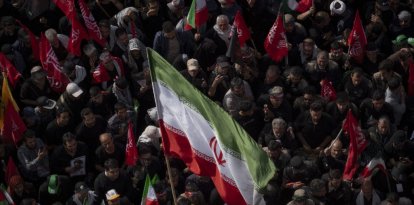
The final blow would come at the end of that year with the massive protests carried out throughout Iran, in which millions of Iranians would take to the streets of the most important cities to express their absolute rejection of Khamenei and their desire to see his theocracy ended. As many feared, the regime's response was one of inhuman and disproportionate brutality, resulting in the deaths of thousands of innocent lives. The little favorability on which his image could count was crumbling, as well as the solidity of his power, in the face of the numerous internal contradictions that began to emerge and the way in which part of his military power was torn to pieces in recent years by the United States and Israel. It was this final context that both Washington and Jerusalem knew how to take advantage of to launch new attacks and put an end to him, a February 28 that will be forever remembered.
Millions of words could be written to explain the life of a tyrant, to analyze the details of an existence framed by blood, power and fanaticism. However, even in the face of the inevitable chaos that can sometimes arise after the end, the death of a tyrant allows hope and the possibility of a future in which freedom replaces the terror he unleashed to set himself up as lord and master of a country, as its leader and eventual executioner, to flourish.
The ayatollah's family
Jamenei and his wife had six children: four boys and two girls. The family hardly appeared in public or in the media, and verified information about their private life was always limited. Of his sons, the second, Mojtaba, stood out for his influence and for the role he played in his father's inner circle, to the point wheremany claim that he could be his successor in the event that the current Iranian political system were to continue.
LATEST