ANALYSIS
Iran's kamikaze 'energy war' to break the West
The Iranian regime has set out a strategy that seeks to drive up energy prices for the West with the closure of the Strait of Hormuz and attacks on refineries and liquefied gas plants in the Gulf.
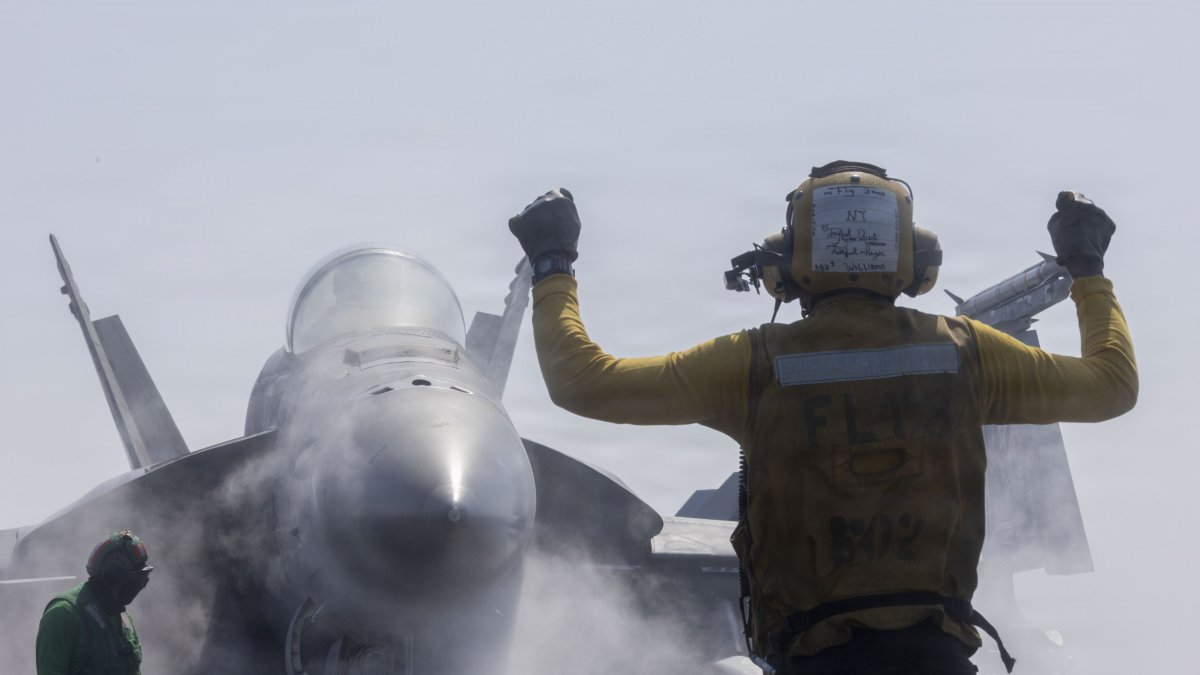
An F18 prepares to take off from the deck of the USS Abraham Lincoln.

Iran is fully aware of the difference in military power vis-à-vis the U.S. if the conflict is prolonged. But it is also aware that not only missiles or bullets are capable of inflicting great damage.... In a globalized world, trade and energy collapse may be even more deadly for the world's major economies, which will face large increases in inflation and, in the event of a long war, could even encounter supply problems.
While the closure of the Strait of Hormuz provoked a seismic shock to shipping routes over the weekend, with major world shipping lines avoiding passage through the area, and with significant increases in the price of gas and oil, on Monday Iran went one step further by attacking a major refinery in Saudi Arabia and liquefied gas plants in Qatar, triggering even steeper rises.
The Strait of Hormuz, between Oman and Iran, is a critical passage for world trade, through which 20% of oil production passes, especially in the direction of Asia, and has China as its main consumer. A large part of the production of the Gulf countries (including Iran) transits through this area.
Oil prices up to over $80 per barrel after market open
Since the market open on Monday in Asia, crude oil went as high as over $80 per barrel, while all the stock exchanges were stained red. In the case of gas, the opening of the European stock exchanges saw increases of 22%.
However, prices suffered a new upward acceleration after the attacks directed by the Iranian regime against the huge refinery of Ras Tanura, on the shores of the Gulf, which was forced to stop some operations due to the fire caused as a result.
Will oil break the $100 barrier?
The Saudi government has already warned that if Iran continues to target its oil giant Aramco, it could respond with a military strike against Iranian oil infrastructure.
The situation has caused a considerable rise of between 8 and 14% in both the West Texas Intermediate (WTI) barrel, the U.S. benchmark, and Brent, which is once again close to $80. Analysts estimate that oil may break the $100 barrier per barrel, although they do not consider it excessively likely that it will return to its historical highs.
Gas soars up 50% after the Iranian attacks on Qatar
Gas was the next domino to fall. In this case, the Qatari Ministry of Defense indicated that two Iranian drones attacked a power plant and a land-based gas processing complex. As a result of the strikes, QatarEnergy, the emirate's state-owned energy company, announced the suspension of its liquefied natural gas production.
"Due to military attacks on QatarEnergy's operating facilities in Ras Laffan Industrial City and Mesaieed Industrial City in Qatar, QatarEnergy has ceased production of liquefied natural gas (LNG) and associated products," the company wrote.
The announcement caused the price of European gas, which was already up sharply on Monday morning, to increase by more than 50%.
A “kamikaze” strategy
With the strategy, Iran is seeking to hurt the West, attacking citizens’ pockets via global inflation, with global inflation as one of the main concerns of families.
However, this is a “kamikaze” strategy, in which Iran itself will also suffer both from the high cost of basic commodities—which are already excessively high there—and from the block on the sale of its own oil as a result of the closure of Hormuz.
Can Iran’s gamble succeed?
The fact that OPEC+ countries agreed to an increase in production of 206,000 barrels per day (higher than expected to meet summer demand) also detracts from the effectiveness of Iran’s move.
Moreover, experts do not foresee the conflict leading to supply shortages, unless it were to continue for more than three months, something that does not seem very likely. Trump himself noted that he estimated it could take about four weeks, if necessary, and War Secretary Pete Hegseth noted that it could be slightly more or even less than that duration.
LATEST