ANALYSIS
Fight for the Hispanic vote exposes Democratic fractures
As the Republican Party doubles down on Hispanic candidates, Democrats are facing growing tensions over their deteriorating relationship with a historically favorable voting bloc.
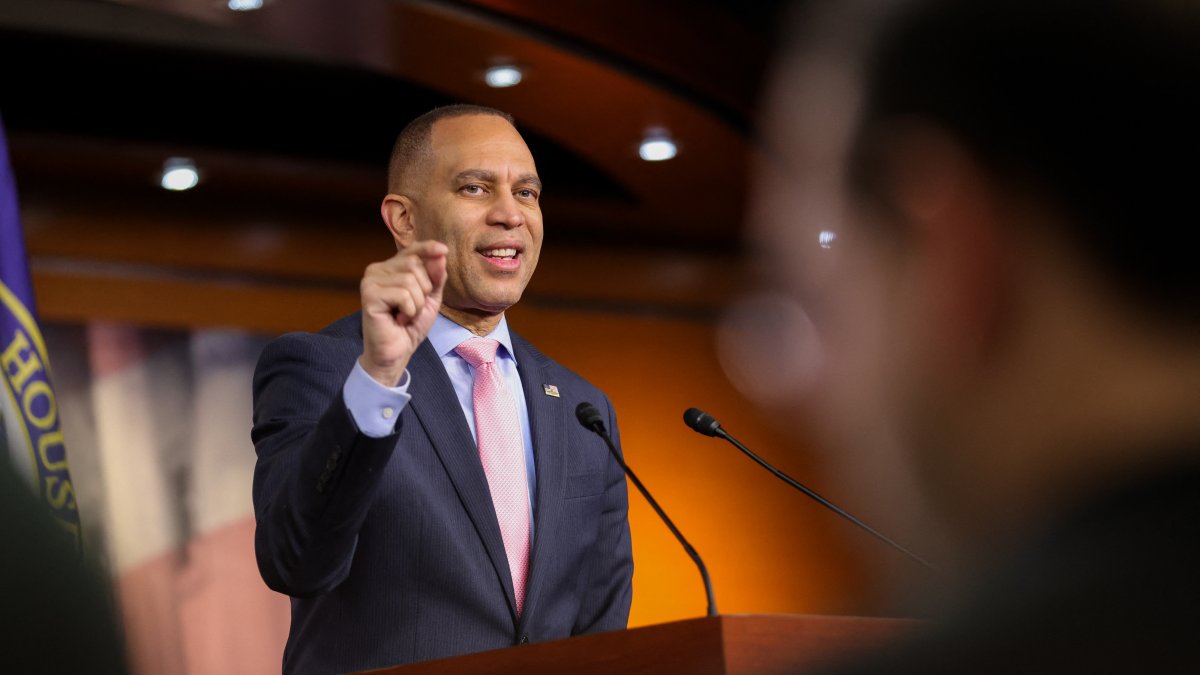
Hakeem Jeffries on Capitol Hill/ Brayan Dozier

The Democratic Party is facing new internal divisions amid declining support among Hispanic voters. Alongside slipping voter support within this demographic, several disputes involving Hispanic candidates have emerged, with some openly criticizing Democratic leadership. On the other side, the Republican Party is increasingly backing Hispanic candidates in key races as they seek to preserve and expand their gains with this demographic group.
Between 2016 and 2024, Donald Trump was the face of a Republican Party that made historic gains among Hispanics. In fact, in the most recent presidential election, Trump posted the strongest Hispanic vote performance for a Republican since polling on the issue began.
By contrast, Democrats are watching a voting bloc they long considered a secure part of their coalition become increasingly competitive. So found a recent poll by The Economist/YouGov. According to its results, Democrats now hold just a two-point advantage over Republicans among Hispanic voters — their weakest performance since 2018, when that margin stood at 40 points.

Politics
Republicans challenge 'Democratic boom' narrative in Texas with fundraising numbers
Joaquín Núñez
Internal conflicts with Hispanic candidates.
With the midterm elections approaching, both parties are in the process of selecting candidates for Congress. During that process, Democratic leadership chose not to support some Hispanic candidates in key races, creating friction within the party.
One example is California’s 22nd Congressional District. The seat is currently held by Republican David Valadao, and Democrats view it as one of their best pickup opportunities.
There, party leadership opted to back Jasmeet Bains instead of Randy Villegas, a Hispanic candidate, despite the district being 72% Hispanic.
Villegas publicly criticized the decision and took aim at party leadership. “This is the most Latino district in California. The Central Valley has never elected a Latino to Congress. I will be the first. But it's frankly outright disrespectful that these party insiders, that these DC elites, would try to put their thumb on the scale to try and block a Latino representative," he expressed in dialogue with the digital media Punchbowl News.
Another example comes from Pennsylvania’s 7th Congressional District, where Democrats hope to unseat Republican Ryan Mackenzie. In that race, the Democratic Congressional Campaign Committee (DCCC) backed Bob Crooks over Hispanic candidate Carol Obando-Derstine. Many local Democrats slammed the DCCC for intervening in the primary on behalf of Crooks, president of the Pennsylvania Professional Fire Fighters Association.


Politics
Hispanic Republicans in Texas strongly support Trump and prefer Rubio for 2028
Joaquín Núñez
The GOP's big bet on Hispanic candidates
By contrast, the Republican Party is increasingly backing Hispanic candidates in key races.
The central goal is to capitalize on growing support among Hispanic voters in competitive districts. To do so, the National Republican Congressional Committee (NRCC) has made a significant effort to recruit competitive Hispanic candidates across the country. So far, only four have secured official endorsements from both President Trump and the NRCC: Eric Flores (TX-34), Tano Tijerina (TX-28), Kevin Lincoln (CA-13) and Greg Cunningham (NM-02).
In an interview with VOZ, NRCC Chairman Richard Hudson, stated that Hispanics are the "most important" voting bloc for Republicans.
"Democrats continue taking Hispanic voters for granted and are now openly trying to clear the field and push Hispanic candidates off the ballot when party insiders don’t approve of them. Republicans continue earning the trust of Hispanic communities because we’re delivering on the issues families care about," said Christian Martinez, national Hispanic press secretary for the NRCC.
LATEST