Cuba, five years after July 11: An exhausted island amid power outages, economic crisis and increased political control
The latest collapse of the national power grid, which occurred Monday, July 6, epitomizes the situation currently facing the largest of the Antilles: a state unable to guarantee basic services, an increasingly impoverished society and a regime facing the fifth anniversary of the largest anti-government protests by tightening its mechanisms of control and repression.
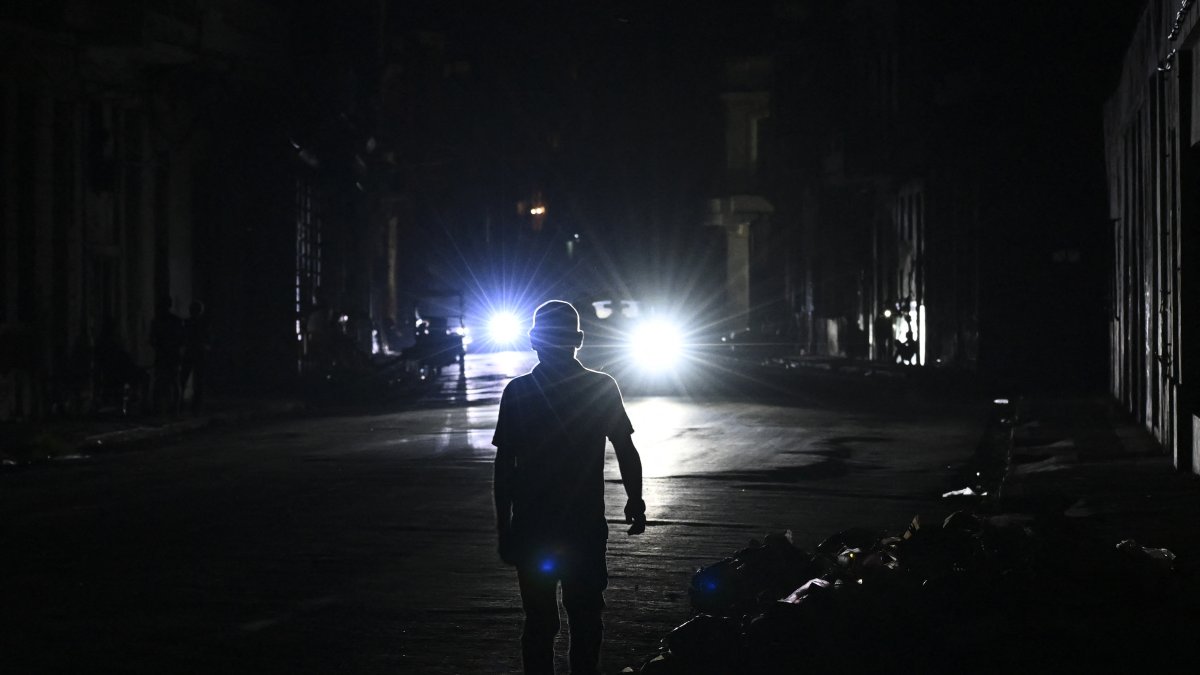
A man walks down a dark street in Havana, Cuba, during the widespread blackout

On Monday, July 6, Cuba was once again plunged into complete darkness following the collapse of the National Electric System (SEN). This is the third nationwide blackout of 2026 and the eighth since October 2024, a pattern that reflects the worsening of an energy crisis that has shifted from temporary to structural.
Even before the collapse, most of the country was already suffering scheduled power outages lasting more than 20 hours, especially outside Havana. The Cuban regime acknowledges that electricity generation remains well below demand due to the deterioration of thermal power plants, fuel shortages and difficulties in importing oil.
Reuters explained that the power grid had been operating at its limit for months and that, at the time of the blackout, much of the island was already without power.
Gradual restoration, the dictatorship’s favorite phrase
According to the latest report from the Havana Electric Co., the "distribution circuits serving 262,369 customers have been restored, representing 30.4% of the city." As for the rest of the country, government officials announced that service will be gradually restored as circumstances permit.
Electricity is no longer the problem: It is a reflection of a systemic crisis
The energy crisis is now the best indicator of the country’s overall deterioration.
Power outages affect virtually every aspect of daily life: food preservation, water pumping, hospital operations, public transportation, telecommunications and, of course, economic activity.
The Associated Press reports that dwindling fuel reserves and the aging electrical infrastructure have even forced the cancellation of medical procedures and the curtailment of numerous public services.
Meanwhile, independent media outlets such as Diario de Cuba or ADN Cuba have been documenting a much broader reality for months: long lines for food, medicine shortages, water supply problems and inflation that continues to erode the population’s purchasing power.
This is not just an electricity crisis. Electricity has become the point where virtually all other crises in the country.

June sent a clear signal: social discontent is on the rise
Over the past few weeks, there has been a noticeable increase in local protests.
The reasons are varied, power outages, water shortages, food or fuel shortages, but they all stem from the same phenomenon: social exhaustion.
The Justicia 11J platform recorded 220 public protests during June, while Cubalex, another organization dedicated to monitoring the human rights situation on the island, documented dozens of arbitrary detentions related to demonstrations and protest actions.
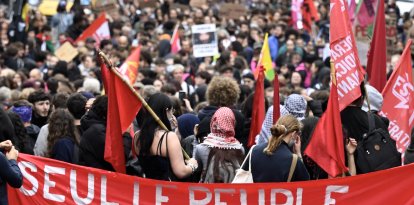
In several towns, there were pot-and-pan protests, spontaneous street blockades, neighborhood protests and political slogans such as "Freedom" or "Down with the dictatorship."
Although none of these demonstrations reached the national scale of the July 11, 2021, protests, they do reveal an increasingly frequent pattern: small, decentralized protests that are difficult to anticipate.
The fifth anniversary of July 11 shapes the political climate
The coincidence has not gone unnoticed.
Various human rights organizations and independent media outlets have been reporting for weeks on an increase in surveillance of activists, police summonses, temporary arrests, threats, restrictions on movement and restrictions on independent journalists.
The pattern mirrors what has happened on previous anniversaries: the regime intensifies preventive measures to reduce any possibility of public mobilization.
The Inter-American Commission on Human Rights has been warning of the persistence of repressive mechanisms against opponents and protesters in connection with July 11.
The official narrative and structural causes
The crisis Cuba is facing is the result of a cumulative economic decline over many years, for which there currently appears to be no path to recovery. Domestic production remains depressed, tourism has not yet recovered to pre-pandemic levels (and has fallen to practically zero) and the government has increasingly fewer foreign currency reserves to import fuel, food and raw materials.
Added to this is the mass emigration of recent years, which has reduced the available labor force and increased dependence on remittances sent from abroad. The result is a vicious cycle in which the decline in production limits the country’s revenue, reduces its ability to import essential goods, deepens shortages, and exacerbates problems such as power outages, which in turn fuel social discontent.
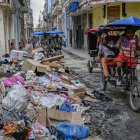
From Havana, the Castro elite maintains that much of this situation stems from the tightening of the U.S. embargo and difficulties in accessing fuel on international markets, as well as reduced supplies from traditional allies such as Venezuela. However, numerous economists and analysts agree that these external pressures are compounded by structural problems that predate the current situation: decades of insufficient investment in infrastructure, an obsolete thermoelectric power plant fleet, limited diversification of the energy mix, low productivity, a heavily centralized economy and an increasingly limited financial capacity to maintain basic services.
Rather than the result of a single factor, the Cuban crisis stems from the convergence of external and internal factors that have fed into one another for years. This combination explains why power outages can no longer be understood as isolated or temporary incidents but rather as the most visible manifestation of an economic and energy model under growing pressure and with increasingly less room to respond to the population’s needs.
Five years after 11J
Five years after the protests that changed Cuba’s recent history, the country faces a different, but not necessarily more stable, scenario.
The state’s ability to control protests remains strong, but so does the level of economic and social strain.
The nationwide blackout on July 6 symbolizes this paradox: while the regime keeps its political control apparatus intact, it is increasingly losing its ability to ensure the country’s basic functioning.
With just a few days to go before another anniversary of July 11, the question is no longer simply whether there will be new protests. The fundamental issue is how long a model that constantly coexists with blackouts, shortages, mass emigration and a growing deterioration in living conditions can be sustained.
LATEST