ANALYSIS
Spain | Ceuta on high alert amid calls on social media for another mass crossing from Morocco: ‘Is the door still open or not?’
Following the mass crossing in late July, WhatsApp, Facebook and Instagram groups are openly coordinating a new attempt at irregular entry into Ceuta scheduled for Aug. 15, with Castillejos as the main gathering point and messages that mix logistics, misinformation and calls to action.
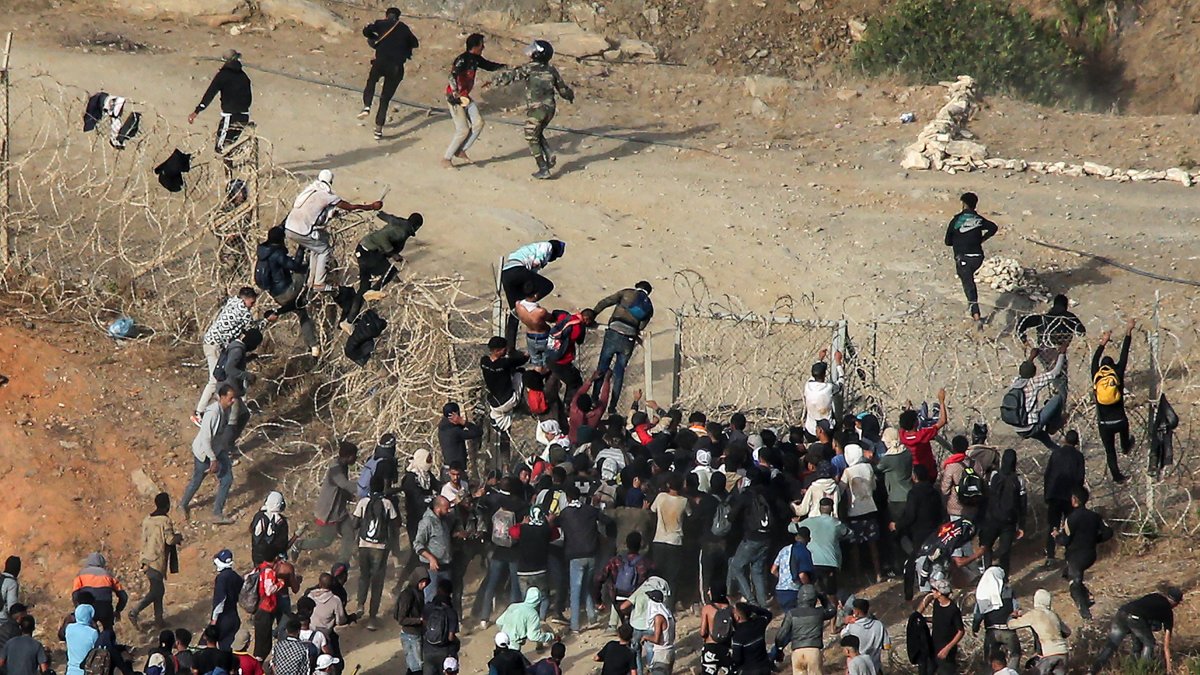
Migration crisis in Ceuta, Spain, in May 2021. File photo

Following the mass crossing that took place on the night of July 30–31, in which thousands of people managed to enter Ceuta from Morocco (some estimates put the figure at 70,000), digital platforms have become the main arena for organizing what is believed to be a new attempt.
An investigation by the fact-checking organization Maldita.es confirmed the existence of at least four active WhatsApp groups, 10 on Facebook, and more than 50 Instagram accounts where the details of this mobilization are openly discussed, including possible times, meeting points and logistical recommendations.
The date most frequently mentioned in the conversations is Aug. 15, although several messages propose moving the action up to avoid an excessive gathering of people and a foreseeable police presence. The main meeting point indicated is the Moroccan town of Castillejos.
Meanwhile, the Unified Association of Civil Guards (AUGC) acknowledges that the "pressure on the border demands an immediate response: more material resources, more personnel and adequate planning to ensure effective surveillance and the safety of those who protect it."

Users asking: "Is the door is still open or not?"
Messages in Arabic, French and Spanish are circulating on social media, accompanied by images highlighting that date and references to Ceuta. Mentions of other border crossings and even Melilla have also been detected, raising questions about whether this is a single call to action or several independent mobilizations.
On Facebook, the groups serve as a showcase. According to Maldita.es, some participants post anonymously, and the discussion focuses primarily on organizing the "crossing," though there are also calls to mobilize, accounts from those who have already crossed describing the conditions they encountered, and recommendations on transportation options and routes.
Some messages include false claims about possible automatic asylum grants from the European Commission or about alleged preferential treatment for those who can demonstrate they have a trade. In one of the groups analyzed, a user wrote on July 30: "Is the door still open or not?" referring to whether the border at Ceuta was still open for crossing.
Another message on Facebook sums up the slogan: "Brothers, at dusk and at dawn on the 15th everyone goes in." It was posted on Aug. 3 by a user in the group "Alhucemas puerta de Ceuta."

World
Milei accuses Sánchez of provoking a migrant influx in Spain to 'perpetuate his tyranny'
Alejandro Baños
WhatsApp, the "operations center"
On WhatsApp, the conversation becomes more technical and operational. Participants exchange phone numbers, invitation links, and specific details about schedules and meeting points.
On Telegram, a group was identified that redirects to another WhatsApp group with the message: "Everyone come in here. Let's agree on a plan for a departure." In that group, too, the proposal to move up the crossing date is being discussed.
"Brothers, there's a push before the 15th; the 15th will be too crowded. Whoever wants to go, send a private message," read several threads.
Logistical concerns also arise: the need to bring enough water and food to survive in Ceuta, fears of increased police presence and doubts about the floating barrier installed at Tarajal. An audio message asks: "Brothers, how big is the net down below where they put a barrier between Ceuta and Fnideq [Castillejos], for anyone who wants to dive under it?" According to the investigation, this question was unanswered.
Following the crossing in late July, several participants recommended moving the conversations to private chats out of fear of infiltration. At the same time, someone asks about the fate of some of those who crossed in late July: "Brothers, what happened to the few people who remain hidden in Ceuta and who haven't come back? What did they do to them?" Another responds that they've all left and that "they didn't even stay at the center."

World
Reform UK proposes deploying the Royal Navy to curb illegal migration in the English Channel
Carlos Dominguez
Ceuta crisis continues
As she explained, Vivas made it clear to her that the situation has not returned to normal and that the fact that the central government is on vacation does not mean the problem has been resolved.
Vivas stated that between 3,000 and 6,000 of the people who entered Ceuta in the past 24 hours are still in the city. After meeting with King Felipe VI, he claimed the reception centers had collapsed and asserted that the incident has caused "a major humanitarian crisis."
The president of Ceuta also criticized the fact that the border is "in the hands of a third country that does not recognize Ceuta's sovereignty."
Instagram: Photos, dates and points of origin
On Instagram, the format is more visual. Dozens of profiles—many of which were created or reactivated between July 31 and Aug. 3—post personal photos with the date "Aug. 15, 2026" superimposed.
The most common hashtags used to indicate the alleged point of departure are variations of the name of the Moroccan town of Castillejos (Fnideq), such as "Fenideq," "Fnidaq," or "FENIDG CEUTA." The slogan "everything will be revealed/appear that day" is repeated insistently.
The comments tend to mix encouragement with calls for caution. Several users share their phone numbers and ask to be added to WhatsApp groups. Some accounts, however, display Spanish or European Union flags in their profile picture and include a disclaimer in their posts stating that they do not promote irregular immigration, even as they spread the call to action for Aug. 15.
World
Ceuta and Melilla are not colonies: History, law, and full integration into Spain
Williams Perdomo
Alternative routes and paid services
In addition to the Tarajal route, videos and screenshots from Google Maps are circulating in the groups, showing routes through forested areas further south. One of them shows a route that starts on the P-4701 highway in Beliones, Belyounech, passes near the Embalse del Infierno reservoir, and avoids the García Aldave military barracks. The stated goal is to reach less-monitored locations and remain hidden in wooded areas.
Another individual Facebook profile has been posting photos of all kinds of watercraft. It posts images of "inflatable boats, jet skis, or dinghies" along with phone numbers. Some of these profiles use the term "haraga," which refers both to those who cross irregularly and to a viral phenomenon that glorifies illegal crossings into Spain. In several cases, the same accounts are active simultaneously on Facebook, Instagram and Threads.
Practical equipment is also discussed: handmade fishing hooks for use once on Spanish territory, diving fins and foam flotation belts. "Water is everything, and it's essential," insists one user in an audio message. Others warn that hunger and thirst are the greatest risks for those trying to stay hidden before the crossing.
Official responses and mutual accusations following Ceuta crisis
Morocco has attributed the sharp increase in crossings to a recent ruling by the Spanish Supreme Court which, according to Rabat, prevents the immediate return of people intercepted at sea near the borders of Ceuta and Melilla.
Moroccan authorities maintain that this court decision created a pull factor and facilitated the mass influx. For its part, Madrid flatly rejected that interpretation and blamed "criminal mafias" for organizing and exploiting the situation.
Meanwhile, Spanish right-wing party Vox demanded on Thursday that the government exclude Morocco from the 2030 World Cup and ensure the final is held in Spain. The party led by Santiago Abascal has filed a non-binding resolution in Congress following the incidents in Ceuta and is calling on FIFA to remove the North African country as a co-host.
LATEST