María Corina Machado cements her leadership, reaches record popularity in Venezuela
Given the possibility of new presidential elections, Machado's leadership translates into a decisive mathematical advantage.
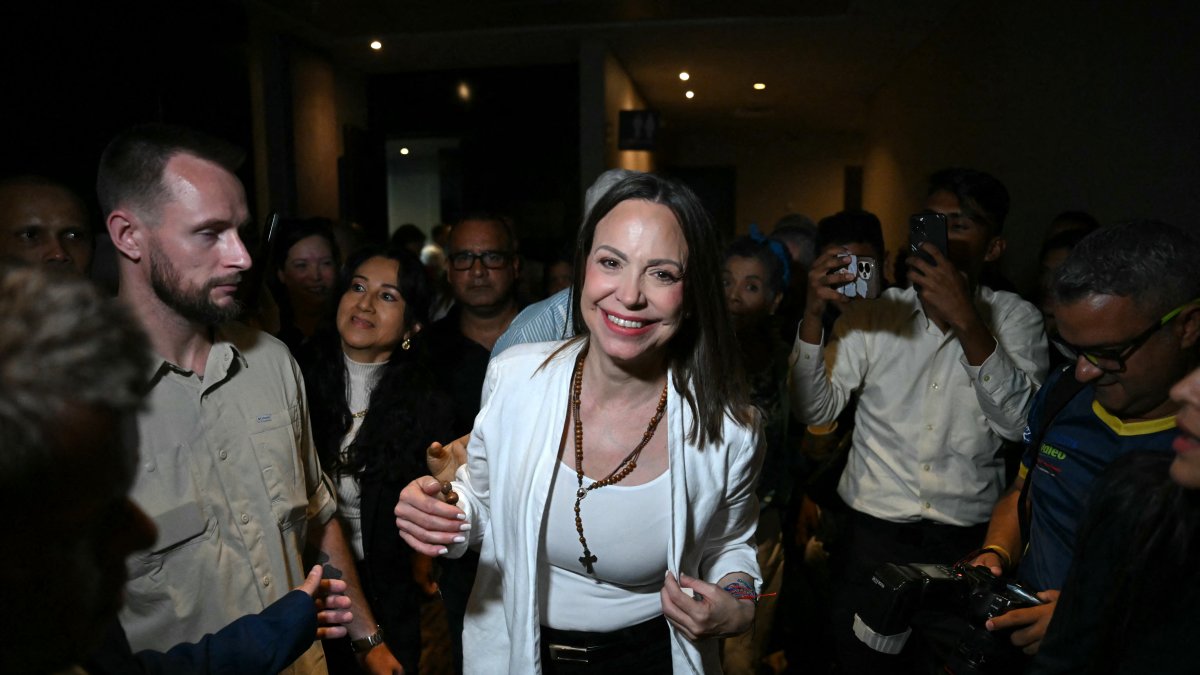
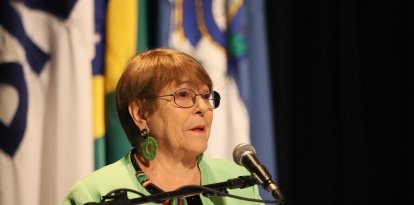
Venezuelan opposition leader María Corina Machado leaves a press conference in Panama City, Panama, on May 23, 2026.

According to the latest report from AtlasIntel, prepared in collaboration with Bloomberg and covering July 2026, opposition leader María Corina Machado has reached her highest point of popular support in Venezuela, establishing herself as the most influential political figure in the country.
This rise coincides with a severe and ongoing decline in public approval of the Chavista regime, now formally led by Delcy Rodríguez.
Unquestionable support amid regime's collapse
Data from the statistical study, collected between July 30 and Aug. 3, 2026, shows that María Corina Machado has a 72% positive image, placing her well above any other national political figure. The consistency of her popular support stands in direct contrast to the widespread rejection of the Chavista leadership.
Delcy Rodríguez, who currently leads the government, has a 71% negative approval rating, while only 19% of those surveyed view her favorably.
This downward trend is also evident in the approval rating for her day-to-day performance: 64.5% of Venezuelans explicitly disapprove of the way she leads the executive branch, and 58% directly rate her administration as "bad or very bad."
This discontent is intertwined with a structural crisis of legitimacy, in which 66.2% of the population identifies corruption as the most serious problem currently afflicting the nation.
Electoral landscape and U.S. influence
Given the possibility of new presidential elections, Machado's lead translates into a decisive mathematical advantage.
Machado commands 57.4% of the vote, leading by more than 39 percentage points over Rodríguez, who barely retains 17.7% of the vote, almost entirely limited to the hard-core base of the United Socialist Party of Venezuela (PSUV). Even a business leader like Lorenzo Mendoza trails in a distant third place with 9%.
The Venezuelan public's preference for principles of economic freedom and institutional restoration is also evident in its perspective on foreign policy.
Fifty-five percent of those surveyed express a positive opinion of the United States, and 56.9% advocate for further strengthening bilateral ties with Washington.
In this context, President Donald Trump enjoys a 51% favorable rating among Venezuelan citizens, cementing a trend in which international figures opposed to regional socialism are gaining ground in the local public consciousness.
Politics
'Not years, but months and weeks': Marco Rubio outlines the timeline for free elections in Venezuela
Andrés Ignacio Henríquez
LATEST