ANALYSIS
Ceuta and Melilla are not colonies: History, law, and full integration into Spain
Both cities have been part of the Spanish state for centuries; they are integrated as autonomous cities, their residents enjoy the same citizenship rights as the rest of the Spanish people, and they participate in the country's democratic institutions.
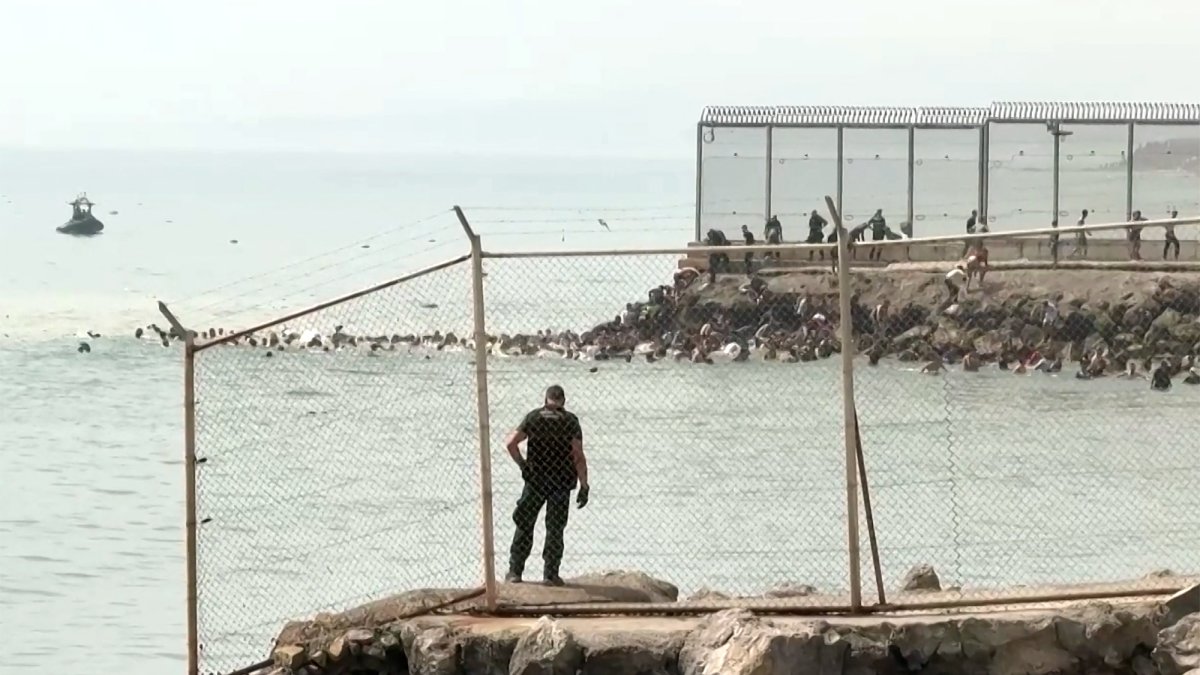
Image of migrants in Ceuta

Ceuta and Melilla are not colonies. Both have been part of the Spanish state for centuries, are organized as autonomous cities, their residents enjoy the same citizenship rights as the rest of the Spanish people, and participate in the country's democratic institutions. Furthermore, the UN has never included them on the list of Non-Self-Governing Territories awaiting decolonization, unlike Western Sahara, which has been on that list since 1963.
The Spanish presence in Melilla began in 1497, when the city was incorporated into the Crown of Castile. Ceuta, for its part, was conquered by Portugal in 1415 and came under the same Crown that ruled Spain during the Iberian Union (1580–1640). Following the restoration of Portuguese independence, Ceuta remained under Spanish sovereignty, a status recognized by the Treaty of Lisbon of 1668. Since then, both cities have remained under Spanish sovereignty for centuries.
Furthermore, the Spanish presence in Ceuta and Melilla predates both the independence of the Kingdom of Morocco in 1956 and the European colonial expansion of the 19th and 20th centuries. During the Spanish Protectorate in Morocco (1912–1956), both cities were already part of Spanish territory and were not included in the protected territory. Over the centuries, various treaties between Spain and Morocco regulated and defined the status and borders of both cities.
Full integration into the Spanish state
The legal status of Ceuta and Melilla also differs from that of a classic colonial territory due to their full integration into the Spanish constitutional order.
The Spanish Constitution of 1978 recognizes their belonging to the Spanish State and, since the adoption of their Statutes of Autonomy in 1995, both have been autonomous cities with their own institutions and powers of self-government. Their residents are full Spanish citizens; they elect representatives to the Cortes Generales—deputies and senators—and participate in general, municipal, and European Parliament elections on an equal footing with the rest of Spanish citizens.
They are also part of the territory of the European Union, although they maintain certain special regimes regarding taxation, customs, and the movement of people due to their unique geographical location.
Migrant invasion in Ceuta
Images published by the Spanish newspaper El Faro de Ceuta show hundreds of migrants crossing illegally from Morocco into Ceuta, a Spanish territory with a population of barely 84,000 inhabitants.
In less than two weeks, around 2,000 people, mostly from Morocco, have managed to enter Ceuta illegally, a situation that has overwhelmed the capacity of political authorities and security forces to address the crisis.
The difference with Western Sahara
On the international stage, the difference with Western Sahara is clear. The UN considers Western Sahara to remain a Non-Self-Governing Territory whose decolonization process is still pending, and it therefore remains on the agenda of the Special Committee on Decolonization (C-24).
Ceuta and Melilla, on the other hand, have never been included on the list of Non-Self-Governing Territories nor have they been treated by the United Nations as territories subject to a decolonization process. Although Morocco maintains a claim over both cities, that claim has not led to their inclusion in the international decolonization framework established by the UN.
Differences with Western Sahara
Consequently, the difference between the two cases lies not only in the existence of sovereignty claims, but also in their treatment under international law and by the United Nations. Ceuta and Melilla are part of the Spanish constitutional order, have full political representation, and have never been classified by the UN as territories pending decolonization, whereas Western Sahara continues to appear on the list of Non-Self-Governing Territories pending the completion of its decolonization process.
LATEST