Venezuela's crude oil exports fell 25% in July after shipments to India were cut in half
On the map of destinations, the United States and India emerged as the main recipients of Venezuelan crude oil.
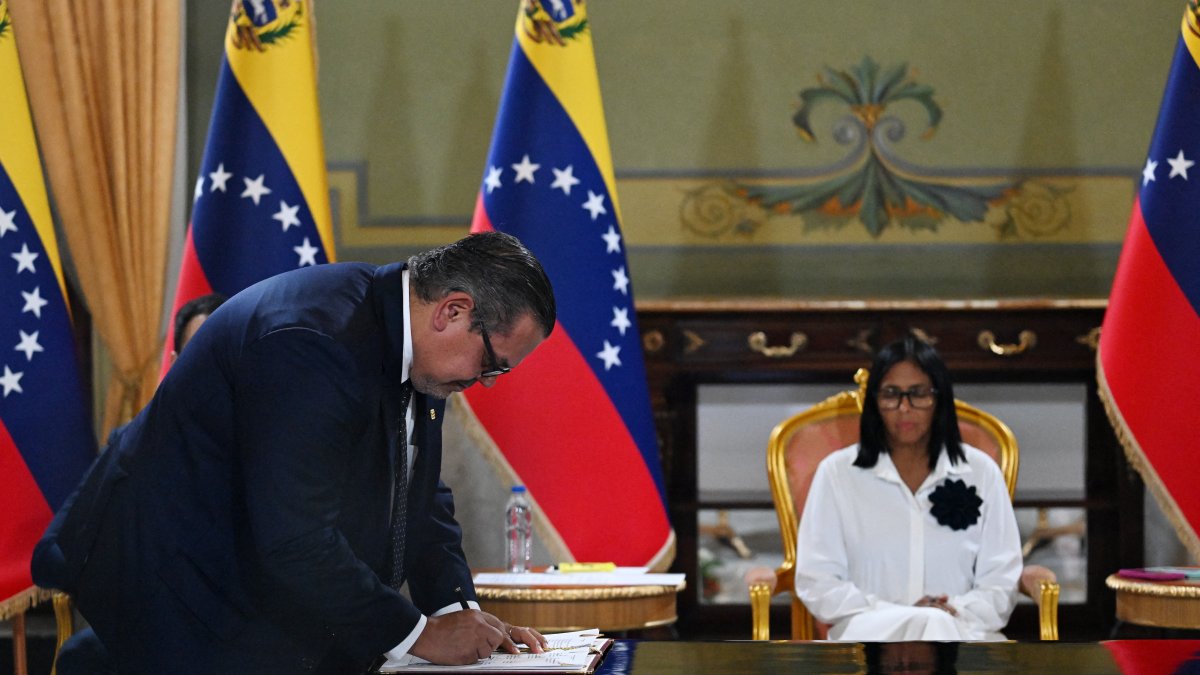
Mariano Vela, president of Chevron Venezuela, signs a document alongside Delcy Rodríguez, president of Venezuela's interim government, on April 13, 2026.

Venezuela's oil exports contracted by 25% during the month of July, averaging 856,000 barrels per day.
The figure represents the lowest shipment level recorded by the national energy industry in the last five months, according to data from the maritime intelligence firm Kpler Ltd and vessel tracking reports published by Bloomberg.
The decline is primarily due to the fact that purchases from India fell by half compared to the previous month. In June, Indian refineries had substantially increased their demand to supply their complex refining systems with lower-cost heavy crude.
However, the gradual normalization of global supplies dampened demand for Venezuelan shipments.
A key factor in this shift in trade patterns has been the evolution of the armed conflict in the Middle East. As the war entered its sixth month, the opening of alternative maritime routes and the implementation of logistical solutions made it possible to release millions of barrels that had been held up in the Persian Gulf. This increased availability of crude oil in Asian markets dampened demand for South American sales.
Figures from previous months were also inflated due to the release onto the market of inventories accumulated during the U.S. sanctions regime in place before Nicolás Maduro left office.
Once that storage surplus was released, the flow of shipments tended to stabilize at volumes consistent with actual production capacity.
Realignment of buyers and China's absence
On the destination map, the United States and India established themselves as the main recipients of Venezuelan hydrocarbons.
The U.S. market has maintained a steady flow of shipments under specific licenses administered by the Treasury Department, which have allowed for greater flexibility in key operations in the energy sector without completely eliminating the regulatory framework.
In contrast, Beijing has radically cut off its direct energy transactions with Caracas. China, which for years was the leading trading partner of the state-owned PDVSA through debt repayment schemes, has not purchased a single barrel of Venezuelan crude oil since the capture and extradition of Nicolás Maduro earlier this year.
Impact of geopolitics on international prices
The trend in Venezuelan exports coincides with a day of declines in international oil prices. Prices fell after the Donald Trump administration announced a temporary pause in attacks on strategic targets in Iran to make room for peace negotiations, which reduced the risk premium on global supply.
Venezuela's ability to sustain its oil revenues will depend on the stability of domestic production and the competitiveness of its prices relative to traditional Middle Eastern supplies.
In an environment of high geopolitical volatility, the country faces the challenge of securing long-term buyers who can guarantee a steady cash flow for economic reconstruction.

World
Talks stalled from day one? Chavismo and the '2015 Assembly' postpone the start of US-backed negotiations
Andrés Ignacio Henríquez

World
Venezuelan oil funds under congressional scrutiny: Lawmakers want to know the fate of the $13 billion collected by the US
Emmanuel Alejandro Rondón
LATEST