ANALYSIS
The shadow of Havana: How Cuba expanded its influence in Colombia during Petro’s administration
An academic report documents agreements between Colombian and Cuban entities, questions the effectiveness of several agreements and warns of a strategy of political influence by Havana.
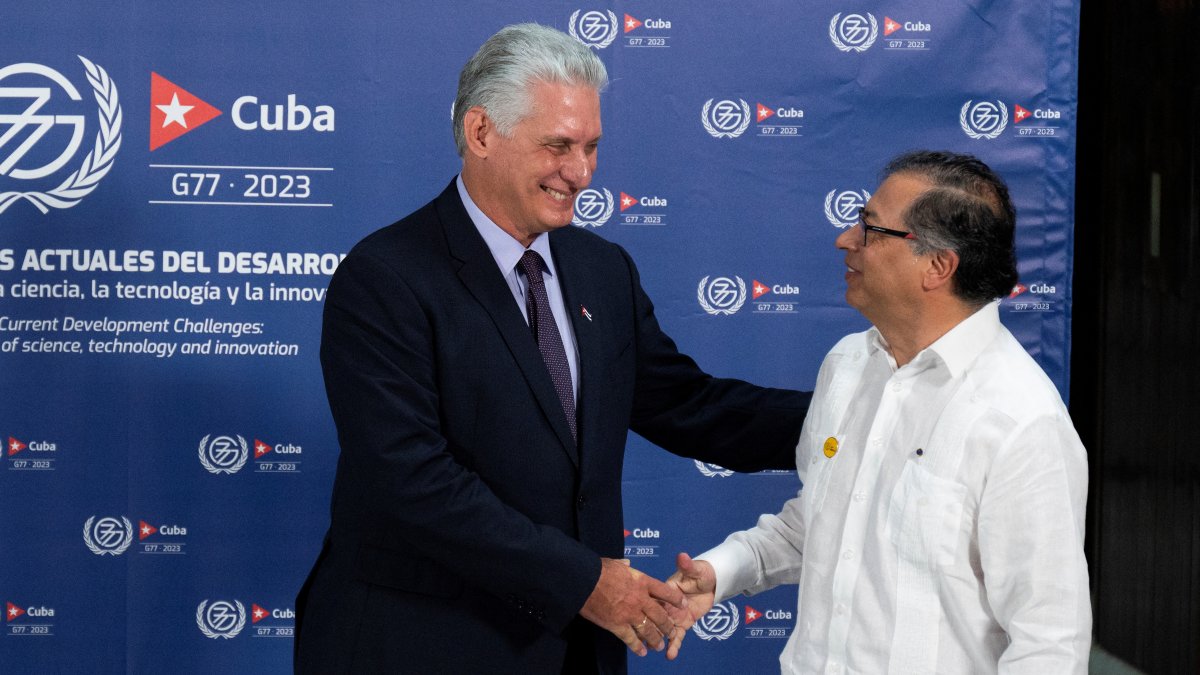
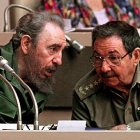
Colombian President Gustavo Petro (right) is welcomed by Cuban dictator Miguel Díaz-Canel (File photo)

A study conducted by the Cuba Program at Sergio Arboleda University in Colombia argues that the Cuban regime significantly expanded its presence and influence within state institutions in that South American country during the administration of President Gustavo Petro through cooperation agreements in areas such as health, agriculture, education, and culture.
The study, titled "The silent co-optation of the Colombian state by the Cuban regime during the Gustavo Petro administration," is part of an investigation launched in 2025 that already has two published installments and a third phase in preparation.
According to the researchers, the findings suggest that several of these agreements were publicly presented as mechanisms for bilateral cooperation, although in some cases the announced results never materialized.
One in three institutions reportedly signed agreements with Cuban entities
According to the report, the research team compiled official information through freedom of information requests submitted to various Colombian state entities.
Sergio Ángel, director of the Cuba Program and head of the investigation, stated that the results show an unprecedented level of ties between Colombian agencies and Cuban entities.
"One in three institutions in Colombia entered into some kind of agreement with some kind of Cuban institution," Ángel stated during an interview with Martí Noticias.
The researcher described the figure as "alarming" and stated that it exceeds the levels of cooperation observed during previous administrations.
The yellow fever vaccines that never arrived
One of the most notable cases highlighted by the investigation involves the donation of 2,000 yellow fever vaccines announced by the Cuban regime during a health emergency in Colombia.
According to the report, the offer was officially announced by the Cuban Embassy in Bogotá and publicly celebrated by then-Colombian Foreign Minister Laura Sarabia.
However, an official response from the Ministry of Health obtained by the investigators concluded that the vaccines were never delivered.
The study also notes that, following inquiries by Colombian media outlets, the Cuban diplomatic mission offered no explanation for the failure to follow through on the announcement.
For Ángel, the episode reflects a strategy aimed at projecting an image of international solidarity without necessarily delivering the promised aid. “The important thing is not to send the vaccines, but to demonstrate that they have a collaborative relationship,” the researcher said.
Colombian humanitarian aid was indeed sent to Cuba
While the vaccine donation did not materialize, the investigation documents that Colombia did send humanitarian aid to the island.
Through the Presidential Agency for International Cooperation (APC-Colombia), the Colombian government dispatched a shipment from Cartagena containing non-perishable food, medicines, hospital supplies, solar panels, electrical materials and household items.
Researchers believe that this type of operation highlights an asymmetrical relationship between the two governments.
"There is no reciprocity in this type of relationship," Ángel stated.
World
Report warns Cuba is the 'epicenter' of destabilization in the US and Latin America
Virginia Martínez
The case of the 300 metric tons of rice
The Rural Development Agency promoted the initiative as a commercial opportunity for producers in the department of Meta and distributed the information through its official channels.
However, the investigation maintains that an official response obtained by the team revealed that the Cuban importer never received the necessary authorization to finalize the purchase. As a result, the export reportedly did not take place.
The case raises additional questions because, according to the investigators, the Colombian producers did receive payment for the rice. “Who paid for that rice?” Ángel asked.
The investigation hypothesizes that the funds may have been covered by the Presidential Agency for International Cooperation, although it acknowledges that there are still unanswered questions regarding the final destination of the funds.
Agricultural cooperation under scrutiny
The report also examines the involvement of Cuban institutions in CampeSENA, a program of the National Learning Service (SENA) aimed at strengthening the productive capacities of small farmers and rural workers.
The authors question the appropriateness of presenting Cuba as an agricultural model for Colombia, given the profound food and production crisis currently affecting the island.
According to the research, this is one of several examples of institutional cooperation whose actual impact has yet to be determined.
Education and culture: The next phase of the research
The team states that several public entities responded only partially to requests for information, forcing them to file new requests and take legal action to access additional documentation.

The central thesis: A model of regional influence
Beyond specific cases, the report’s main conclusion is that the Cuban government is implementing a strategy of political influence in Colombia similar to that previously developed in other Latin American countries.
According to Sergio Ángel, the objective is to build relationships of institutional dependence through government agreements, technical cooperation and economic assistance mechanisms.
“Havana seeks to replicate in Colombia a model of influence already applied in Venezuela and Mexico,” the study states.
The researchers believe that the continuation or revision of these agreements will depend largely on the decisions made by the next Colombian government.
LATEST