INTERVIEW
'Hoz y Cruz': Yoe Suárez's new book sheds light on an uncomfortable chapter in Cuban history
Eight years of research, censorship, exile and memory to reconstruct the silent resistance of thousands of Cuban evangelicals.
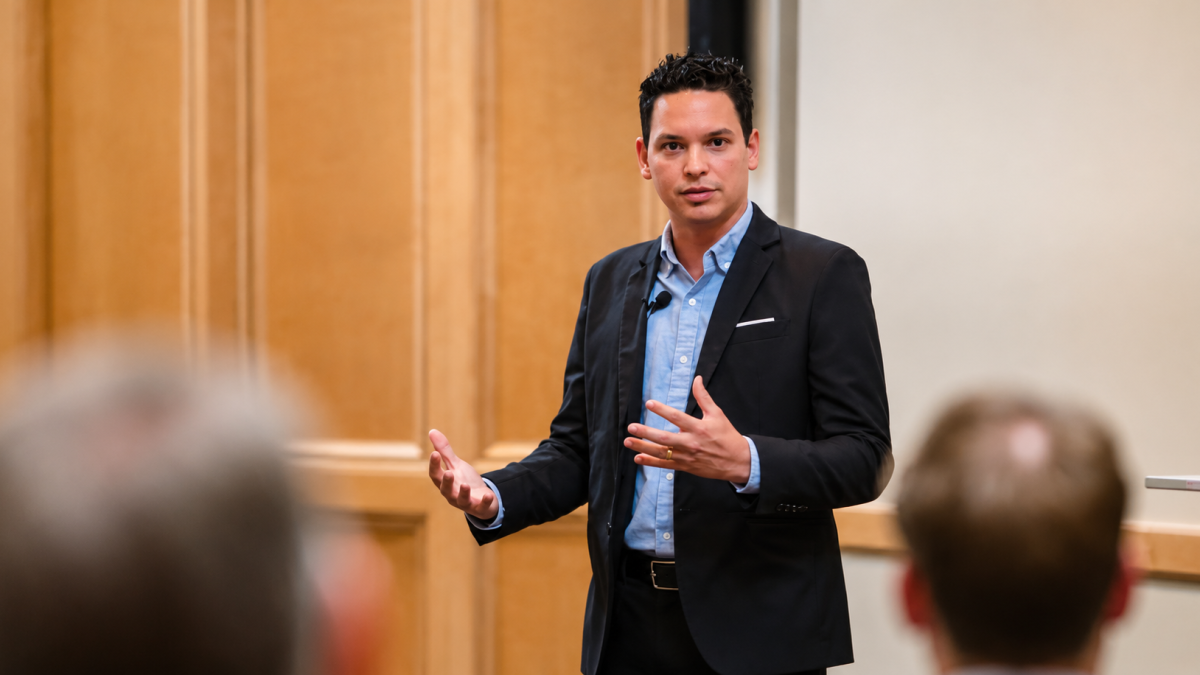
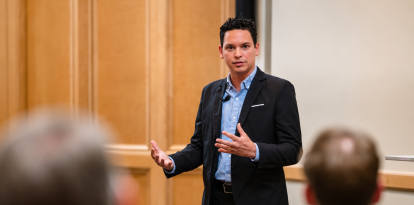
Photograph by Cuban journalist and writer Yoe Suarez.

There are books that are born from an idea. Others, from a question. And some are born from discomfort.
For Cuban journalist and writer Yoe Suárez, Hoz y Cruz began long before it became a book. It began in 2018, when he observed a phenomenon that, he argues, was being ignored, minimized or outright invisibilized: the prominence of the evangelical community in the civic resistance to the Cuban regime.
The work - which has been recognized for rescuing the history of the non-violent struggle of evangelical Christians on the island - covers a quarter of a century of Cuban history, from 2000 to 2025. But it is also the result of eight years of research marked by arrests, surveillance, censorship, internet shutdowns and, finally, exile.
"I started writing Hoz y Cruz in 2018, without knowing I was writing it," Suárez recalls.
The seed emerged while he was researching the transformations that were beginning to take place within Cuban civil society. At the time, he says, massive access to mobile internet and social networks was altering the way citizens were organizing and participating in the public sphere.
For the author, 2018 marked a before and after.
"It triggered such political participation, in all sectors of civil society, because of two key factors. One, the penetration of the use of mobile data and, consequently, of social networks from the island; something that allowed Cubans to organize, debate, express themselves with more or less freedom in the virtual sphere. And, two, a legislative 'reform' schedule that would make up the State, without real changes, to make Cuban socialism more digestible to the standards of an increasingly progressive West."
In the midst of that effervescence, multiple social actors emerged: animal activists, artists, LGBT groups, gamers and activists of different kinds. However, Suarez argues that evangelicals occupied a singular place.
"They stood out for their mobilizing capacity, uniqueness in the political spectrum and impact."
As documented in the book, dozens of evangelical churches led a national campaign against various aspects of the new Constitution promoted by the regime. The mobilization included the collection of approximately 180,000 signatures, one of the largest independent initiatives recorded in Cuba in the last six decades.
That experience occupies the heart of Hoz y Cruz.
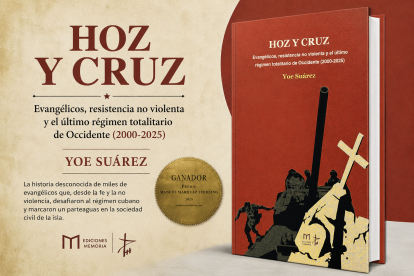
Cover of the book 'Hoz y Cruz' by Yoe Suarez.
The birth of a concept
One of the main contributions of the research is the formulation of a concept of its own: the Evangelical Civic Movement, or MoCE.
Suarez defines it as "the peaceful, sustained and massive articulation of demands and actions more or less coordinated by the vast majority of the evangelical community against Castro's policies between 2018 and 2022."
In his opinion, that phenomenon transcended the limits of the churches and ended up influencing other social sectors.
"The MoCE energized the public sphere in a unique way," he explains.
The author symbolically places the beginning of the movement on June 28, 2018, when the main evangelical churches in Cuba disseminated a declaration against the draft constitutional bill promoted by the government.
Weeks later, another event would mark the public agenda: an artistic protest in front of the Havana Capitol against Decree 349.
For Suarez, both events represented distinct expressions of resistance to power, although they received very different treatments.
"The state media denigrated both. However, the independent media demonized or ignored the first, while they praised the second."
This difference in media treatment is one of the issues that runs throughout the book.
The memory that was being lost
Over the years, Suárez realized that research was no longer just about a social movement. It was also a battle against forgetting.
"One reason for writing the book was to collect all that memory that was being swept under the rug or that, in the case of the MoCE, was invisibilized by the media or frankly demonized."
The author assures that one of the ideas that drove him was to dismantle the perception that the churches had remained silent in the face of Cuban reality.
"Since 2018 most of the people who were complaining, wrongly: 'But the church has never raised its voice', began to tell the church: 'Shut up, you have no right to speak'."
For him, there is an obvious contradiction in those who celebrate the political participation of certain religious sectors when they ideologically coincide with their positions, but question that participation when it expresses conservative ideas.
"It seemed that, if it is a political vision that supports the left or progressivism, then yes, the voice of the Church was welcome; but if it was one of a conservative, counterrevolutionary or Liberty sign, then it was not convenient for that part of the citizenry to speak."
Eight years against the current
The research, now a book, required reconstructing a history scattered in documents, testimonies, recordings, digital files and personal memories.
"Building the story of the first quarter of the Cuban century from a counterrevolutionary, libertarian and conservative perspective from scratch was the biggest challenge."
Suarez argues that much of the intellectual production on Cuba has privileged progressive or leftist views, even within spaces that present themselves as independent. This forced him to patiently search for episodes, characters and processes that, he says, have been ignored or marginalized for ideological reasons.
Even so, he is especially grateful to those who shared their stories.
"Some interviewees were surprised that anyone was interested in their stories again, after decades of anti-communist struggle and supine neglect."
World
The OCDH denounced at least 873 violations of religious freedom in Cuba during 2025
Diane Hernández
Stories worth telling
Among the stories that most marked him are three that he considers practically unknown to the new generations.
One is the recovery of the Baptist temple of Yaguajay by a group of believers who peacefully occupied the building after years of dispute.
Another was the breakfast led by Dr. Oscar Elías Biscet in 1999 to draw international attention to Cuban political prisoners.
And the third, the protest of approximately 1,000 evangelicals in front of the Camagüey Provincial Court in support of political prisoner Orson Vila.
"They are deeply inspiring stories," he says.
Stories that, in his opinion, are part of a tradition of nonviolent resistance that has been insufficiently studied.
Conscience versus power
He mentions names like Oscar Elias Biscet, Nancy Alfaya, Jorge Olivera and Sara Marta Fonseca.
"They all felt that their conscience, anchored in their Christian faith, called on them to raise their voices against injustices they saw around them."
That same logic, he assures, can be seen today in a new generation of Christian content creators and influencers who actively participate in the Cuban public debate.
Cuba and the battle for the soul of the nation
As the conversation progresses, the book ceases to be solely a work about the past. It also becomes a reflection on the future.
"If we don't preserve this memory we are condemned to walk in circles in the same place."
He then adds a phrase that sums up much of the spirit of Hoz y Cruz: "The battle in the future Cuba will not be the reconstruction of buildings, but of the soul of the nation."
For Suarez, ignoring phenomena such as the Evangelical Civic Movement leads to an incomplete understanding of subsequent events, including the social outburst of July 11, 2021.
"Every group that engaged in activism in the period contributed to the root of the 11J outburst."

An island that can still change
The conversation concludes with a mix of realism and hope. Suarez describes Cuba's current situation as a national tragedy stemming from decades of socialism.
But after eight years researching stories of resistance, he also retains a conviction.
"To the healthy pride of seeing so many Cubans rise up against the Revolution in so many different ways was added a sense that this island can indeed change."
Before saying goodbye, I ask him to sum up Hoz y Cruz in a single sentence.
He didn't hesitate.
"Vindication of the vilified; unfinished portrait of a sleeping giant."
And perhaps therein lies the essence of the book.
Not only to tell a forgotten story, but to awaken a memory that still has much to say about Cuba's past, present and future.
Available on digital platforms
LATEST