Abelardo 'el Tigre' de la Espriella, the disruptor shaking up Colombia's right with a Bukele-Milei playbook ahead of the election
With a fresh, sharp and direct rhetoric, de la Espriella has clearly become the candidate of the hard right-wing vote in Colombia.
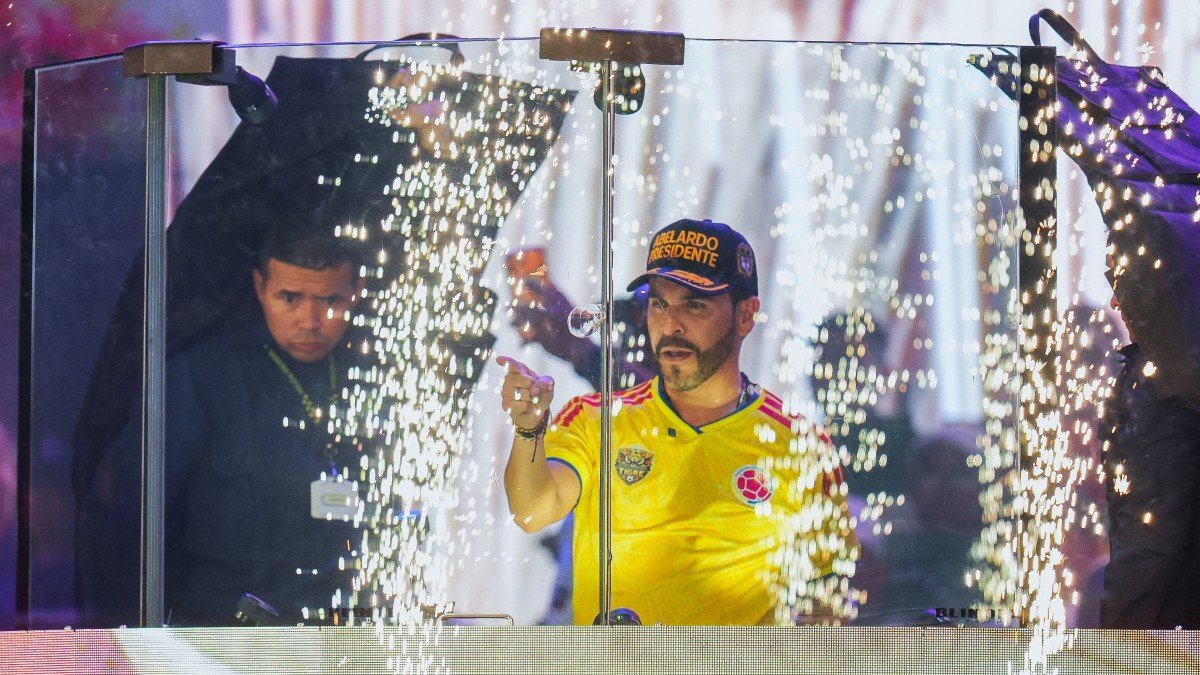
Abelardo de la Espriella, presidential candidate, gestures behind bulletproof glass during his latest rally

On May 31st, Colombians will head to the polls to elect their next president or should it prove necessary, a runoff election, scheduled for June 21st. Three names currently lead the pack: the leftist Iván Cepeda, the candidate backed by progressive incumbent and former guerrilla Gustavo Petro; the center-right Paloma Valencia, the candidate of former president and Colombian right-wing icon Álvaro Uribe; and, finally, the outsider who is turning the polls upside down: Abelardo "El Tigre" de la Espriella.
With a fresh, sharp and direct rhetoric, de la Espriella has clearly become the candidate of the hard right-wing vote in Colombia. The lawyer, founder of the firm De La Espriella Lawyers Enterprise, has not hesitated for a second to speak to the most conservative core of the Colombian electorate, promising a hard hand against the guerrillas and criminal groups (a la Bukele), a liberalization of the economy (a la Milei) and a discourse where God, homeland and family are put at the top of the priorities (a la Trump and conservative populist leaders in Europe).
For this reason, "el Tigre," a suggestive nickname that he himself cultivated during a very active campaign on social media, today clearly dissociates himself from Paloma Valencia, the candidate of the establishment of Colombian conservatism, historically represented by the Democratic Center, the party of the former president Álvaro Uribe Vélez.
Valencia, unlike Abelardo de la Espriella, has tried in recent weeks to appeal to the center voter, seeking, by all means, to avoid a new leftist government in Colombia, a historical anomaly that occurred with Petro and that, according to polls, could be repeated with Cepeda, whom his critics describe as even more radical than the current progressive president.

Lawyer of impossible cases and eccentric millionaire
Before being a politician, Abelardo de la Espriella was, without a doubt, a renowned criminal lawyer who made his fortune taking cases that only a few wanted to defend. Born in Bogotá on July 31, 1978, but raised in Montería, on the Caribbean coast, he studied law at the Sergio Arboleda University, and in 2002, at just 24 years old and 500,000 Colombian pesos, less than $200 at the time, he founded his own law firm. More than two decades later, De La Espriella Lawyers has offices in Colombia and the United States and has declared assets of more than 39 billion pesos, about 10.5 million dollars, according to a profile by France 24.
It was precisely that willingness to take on difficult cases that brought him to fame. The first one that put him in the media spotlight was that of David Murcia Guzman, the mastermind of the DMG financial pyramid, considered the biggest fraud in Colombia's history. He later represented former president Álvaro Uribe in his lawsuit against the creator of the web series "Matarife" and also Natalia Ponce de León, the victim of an acid attack in 2014, a case in which he won a landmark conviction and helped push for a specific law against such crimes.
According to EFE, in parallel with the courts, De la Espriella cultivated an eccentric persona and a luxurious lifestyle. Nicknamed "el Tigre," he shows himself on social media aboard his private jet, at the wheel of his Rolls-Royce Phantom and in his homes in Miami, Bogota, and the Italian countryside. An Italian and U.S. citizen as well as a Colombian, he has recorded two albums showcasing his tenor voice, published several books and launched his own brand, De la Espriella Style, which ranges from a rum and wine named after him to a line of men's clothing. He is married to business administrator Ana Lucía Pineda, with whom he has four children.

The Saab file, his campaign's longest shadow
That willingness to take on difficult cases has also played tricks on him. So far, no client today weighs as heavily on his candidacy as controversial Alex Saab, the businessman accused by Washington of being the front man for the former dictator Nicolás Maduro and a key player in the Chavista regime's money-laundering and criminal business structure abroad. De la Espriella was his legal advisor between 2013 and 2019, years in which Saab -now awaiting trial in the United States for money laundering- was already a key piece of the Venezuelan regime's network. A dictatorship that, of course, "el Tigre" has questioned on numerous occasions.
The candidate has tried to dodge criticism by appealing to the fundamentals of law: that defense is a universal right and that confusing the lawyer with his client is a fallacy.
"I was not his partner or his confidant; I was his lawyer," he said on several occasions, and claims that he resigned from the defense when Saab refused to collaborate with U.S. justice. The argument, however, has not dispelled all the doubts: a week before the elections, journalist Daniel Coronell published in Cambio magazine documents according to which De la Espriella received money transfers for more than $370,000 from firms linked to Saab and to the embezzlement of the Venezuelan State, an accusation that the campaign rejects. In addition, press defense organizations have documented a pattern of judicial harassment by the lawyer against journalists who have investigated this link, a situation that has put the candidate in a tight spot.

World
Colombia: ELN terrorists declare unilateral ceasefire during May 31 presidential election
Carlos Dominguez
Ten mega-prisons, chainsaw economics and God, country and family
De la Espriella's program is based on the principles of the political referents he admires. On security, the centerpiece of his entire campaign, he promises to end any negotiations with armed groups and to apply an iron fist in the style of El Salvador's Nayib Bukele: the construction of ten maximum security mega-prisons inspired by the Salvadoran Cecot, military reinforcement, the bombing of guerrilla camps and a strategic alliance with the United States and Israel to combat drug trafficking. "In my government, any bandit who does not submit to justice will be killed," he said.
On economic matters, "El Tigre's" inspiration is Argentine president Javier Milei. De la Espriella proposes reducing the size of the State by 40%, eliminating what he calls the "regulatory jungle" and the "political payroll," thereby generating savings his campaign estimates at some 31.8 billion pesos per year. He also defends the carrying of weapons, an uncommon position among Colombian candidates, the return of aerial spraying with glyphosate against coca crops and fracking, a point of clear divergence with current President Gustavo Petro. All this was carefully wrapped in a discourse of defense of God, the homeland, and the family, and of frontal rejection of Petro's proposal to call a new Constituent Assembly.
A campaign tainted by violence
The conclusion of De la Espriella’s campaign has, regrettably, been marred by violence. On May 15, two of his coordinators in the department of Meta, former Cubarral mayor Rogers Mauricio Devia and his advisor, Eder Fabián Cardona, were shot dead by armed men while returning from collecting campaign materials. The candidate held the Petro administration responsible for "giving oxygen, impunity, and territory" to criminal groups and, more recently, has directly pointed the finger at both Petro and Cepeda regarding the threats against his team, calling for international oversight.
The double crime added to an escalation that included an alleged plan to assassinate him with snipers, an attempted attack in Envigado and the infiltration of a fake bodyguard. Today, De la Espriella is campaigning among armored vehicles and bulletproof glass.
What do the latest polls show?
To date, polls consistently agree that the leftist Cepeda leads the first round, polling between 34% (Génesis Crea) and 44.6% (Invamer), though without reaching the 50% threshold that would avert a runoff. The second-place spot is being contested by De la Espriella and Valencia: Guarumo (27.5%), Invamer, and AtlasIntel (31.5%) place De la Espriella ahead, while Génesis Crea places Valencia in second. Furthermore, AtlasIntel and Guarumo project De la Espriella defeating Cepeda in a runoff by approximately 3.6 points (43.6% versus 40%), whereas Invamer predicts the opposite outcome (Cepeda at 52.4% against 45.3%). In betting markets, Polymarket went so far as to assign Abelardo a 71% probability of winning, a development that has galvanized his campaign in recent hours, providing a final surge of momentum ahead of May 31st, the date on which De la Espriella could potentially defeat the Colombian Left and Center.
LATEST