LIVE | Latest developments in the Middle East war
In recent days, there have been airstrikes on Iranian territory, missile and drone offensives against U.S. targets, and a rise in activity by Tehran’s allies on fronts such as Yemen and Lebanon as the broader regional conflict continues to evolve.
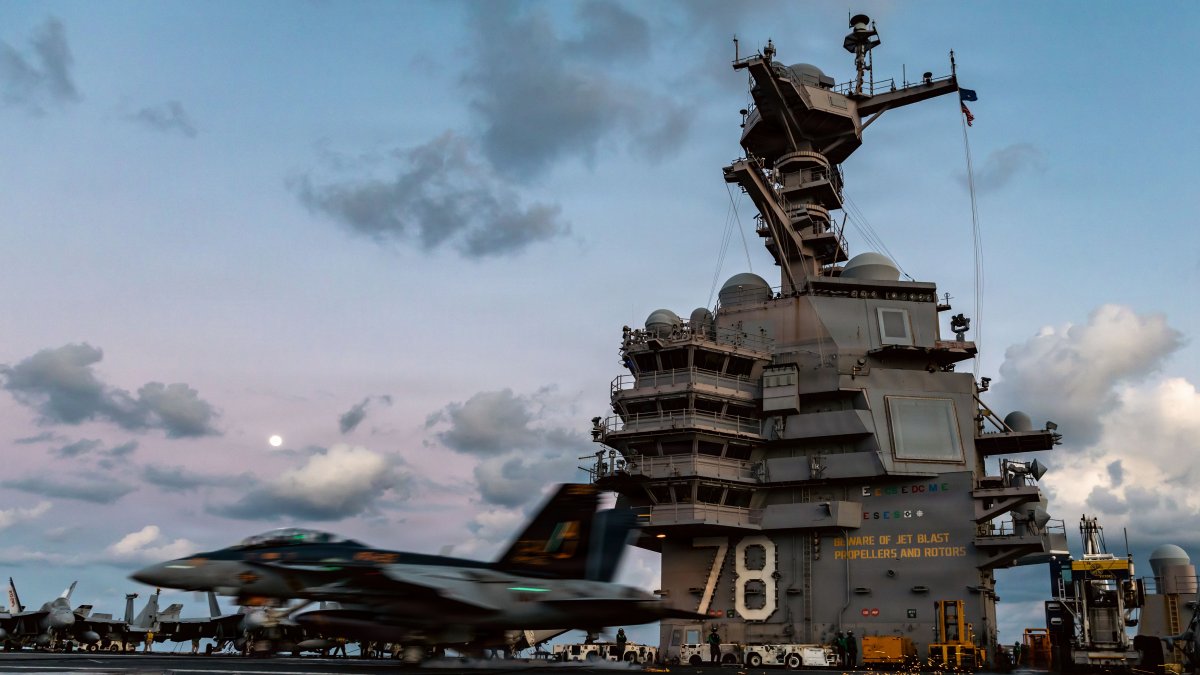
USS Gerald R. Ford during "Operation Epic Fury"

The war in the Middle East is entering a new phase of escalation, with exchanged attacks between the United States, Israel and Iran expanding the conflict beyond its initial boundaries. In recent days, strikes have hit Iranian territory, while missiles and drones have targeted U.S. positions and Iran-backed groups have stepped up activity in fronts such as Yemen and Lebanon.
Tensions are also spilling into the economic sphere, with threats to the Strait of Hormuz, an artery for global oil shipments, driving volatility in energy markets. Diplomatic efforts to contain the crisis are ongoing, but so far have shown little progress amidst an increasingly volatile and unpredictable landscape.
All times are Eastern Standard Time (EST).
Former CENTCOM chief reveals U.S. has spent years preparing raids in Iran
Retired Gen. Frank McKenzie, the former head of U.S. Central Command (CENTCOM), said Sunday that the U.S. military has been working for years on plans for ground raids in Iran, as President Donald Trump reportedly considers sending troops into the conflict.
“Margaret, for many years we’ve considered options along the southern coast of Iran, seizing islands, seizing small bases. Typically raids. And a raid is an operation with a planned withdrawal. You’re not going to stay. But some of those islands you could seize and hold. That would have a couple effects. First of all, it would be profoundly humiliating for Iran and would give us great weight in negotiations. The second, the example of Kharg Island, which everyone talks about, if you seize Kharg Island, you really can shut down the Iranian oil economy completely. And the beauty of seizing it is, you’re not destroying it,” McKenzie told Margaret Brennan of CBS News on “Face the Nation.”
He added that the United States could achieve a certain level of success without a ground component in its operations in Iran. “I think a success looks like the Strait of Hormuz is open. We get some kind of deal on the ballistic missile program, some kind of deal on the nuclear program. That’s probably about as much as you could hope for,” he said.
Pakistan hosts talks on Middle East war with Saudi Arabia, Turkey and Egypt
The foreign ministers of Pakistan, Saudi Arabia, Egypt and Turkey met on Sunday for talks on the war in the Middle East, with Islamabad acting as an intermediary between the United States and Iran.
The meeting between the top diplomats of these Muslim-majority nations was convened “to review developments in the regional situation and discuss issues of common interest,” Pakistan’s Foreign Ministry said in a brief statement.
Several roads leading to Islamabad’s Red Zone — home to key government buildings and diplomatic missions — were closed, AFP reporters said.
Iran, the United States and Israel were not represented, according to a source from the ministry in charge of organizing the talks, which brought together Egypt’s Badr Abdelatty, Turkey’s Hakan Fidan and Saudi Arabia’s Faisal bin Farhan.
All held prior bilateral meetings with Pakistani Foreign Minister Ishaq Dar.
Pakistan’s government has emerged as a key facilitator between Iran and the United States as the war drags on, acting as a channel for exchanging messages between the two sides.
Islamabad maintains longstanding ties with Tehran and close contacts in the Gulf, while Prime Minister Shehbaz Sharif has developed a personal relationship with U.S. President Donald Trump.
American University of Beirut moves to online learning after Iranian threats
The American University of Beirut (AUB) said on Sunday that it would operate remotely over the next two days, following the Iranian Revolutionary Guard Corps' threat to target American universities in the region.
"At this time, we have no evidence of direct threats against our university, its campuses or medical centres. At the same time, out of an abundance of caution, we will operate fully online on Monday and Tuesday, with the exception of essential personnel," AUB President Fadlo Khouri said in a statement.
Earlier on Sunday, Iran's Revolutionary Guard threatened to target American universities in the Middle East after saying U.S.-Israeli strikes had destroyed two Iranian universities.
Qatari network Al Araby reports damage to Tehran office after attack
Qatari broadcaster Al Araby reported on Sunday that an Israeli missile struck the building housing its office in Tehran, causing material damage.
"An Israeli missile targeted Al Araby’s building in the capital, Tehran. Significant damage and disruption to live broadcasts," the network said in a post on X.
Footage from inside the office showed shattered windows and glass, while nearby buildings were damaged and streets were littered with debris.
It is not yet clear what the intended target was.
Al Araby’s office is located in a residential neighborhood in northeastern Tehran.
Iran threatens to strike the USS Abraham Lincoln aircraft carrier
The head of the Iranian Army Navy, Shahram Irani, said on Sunday that the U.S. aircraft carrier USS Abraham Lincoln would be attacked if it comes within striking distance.
"As soon as the USS Abraham Lincoln carrier strike group is within range, we will avenge the blood of the martyrs of the Dena ship by launching various types of surface-to-surface missiles," he said in remarks carried by state television, referring to the Iranian frigate sunk by the United States on March 4.

Syria repels attack on U.S. base
Syria reported on Sunday that it repelled a drone attack originating from Iraq against the U.S. base at Qasrak in the country’s northeast.
According to officials, four drones were launched from Iraqi territory, but all were shot down without causing any casualties.
Syria held Iraq responsible and urged the country to prevent further attacks that could threaten regional stability.
Iranian Revolutionary Guards announce attacks on Bahrain and UAE
The Iranian Revolutionary Guards announced on Sunday the launch of missiles and drones targeting aluminum plants in Bahrain and the United Arab Emirates (UAE), facilities they claimed were linked to the U.S. military.
The UAE Ministry of Defense reported that its air defense systems responded to the missile and drone attack.
Bahraini state media reported that two people were injured in the Iranian strike on an aluminum plant, according to AFP.
World
Trump Administration assesses ground operations in Iran that could last for weeks
Luis Francisco Orozco
Iran threatens to target U.S. universities
The Iranian Revolutionary Guards threatened on Sunday to strike U.S. universities in the Middle East, after reporting the destruction of two universities in Iran by U.S. and Israeli airstrikes.
Numerous American universities have campuses in Gulf countries, including Texas A&M University in Qatar and New York University in the United Arab Emirates.
The ideological branch of the Iranian military called on Washington to condemn the bombing of Iranian universities before Monday, March 30.
U.S. amphibious ship arrives in the Middle East
The amphibious assault ship USS Tripoli arrived in the Middle East, the U.S. Central Command (CENTCOM) reported on Saturday, amid speculation about a possible deployment of American troops in Iran.
CENTCOM specified that the helicopter carrier is leading a naval group that includes “around 3,500” sailors and Marines.
You can follow all the previous details here:

Mundo
EN VIVO: al menos 12 soldados estadounidenses heridos en Arabia Saudita tras un ataque iraní
Carlos Dominguez
LATEST